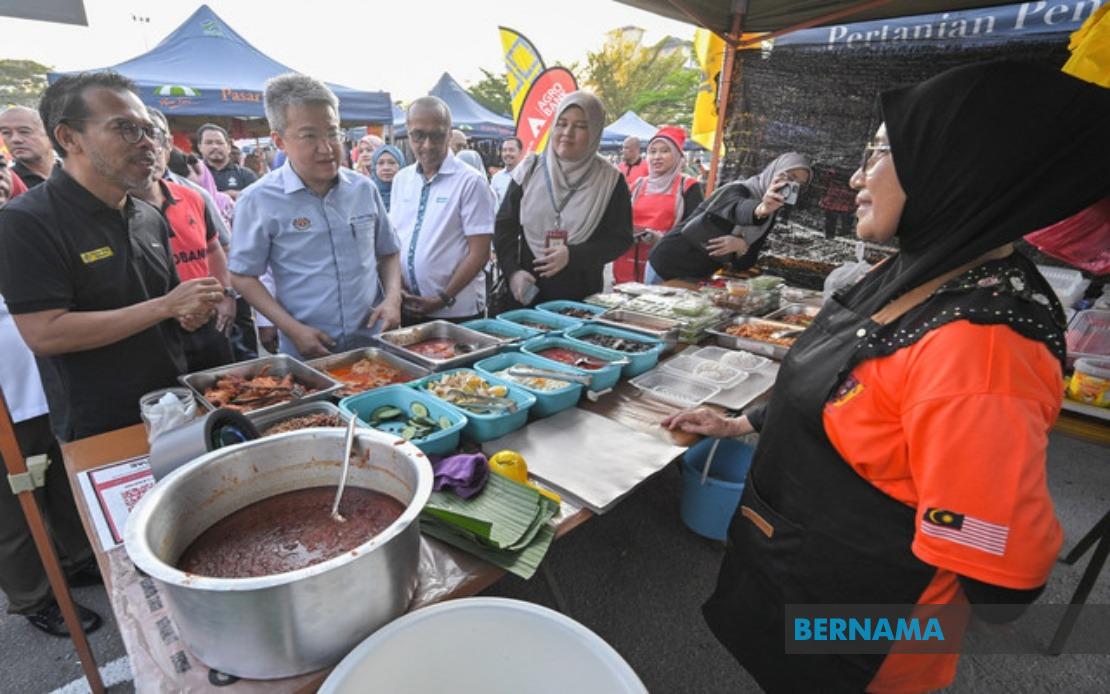
Malaysia's government has allocated RM9.8 billion in microfinancing funds distributed across six major financial institutions, marking a significant commitment to broadening access to capital for hawkers and small entrepreneurs throughout the country. Deputy Finance Minister Liew Chin Tong disclosed the allocation while visiting the Dataran Puchong Permai Farmers' Market in Puchong, where the government has launched an on-ground initiative to bring lending services directly to micro-traders and small business operators.
The substantial investment reflects policymakers' recognition that small traders often face barriers when attempting to secure conventional banking facilities, a persistent challenge in Malaysia's economic landscape despite decades of development initiatives. By ensuring that hawkers and small entrepreneurs have viable pathways to obtain working capital, the government aims to prevent marginalisation of the grassroots business community from formal financing channels and thereby sustain growth across the informal and semi-formal sectors that employ hundreds of thousands of Malaysians.
The microfinance expansion operates through the Mikro Kredit Turun Padang programme, which departs from the traditional model of requiring applicants to visit financial institutions. Instead, the initiative brings government agencies and lending bodies directly to farmers' markets and community spaces where traders congregate. This grassroots approach acknowledges the practical difficulties faced by busy vendors who may struggle to navigate complex application procedures or justify the time cost of visiting multiple offices to explore financing options.
Six institutions collaborate in delivering advisory services and processing applications on-site. Bank Simpanan Nasional, Agrobank, Bank Rakyat, the Companies Commission of Malaysia, TEKUN Nasional, and Majlis Amanah Rakyat collectively provide a comprehensive ecosystem enabling entrepreneurs to obtain guidance tailored to their circumstances and submit applications without unnecessary administrative friction. Early results from the Puchong farmers' market demonstrate the model's viability, with twelve hawkers securing financing approvals within a single implementation period.
The breakdown of approvals at the Puchong venue illustrates how different institutions cater to varying trader profiles and capital requirements. Amanah Ikhtiar Malaysia approved seven applications, suggesting strong uptake among borrowers seeking smaller loan amounts typical of microfinance institutions. Bank Simpanan Nasional processed three approvals, while Agrobank facilitated two, indicating that conventional banks have meaningful roles in serving the small business segment when proper outreach mechanisms exist. This diversity of funding sources reduces dependency on any single lender and provides traders with genuine choice when evaluating terms and conditions.
Deputy Finance Minister Liew emphasised that the initiative seeks to gather direct feedback from traders about their financing needs and constraints, with the intention of escalating grassroots concerns through ministerial channels to the Prime Minister for consideration during budget deliberations. This feedback mechanism represents an often-overlooked dimension of policy development, recognising that hawkers and small entrepreneurs possess invaluable insights into what actually works or fails in practice, insights that frequently go unheard in formal policy circles dominated by academics, consultants, and officials lacking frontline exposure.
The morale dimension of the programme should not be underestimated. By demonstrating that government remains attentive to the challenges faced by informal traders, and by making financing officials and advisory resources physically accessible in the spaces where traders work and meet, the initiative sends a powerful symbolic message that small business operators matter to policymakers. For communities often feeling neglected by rapid urbanisation and formal sector-oriented development strategies, such tangible governmental presence can reinforce confidence in institutions and encourage participation in programmes designed for their benefit.
The programme has already gained traction in multiple locations beyond Puchong. Earlier iterations were conducted at the Taman Melawati Farmers' Market, Kelana Jaya Farmers' Market, and Bandar Tasik Permaisuri Farmers' Market, suggesting a coordinated rollout strategy across different residential zones in the Klang Valley region. This geographic distribution appears deliberate, ensuring that traders in diverse neighbourhoods encounter the services rather than concentrating efforts in a single locality that might suggest tokenistic gesturing.
For Malaysia's broader economic development trajectory, the RM9.8 billion allocation carries implications extending beyond simple capital provision. Strengthening the microfinance ecosystem addresses a foundational gap in the financial inclusion architecture. When small traders can access reliable credit to purchase inventory, upgrade equipment, or manage seasonal cash flow challenges, they operate more efficiently and can employ additional workers, creating multiplier effects throughout local economies. The microfinance expansion thus contributes to employment generation and income distribution objectives that complement formal sector development strategies.
The initiative also reflects evolving understanding among Malaysian policymakers that financial inclusion requires more than institutional change; it demands that institutions actively pursue excluded populations rather than awaiting their arrival. By bringing services to traders rather than expecting traders to navigate bureaucratic systems, the government acknowledges that access encompasses both the existence of formal facilities and the practical ability to utilise them—a distinction that conventional policy frameworks sometimes overlook.
Moving forward, the success of this microfinance expansion depends substantially on whether institutional and bureaucratic behaviour genuinely adapts to accommodate grassroots traders. If the on-site visits represent merely temporary public relations exercises after which lending standards revert to practices that inherently exclude small operators, the initiative will deliver disappointment. Conversely, if the programme catalyses lasting changes in how the six participating institutions assess creditworthiness and structure lending products for micro-traders, it could establish a template for financial inclusion that other Southeast Asian nations might usefully examine and potentially emulate.