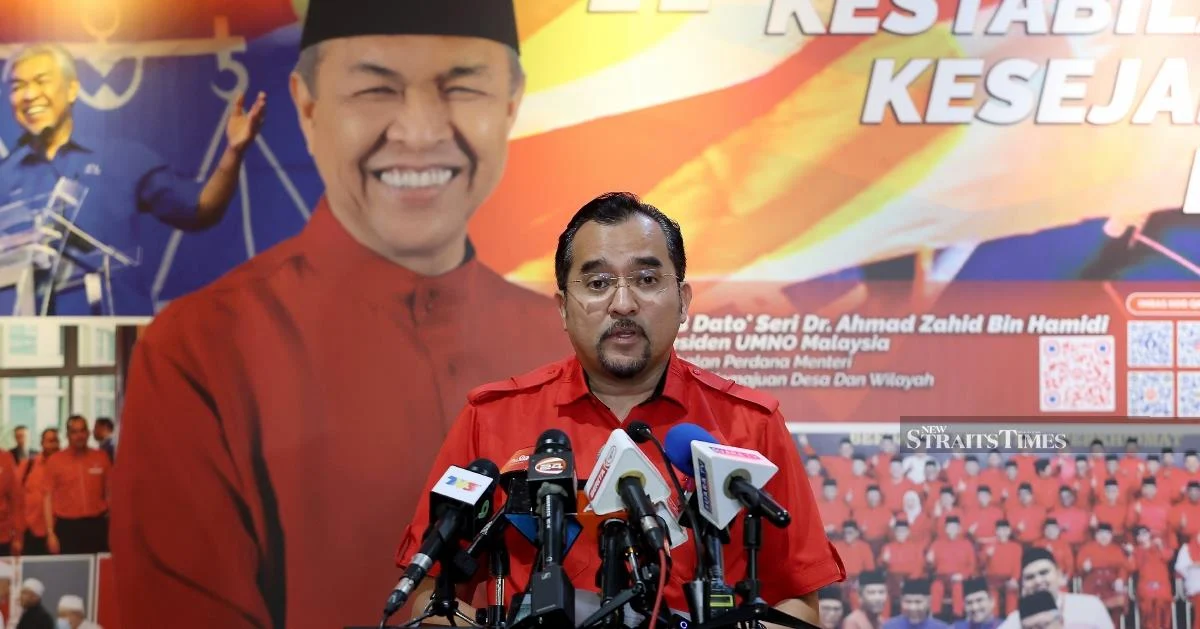
Umno has committed to running substantive campaigns in the forthcoming Johor and Negri Sembilan state elections, with the ruling party's secretary-general Datuk Dr Asyraf Wajdi Dusuki asserting that the focus will remain on practical policy solutions and tangible benefits for voters rather than personal attacks or character assassination. The statement signals an intent to elevate the tone of political discourse in these closely watched contests, reflecting broader efforts within the Malaysian political establishment to move away from the acrimony that has sometimes characterised previous electoral cycles.
Datuk Dr Asyraf Wajdi Dusuki's comments come at a pivotal moment for Umno, which continues to consolidate its position within Malaysia's federal coalition government whilst simultaneously seeking to retain and strengthen control at the state level. The party recognises that credibility and public trust are essential commodities in competitive electoral environments, particularly in states where margins of victory may be narrow and swing voters hold decisive influence. By emphasising policy substance over personality-driven attacks, Umno appears to be banking on the notion that voters increasingly reward parties that present clear, achievable agendas centred on economic development, service delivery, and social welfare.
Johor represents a traditional Umno stronghold with significant strategic importance for national politics, given its large parliamentary representation and the state's economic prominence as a manufacturing and commercial hub. Recent years have witnessed tightening electoral contests across Malaysian states, suggesting that incumbent parties can no longer rely solely on traditional support bases. The renewed emphasis on policy messaging suggests Umno's recognition that it must actively compete for voter affection by demonstrating concrete deliverables and forward-looking vision. This approach contrasts sharply with campaigns that depend primarily on questioning opponents' integrity or exploiting divisive social issues, tactics that Umno has faced criticism for employing in past contests.
Negri Sembilan, meanwhile, presents its own distinct political dynamics and demographic considerations. The state has experienced competitive political contests in recent electoral cycles, with opposition and coalition parties seeking to expand their respective support networks. Umno's pledge to maintain campaign decorum in Negri Sembilan thus reflects both a calculated political strategy and a response to voter preferences for substantive debate. The party's messaging suggests confidence that its policy platform and track record of governance can withstand rigorous scrutiny and comparison with opposition alternatives without requiring resort to negative campaigning tactics.
The commitment to issue-focused campaigns also reflects evolving expectations within Malaysia's democratic system regarding political conduct standards. Civil society organisations, media outlets, and increasingly vocal segments of the electorate have expressed concern about the degradation of political discourse and the proliferation of false information during election periods. By positioning itself as a responsible player committed to principled campaigning, Umno may be attempting to capture the moral high ground whilst simultaneously setting expectations for how opposing parties should conduct themselves. This approach carries reputational benefits that extend beyond immediate electoral calculations.
For Malaysian voters weighing their choices in these state elections, Umno's stated commitment to policy-centred campaigns offers the prospect of more substantive engagement with competing visions for state governance. Rather than focusing on inflammatory rhetoric or personal controversies surrounding candidates, campaigns rooted in policy proposals enable electorates to evaluate which party genuinely addresses their priorities regarding education, healthcare, employment, infrastructure development, and economic opportunity. This framework theoretically creates space for informed decision-making based on comparative assessment of competing parties' practical commitments and implementation capacity.
The strategic calculus behind Umno's positioning also reflects broader trends within Asian democracies where established parties have recognised that excessive negativity can backfire, particularly among younger and more educated voters who demonstrate heightened sensitivity to campaign ethics and substantive governance issues. By explicitly rejecting mudslinging approaches, Umno signals that it perceives advantages in occupying the higher ground of respectful, issue-based competition. This may also influence how other parties calibrate their own campaign strategies, potentially elevating overall discourse quality during the electoral period.
Umno's governance record in both Johor and Negri Sembilan provides substantial material for constructive campaign messaging. Long-standing state governments can reference infrastructure projects, business-friendly policies, human capital development initiatives, and social safety net programs when articulating their achievements and future agenda. The party's emphasis on such concrete offerings rather than attacking opponents' character suggests confidence that its stewardship record can withstand direct comparison. This messaging approach particularly resonates in states where economic concerns and employment prospects occupy prominent places in voter consciousness.
The regional dimension of these elections carries significance extending beyond state boundaries. Johor's proximity to Singapore and its role as a crucial economic corridor for Southeast Asian trade and investment make state stability and governance capacity matters of regional interest. Umno's commitment to professional, policy-focused campaigns potentially signals to business communities and international observers that Malaysian politics continues maturing toward greater institutional stability and predictability. Such perceptions influence investment decisions and regional confidence in Malaysia's political trajectory.
As campaigns unfold across Johor and Negri Sembilan, the practical realisation of Umno's pledge to avoid mudslinging will merit close observation. Voter reception of policy-centred messaging versus opposition party strategies will provide insights into current electoral sentiment across these demographic and geographic contexts. The outcomes will likely inform how Malaysian political parties calibrate campaign approaches in subsequent contests, potentially establishing precedents for the tenor and substance of electoral competition in coming years.

%22%2F%3E%3C%2Fpattern%3E%3C%2Fdefs%3E%3Crect%20width%3D%22100%25%22%20height%3D%22100%25%22%20fill%3D%22url(%23ph40buhg)%22%2F%3E%3Crect%20width%3D%22100%25%22%20height%3D%22100%25%22%20fill%3D%22url(%23ph40buhp)%22%2F%3E%3Ctext%20x%3D%2250%25%22%20y%3D%2250%25%22%20text-anchor%3D%22middle%22%20dominant-baseline%3D%22central%22%20fill%3D%22rgba(255%2C255%2C255%2C0.95)%22%20font-family%3D%22Georgia%2C%20'Times%20New%20Roman'%2C%20serif%22%20font-weight%3D%22700%22%20font-size%3D%22320%22%20letter-spacing%3D%22-0.02em%22%3EGRS%3C%2Ftext%3E%3C%2Fsvg%3E)