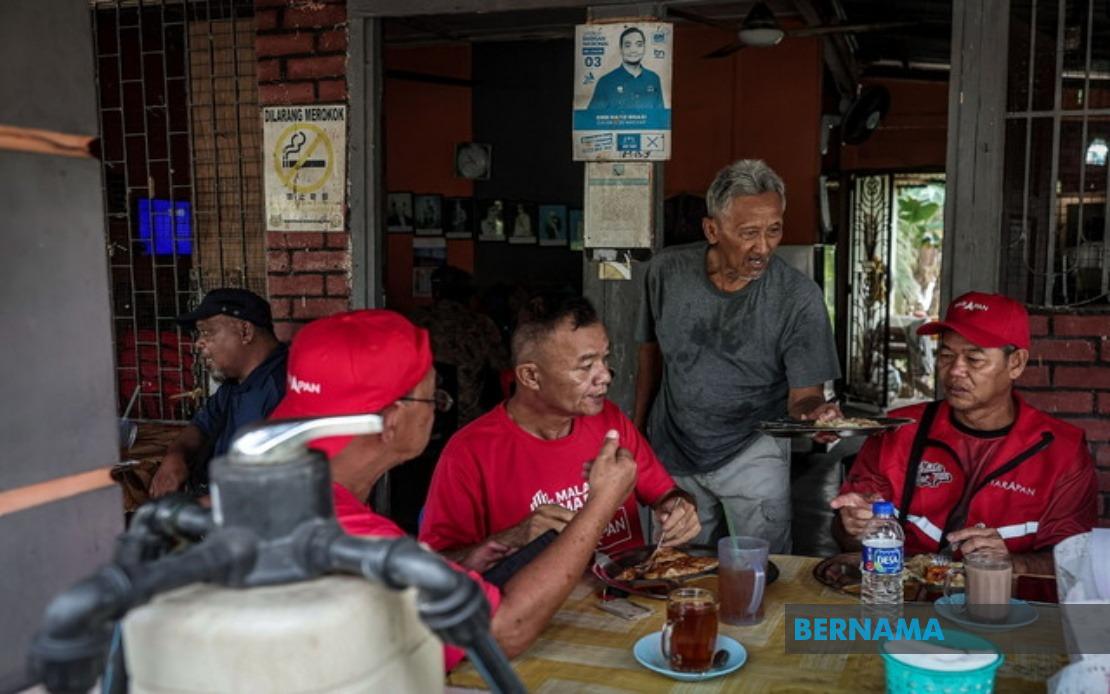
The Johor State Election campaign season is delivering an unexpected economic windfall to small traders and hawkers across the state, transforming what is primarily a democratic event into a genuine commercial opportunity for those operating modest food businesses in rural areas. Communities in Layang-Layang and Simpang Renggam have witnessed particular buoyancy in trade activity, with petty vendors reporting earnings that substantially exceed their ordinary daily figures. This phenomenon illustrates how election campaigns, beyond their political significance, generate tangible economic ripple effects that benefit ordinary Malaysians engaged in grassroots commerce.
Noorma Zafmeeden, a 70-year-old stall operator in Felda Layang-Layang, represents the thousands of small business owners capitalising on heightened foot traffic during the campaign period. Her morning sales from roti canai and nasi lemak typically generate less than RM400 on ordinary days, yet the arrival of election season has fundamentally altered her daily takings. The surge reflects not merely increased customer numbers but changing purchasing patterns, with campaign workers and political party representatives requiring meals and refreshments as they move through constituencies. Noorma and her husband Bahari Madiran, 76, have operated their warung continuously since settling in the Felda community in 1987, establishing themselves as a trusted food destination across several decades.
The couple's business model exemplifies the resilience of Malaysia's informal food economy. They maintain a disciplined routine that begins before dawn with food preparation, moving through breakfast offerings into evening fried dishes that cater to different customer preferences throughout the day. For Bahari, the warung transcends its commercial function to serve as a community meeting space where racial and religious harmony emerges naturally through shared meals and conversation. The election campaign has amplified this social dimension, bringing together campaign workers, political representatives, and local residents in an atmosphere of goodwill and mutual respect. Bahari, father of five, expresses genuine satisfaction at this expanded interaction, viewing the influx of visitors as enriching rather than merely profitable.
The economic benefits extend beyond individual stall operators to encompass broader commercial ecosystems. Ahmad Ridzuan Awang, a 45-year-old nasi campur trader operating in Simpang Renggam, reports that his sales have doubled during the campaign period compared to ordinary trading days. His experience reveals the substantial scale of the upturn, with meal preparation quantities that normally sell out only by evening now exhausted as early as 1.30 pm due to bulk orders from various political parties and their representatives. This acceleration in sales velocity creates secondary economic effects throughout supply chains, as vendors require increased quantities of raw ingredients, prompting local suppliers to expand production and logistics operations.
Ahmad Ridzuan's observation about "political tourists" provides valuable perspective on the campaign's economic mechanics. These visitors—campaign workers, party officials, and supporters travelling from other parts of Malaysia—require accommodation, meals, transport, and various services while present in constituency areas. This injection of external spending stimulates not only food traders but also hotels, transportation services, and retail businesses operating in surrounding localities. The temporary but concentrated nature of election campaigns thus creates seasonal economic opportunity analogous to festival periods or tourist seasons, though driven by political activity rather than recreational travel.
The Johor state election represents one of Malaysia's most significant regional democratic exercises, with 172 candidates contesting across 56 seats, establishing the competitive intensity and associated campaign spending that generates the documented economic benefits. Polling day scheduled for July 11, with early voting conducted on July 7, provides a defined timeline during which this economic stimulus operates at peak intensity. The campaign period concentrates political activity and associated movement of people and resources, creating the conditions for vendors to experience substantially elevated demand.
For traders operating in rural areas and Felda settlements, election campaigns represent meaningful economic relief from the grinding monotony of modest daily earnings. These periods demonstrate that rural and semi-rural constituencies possess latent demand that remains unmet during ordinary times, suggesting potential business expansion strategies that extend beyond election seasons. Vendors who effectively serve campaign workers may establish relationships and reputations that extend their customer base beyond the electoral period itself. The experience of Noorma and Ahmad Ridzuan illustrates how small traders, despite limited capital and modest scale, can respond dynamically to changing demand conditions and capture economic opportunity when circumstances permit.
The phenomenon also raises questions about the sustainability of election-driven economic benefits and their broader implications for Malaysia's informal economy. While the campaign period generates genuine commercial advantage, the subsequent return to normal trading patterns typically represents a sharp contraction in earnings. Small traders experience volatile income streams rather than stable revenue, creating financial instability and complicating business planning. However, repeated election cycles—whether state or federal—provide recurring opportunities that traders anticipate and attempt to leverage through increased stock preparation and extended operating hours.
The intersection of democratic processes and economic activity evident in Johor's campaign season reflects distinctive characteristics of Malaysian political culture. Election campaigns generate intense localised activity that mobilises people, resources, and spending across constituencies. Unlike centralised economies where political activity occurs primarily in capital cities, Malaysia's federal and state structures distribute campaign activity across numerous locations, creating dispersed economic stimulation. Rural communities that otherwise experience limited commercial dynamism benefit from this distribution effect, providing traders with seasonal income enhancement that contributes meaningfully to household finances.
The experiences documented in Layang-Layang and Simpang Renggam carry implications for understanding the informal economy's relationship to electoral cycles in Malaysia and Southeast Asia more broadly. Street vendors and small traders constitute essential components of urban and rural commercial ecosystems, yet their earnings remain vulnerable to external shocks and seasonal fluctuations. Election campaigns, despite their primary political purpose, function as genuine economic events that generate measurable commercial benefits. Recognising this relationship helps policymakers appreciate how political processes intersect with livelihood generation for millions of Malaysians engaged in informal sector employment.

