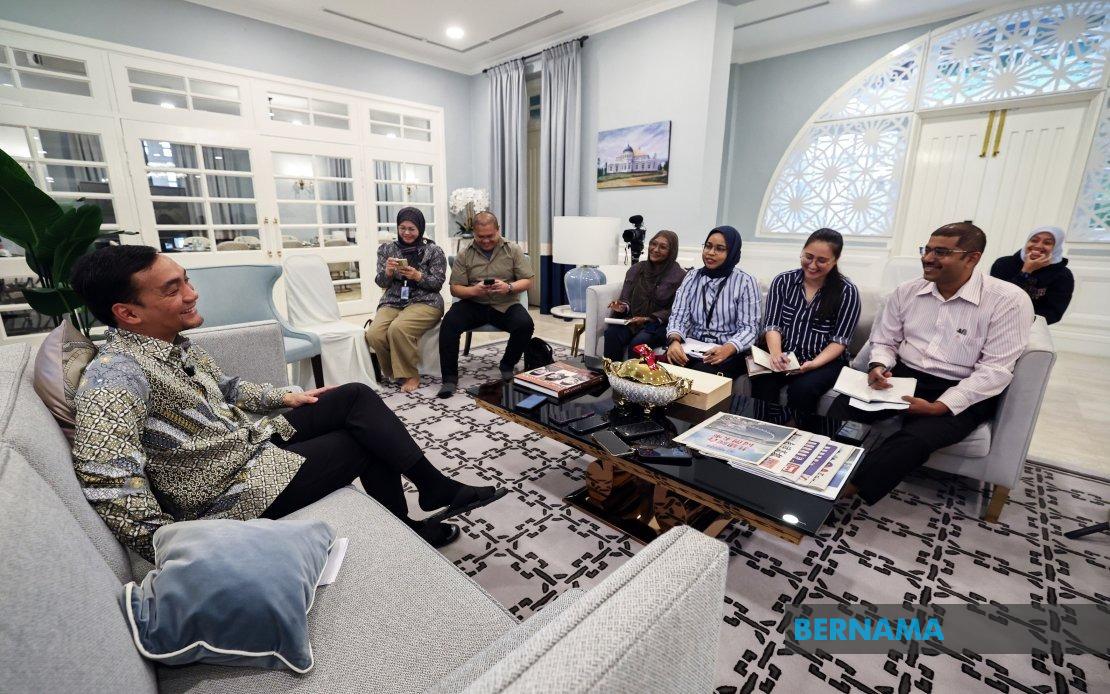
Johor Barisan Nasional leadership has sent a clear message to party members who have not been selected as candidates in the forthcoming state election: rejection for candidacy does not diminish their role in the broader political struggle. Datuk Onn Hafiz Ghazi, the Johor Menteri Besar and BN chairman for the state, made this appeal during a media interview at his official residence in Saujana, emphasizing that party consolidation remains crucial even as the organization narrows its slate of candidates for the July 11 polls.
Onn Hafiz framed the selection process not as a final judgment on individuals but as a practical response to structural constraints within the electoral system. He acknowledged that available parliamentary and state assembly seats are finite, creating an inherent mismatch between aspiring candidates and available positions. Within this context, he positioned non-selected members as having alternative avenues through which to contribute—whether as potential Members of Parliament in future contests, as functionaries within party machinery, or in other capacities yet to be determined. This reframing attempts to convert potential disappointment into renewed motivation, casting the struggle for public service as transcending individual candidacy.
The candidate selection machinery itself remains partially fluid at this juncture. With the process reported to be approximately 80 percent complete as of mid-June, Onn Hafiz emphasized that finality arrives only upon receipt of the official watikah, or letter of appointment. This procedural detail carries significance: the window for changes persists until formal issuance, and historical precedent exists for withdrawal of previously issued letters. The message implicitly warns aspirants against premature celebration or despair, reinforcing uncertainty as a feature of the selection timeline rather than an anomaly.
The criteria governing candidate selection, according to the Menteri Besar, reflect both pragmatism and inclusivity in conception. Professional diversity is actively sought, with no age-based restrictions formally embedded in selection guidelines. Instead, the emphasis falls upon localized presence and community acceptance—candidates must be genuine residents of their constituencies with established relationships and credibility among constituents. This framework aligns with what Onn Hafiz referenced as the WALI principle articulated by BN's national leadership: candidates must be winnable, acceptable, and likeable. Age, he stressed, holds secondary importance compared to demonstrable capacity to serve public interests; youthful energy without competence serves no purpose, whilst older candidates with proven track records merit consideration.
Decision-making authority within the selection architecture extends beyond the state level. Approval from Datuk Seri Dr Ahmad Zahid Hamidi, who holds dual roles as BN chairman and UMNO president, remains mandatory, as does clearance from senior party leadership. This multi-layered approval structure both legitimizes final selections through collective party endorsement and distributes responsibility across the hierarchy, complicating any narrative of arbitrary or unilateral decision-making at the state level. Such institutional architecture reflects the federation-wide nature of BN's organization and the precedence of national party structures over state-level prerogatives.
A significant analytical dimension of Onn Hafiz's remarks concerned the electoral arithmetic of youth participation in Johor. Voters under 40 years of age comprise between 20 and 40 percent of the state's population—a demographic cohort whose political preferences could significantly influence outcomes. The Menteri Besar suggested that extensive engagement between elected representatives and this age group has occurred, implying that awareness of youth political significance has filtered through BN's organizational structures. This acknowledgment reflects broader regional trends across Southeast Asia, where demographic shifts toward younger electorates have compelled traditional parties to recalibrate messaging and candidate profiles to remain competitive.
Voter mobilization constituted another key theme in Onn Hafiz's public statements. He explicitly called upon all Johoreans—including those residing in Singapore for employment purposes—to exercise their franchise on July 11. This invocation of diaspora voters, whilst numerically modest, carries symbolic weight in contexts where cross-border migration is economically significant. The framing of voting as a fundamental democratic right and civic duty sits alongside his assertion that higher voter participation strengthens governmental legitimacy and representational quality. In competitive electoral environments, turnout manipulation can determine outcomes, making such appeals from incumbent leadership strategically consequential.
Regarding the state government's track record, Onn Hafiz articulated a narrative of diligent stewardship, claiming that his administration has endeavored to deliver optimal governance outcomes for Johoreans. Should voters grant another mandate, he pledged continuity in this effort, invoking the Islamic phrase "insya-Allah" (God willing) to frame future performance as contingent upon both human effort and divine grace. This rhetorical construction—combining personal accountability with transcendent deference—represents a common trope in Malaysian political discourse, particularly within UMNO-led contexts where Islamic framing carries cultural resonance.
The institutional framework for the July 11 election encompasses three key dates that structure the campaign period. Nomination day on June 27 initiates formal candidate registration, whilst early voting on July 7 provides procedural convenience for certain voter cohorts unable to vote on the main election day. This compressed timeline—barely two weeks from Onn Hafiz's interview to nomination—leaves minimal duration for intensive campaigns, though Malaysian state elections typically operate within similarly condensed periods. The brevity may advantage incumbents with established organizational apparatus and media visibility over challengers requiring time to build campaign infrastructure.
For Malaysian political observers, Onn Hafiz's statements illuminate the internal dynamics of BN's candidate selection process—a recurring source of party tension across electoral cycles. By publicly reframing non-selection as preliminary rather than final, and by emphasizing alternative pathways for political contribution, the Johor leadership attempts to forestall the demoralization and defection that sometimes follows candidate rejection. Whether such messaging proves effective in retaining commitment from disappointed aspirants remains contingent upon broader perceptions of fairness within the selection process and confidence in promised future opportunities. The approach, nevertheless, represents an explicit acknowledgment that party cohesion requires active management beyond formal organizational hierarchies.

%22%2F%3E%3C%2Fpattern%3E%3C%2Fdefs%3E%3Crect%20width%3D%22100%25%22%20height%3D%22100%25%22%20fill%3D%22url(%23ph40buhg)%22%2F%3E%3Crect%20width%3D%22100%25%22%20height%3D%22100%25%22%20fill%3D%22url(%23ph40buhp)%22%2F%3E%3Ctext%20x%3D%2250%25%22%20y%3D%2250%25%22%20text-anchor%3D%22middle%22%20dominant-baseline%3D%22central%22%20fill%3D%22rgba(255%2C255%2C255%2C0.95)%22%20font-family%3D%22Georgia%2C%20'Times%20New%20Roman'%2C%20serif%22%20font-weight%3D%22700%22%20font-size%3D%22320%22%20letter-spacing%3D%22-0.02em%22%3EGRS%3C%2Ftext%3E%3C%2Fsvg%3E)