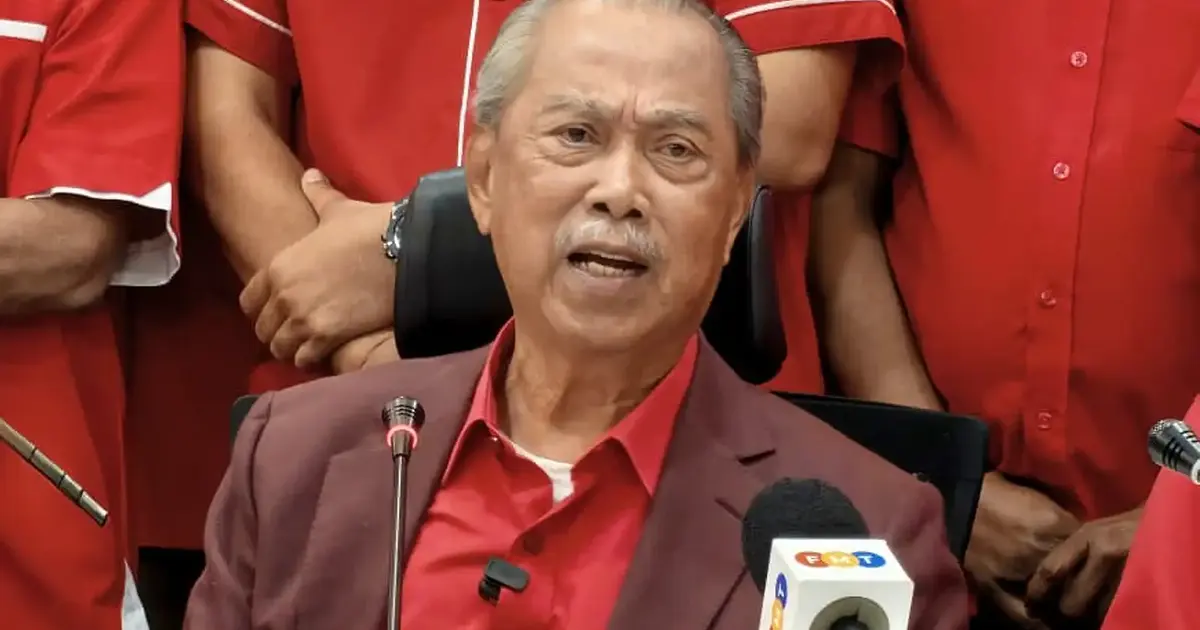
Bersatu is bracing for an escalating rivalry with PAS, according to a statement from the party's leader Muhyiddin Yassin, who has declared that his organisation stands ready to engage the Islamist party across multiple dimensions of political competition. The former prime minister's comments reflect deepening tensions within Malaysia's opposition bloc, signalling that the fractures between these two key players will likely intensify as the political landscape evolves.
The emphasis on fighting "on all fronts" suggests Bersatu anticipates a comprehensive struggle that extends beyond traditional electoral contests. This language implies confrontation across ideological positioning, grassroots mobilisation, media narratives, and organisational capacity—indicating that the rivalry has matured beyond simple electoral competition into a fundamental struggle for political identity and strategic direction. For Malaysian observers, this signals that the opposition coalition framework that held together during the 2022 general election has fundamentally transformed into a more volatile arrangement.
Muhyiddin's positioning of Bersatu as a willing combatant carries particular significance given his party's trajectory since the 2023 general election. Bersatu emerged from that contest with considerably reduced parliamentary representation compared to its initial expectations, and the party has since sought to redefine its political space. The willingness to frame competition with PAS in explicitly confrontational terms suggests that Bersatu leadership has concluded that accommodation and coalition management are no longer viable strategies for the party's political survival.
The decision to contest the forthcoming Johor state election under the Perikatan Nasional banner represents a significant strategic move. Johor, as Malaysia's largest state economy and traditionally a stronghold of the ruling coalition, has become a crucial battleground where Bersatu's performance will substantially influence its national relevance. By explicitly announcing PN's participation, Muhyiddin is signalling that Bersatu will not remain a junior partner in any coalition but will establish a distinct political presence through this historical platform.
Negeri Sembilan holds comparable strategic importance in Bersatu's calculations, though for somewhat different reasons. As a geographically compact state with a relatively small electorate, Negeri Sembilan offers the opportunity to concentrate resources and potentially achieve a decisive showing that generates national momentum. The state's proximity to Kuala Lumpur also ensures that electoral outcomes receive disproportionate media attention, amplifying the significance of any results Bersatu achieves there.
The underlying tensions between Bersatu and PAS reflect broader structural incompatibilities within Malaysia's opposition ecosystem. While both parties nominally align within the PN framework, their core constituencies, ideological orientations, and strategic objectives differ substantially. PAS has consolidated power within Malaysia's Malay-Muslim demographic and operates within an explicitly Islamic political framework, whereas Bersatu has positioned itself as a multi-racial, multi-religious alternative that appeals across demographic lines. These fundamental differences make sustained cooperation inherently unstable.
Regional observers should note that Bersatu's confrontational posture towards PAS occurs simultaneously with Muhyiddin's apparent distancing from the governing Barisan Nasional coalition. This dual positioning—hostility toward PAS while remaining outside BN—leaves Bersatu in a precarious middle ground. The party must simultaneously establish itself as a credible alternative to both the ruling coalition and PAS, a strategically demanding objective that requires careful calibration of messaging and resource allocation across multiple fronts.
The timing of Muhyiddin's statements also merits attention within the context of Malaysian political cycles. State elections in Johor and Negeri Sembilan represent opportunities for Bersatu to demonstrate organisational vitality and electoral appeal before the next general election cycle begins in earnest. Strong performances in these contests could rejuvenate the party's national profile and position it more attractively for potential coalition negotiations, whether with Barisan Nasional, PAS, or other opposition actors.
For the broader Malaysian electorate, particularly in Johor and Negeri Sembilan, Bersatu's explicit challenge to PAS introduces an additional layer of complexity to electoral choice. Rather than a straightforward contest between government and opposition, voters in these states will encounter a more fragmented opposition landscape where multiple parties vie for anti-establishment support. This fragmentation could potentially benefit the incumbent ruling coalition by preventing opposition consolidation, a dynamic that Muhyiddin's strategy may inadequately account for.
PAS's response to these statements will prove equally revealing about the trajectory of Malaysian opposition politics. The party holds substantial grassroots organisation and enjoys considerable support within key demographic segments, particularly in Malay-majority constituencies where Bersatu has historically struggled to establish deep roots. The ensuing confrontation between these parties will likely shape not merely the outcomes of Johor and Negeri Sembilan elections but the entire character of Malaysian political competition in the coming years. Muhyiddin's declaration of readiness for multi-front engagement effectively signals that the old coalitional frameworks have dissolved, replaced by a more fluid and unpredictable political environment where alliances form and dissolve based on immediate strategic advantage rather than stable organisational commitments.

%22%2F%3E%3C%2Fpattern%3E%3C%2Fdefs%3E%3Crect%20width%3D%22100%25%22%20height%3D%22100%25%22%20fill%3D%22url(%23ph40buhg)%22%2F%3E%3Crect%20width%3D%22100%25%22%20height%3D%22100%25%22%20fill%3D%22url(%23ph40buhp)%22%2F%3E%3Ctext%20x%3D%2250%25%22%20y%3D%2250%25%22%20text-anchor%3D%22middle%22%20dominant-baseline%3D%22central%22%20fill%3D%22rgba(255%2C255%2C255%2C0.95)%22%20font-family%3D%22Georgia%2C%20'Times%20New%20Roman'%2C%20serif%22%20font-weight%3D%22700%22%20font-size%3D%22320%22%20letter-spacing%3D%22-0.02em%22%3EGRS%3C%2Ftext%3E%3C%2Fsvg%3E)