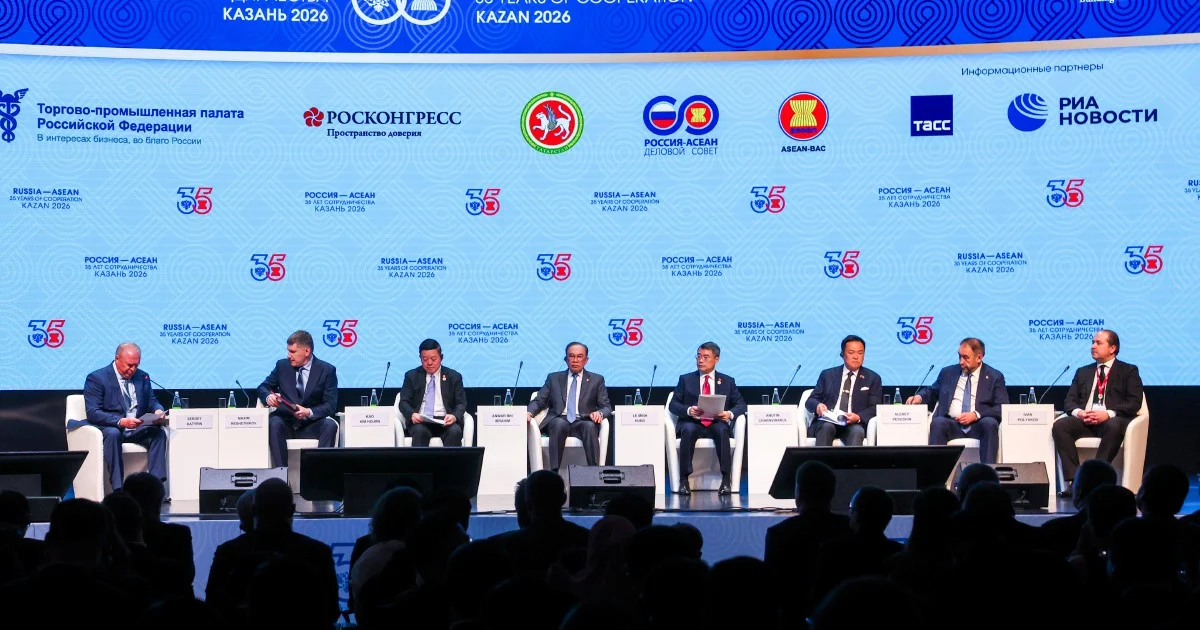
Prime Minister Datuk Seri Anwar Ibrahim has emphasised the necessity for Asean and Russia to substantially widen their multilateral engagement, particularly in sectors fundamental to economic stability and long-term regional development. Speaking in Kazan, the Malaysian leader outlined a comprehensive vision for deepened ties that extends well beyond traditional diplomatic channels, encompassing critical areas from agricultural resilience to technological advancement.
Anwar's remarks underscore a strategic reorientation towards Russia amid a complex geopolitical environment where Southeast Asian nations are navigating their relationships with major powers. The timing of his statements reflects Asean's broader effort to maintain balanced engagements while pursuing pragmatic economic partnerships that serve member states' development aspirations. By explicitly addressing food security as a priority, Anwar highlighted vulnerabilities that remain acute across the region, where supply chain disruptions and climate challenges continue to threaten agricultural production and food price stability.
Food security has emerged as a pressing concern for Asean, particularly following global supply shocks that exposed the region's dependencies on distant suppliers. Russia's position as a major agricultural exporter, coupled with its significant capacity in grain and fertiliser production, makes it a potentially valuable partner for Southeast Asia. The prospect of deepened cooperation in this domain could facilitate more stable import agreements and reduce the region's exposure to volatile international commodity markets. For Malaysia specifically, diversifying food sourcing relationships aligns with broader national security considerations and domestic inflation concerns.
Energy cooperation represents another dimension where Asean-Russia engagement holds substantial mutual benefit. Russia's hydrocarbon reserves and technological expertise in energy production complement Asean's substantial energy consumption needs as the region continues its industrial expansion. The energy sector remains pivotal for economic growth across Southeast Asia, and expanding the pool of reliable suppliers and partners creates competitive pressure that can moderating prices while enhancing supply diversification. This is particularly relevant for Malaysia, an energy producer itself that maintains strategic interests in regional energy security and market dynamics.
The inclusion of advanced manufacturing in Anwar's cooperation agenda reflects recognition that Southeast Asia's economic transformation requires upgraded industrial capabilities. Russia's technical expertise, combined with Asean's labour resources and growing manufacturing base, could generate collaborative opportunities in specialised production sectors. Such partnerships might facilitate technology transfer that elevates manufacturing standards across the region while creating higher-value employment opportunities that move beyond traditional low-cost assembly operations.
Digital technologies represent an increasingly crucial domain where Asean-Russia cooperation could yield substantial dividends. The region's rapid digitalisation creates demand for infrastructure, expertise, and technological solutions that extend beyond what individual Asean members can develop independently. Russian capabilities in software development, cybersecurity, and digital platforms could complement Asean's growing tech ecosystem, while regional expertise in digital payments, e-commerce and fintech innovation could flow in the opposite direction, creating mutually enriching knowledge exchanges.
Educational collaboration emerging as a cooperation pillar demonstrates longer-term thinking about bilateral relationships. Expanded student exchange programmes, research partnerships, and institutional linkages between universities would build human capital across both regions while fostering personal and professional networks that underpin sustained diplomatic relations. For Malaysian students and academics, enhanced access to Russian educational institutions in scientific, engineering and technical fields could strengthen the nation's research capabilities and diversify the geographic sources of tertiary education.
Anwar's articulation of this multi-sector partnership framework signals Malaysia's confidence in managing complex great power relationships without compromising its non-aligned positioning. Rather than viewing Asean-Russia engagement as competitive with other strategic partnerships, the Malaysian approach positions diversified cooperation as complementary to existing relationships with China, the United States, India and other powers. This reflects the pragmatism increasingly characteristic of Southeast Asian statecraft in an era of strategic competition between major powers.
The broader context for these statements involves Asean's ongoing efforts to maintain centrality in regional affairs despite intensifying competition among major powers. By actively cultivating substantive partnerships across multiple economic sectors, Asean member states resist pressure to align exclusively with any single power while maintaining agency over their development trajectories. Anwar's emphasis on concrete cooperation areas, rather than vague diplomatic commitments, suggests Malaysia's intention to translate stated partnership into tangible benefits for Malaysian economy and citizens.
Implementing expanded cooperation across these five domains will require establishing institutional mechanisms, regulatory harmonisation, and sustained political commitment from both sides. Trade agreements, investment frameworks, and technical working groups would need to translate high-level declarations into operational reality. The success of such partnerships depends not merely on political will but also on building business confidence, ensuring transparent operating environments, and demonstrating concrete returns that justify commercial participation from private sector actors across the region.

%22%2F%3E%3C%2Fpattern%3E%3C%2Fdefs%3E%3Crect%20width%3D%22100%25%22%20height%3D%22100%25%22%20fill%3D%22url(%23ph40buhg)%22%2F%3E%3Crect%20width%3D%22100%25%22%20height%3D%22100%25%22%20fill%3D%22url(%23ph40buhp)%22%2F%3E%3Ctext%20x%3D%2250%25%22%20y%3D%2250%25%22%20text-anchor%3D%22middle%22%20dominant-baseline%3D%22central%22%20fill%3D%22rgba(255%2C255%2C255%2C0.95)%22%20font-family%3D%22Georgia%2C%20'Times%20New%20Roman'%2C%20serif%22%20font-weight%3D%22700%22%20font-size%3D%22320%22%20letter-spacing%3D%22-0.02em%22%3EGRS%3C%2Ftext%3E%3C%2Fsvg%3E)