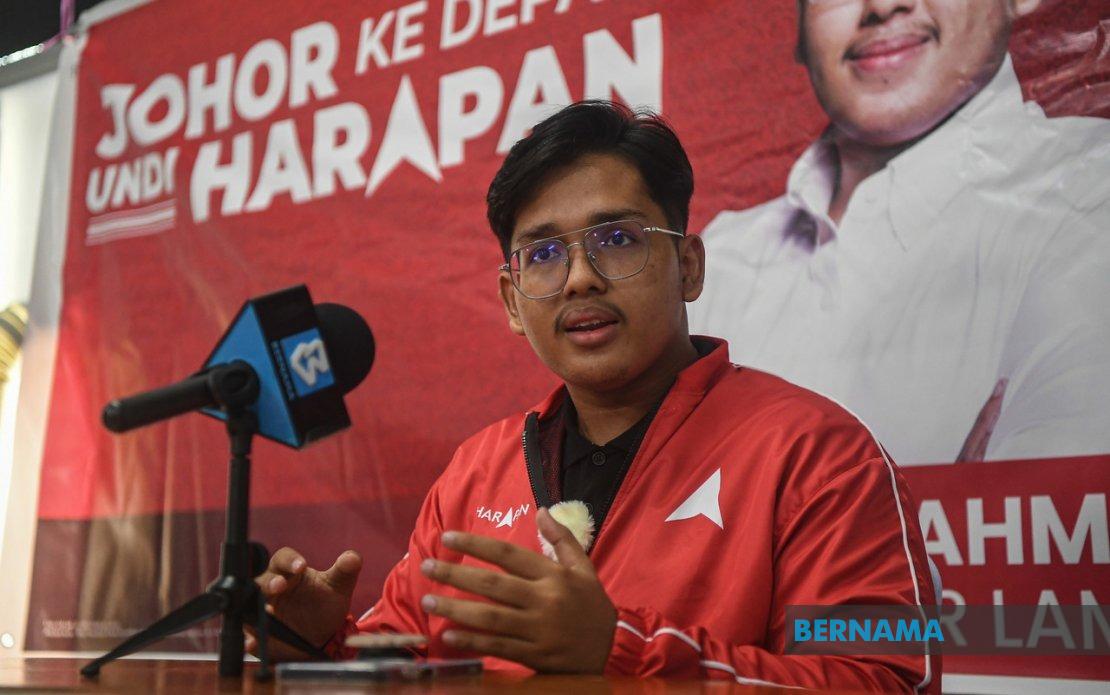
The 16th Johor state election has introduced an unusual protagonist: Danish Hossman Abd Rahman, at 23 years old the youngest candidate competing across 172 hopefuls vying for 56 state seats. Running under the Pakatan Harapan banner in the Johor Lama constituency, Hossman—a Master of Information Technology student at Universiti Tun Hussein Onn Malaysia—brings an unconventional energy to a campaign dominated by seasoned political figures. His emergence highlights a broader push by PH to inject youth-driven momentum into contests where incumbents and established rivals dominate.
Hostman's reception on the ground appears to contradict conventional assumptions about voter scepticism toward youthful candidates. During fieldwork across the Johor Lama district, he reports sustained engagement from unexpected quarters, particularly senior citizens and veterans. This demographic, typically associated with preference for established leadership, has expressed openness to his candidacy, viewing his age not as a liability but as evidence of genuine commitment. Where older and middle-aged incumbents rarely venture into constituent encounters, Hossman's visible presence in towns, villages, and Felda settlements stands in sharp contrast, suggesting voter appetite for representatives who maintain regular community contact.
Hostman frames his campaign not as a rejection of experience but as a deliberate fusion. He positions himself as a "strategic bridge" connecting the institutional knowledge of preceding generations with the contemporary aspirations of younger voters frustrated by stalled economic mobility. This rhetorical move sidesteps the generational resentment that often surfaces in campaigns featuring youth candidates, instead proposing complementarity rather than replacement. For Malaysian observers, this approach reflects a maturing political consciousness among young candidates seeking to avoid the appearance of dismissing their elders while still advancing distinct policy priorities.
The substance of his platform addresses tangible grievances within Johor Lama: insufficient affordable housing and scarce employment prospects driving outmigration of young professionals. Hossman diagnoses these challenges as symptoms of insufficient local investment and industrial development. His proposed remedy involves attracting new capital and nurturing downstream sectors aligned with regional comparative advantage, particularly agribusiness encompassing crop cultivation and livestock operations. This economic strategy resonates with efforts by PH to rebrand itself as development-focused rather than purely oppositional, offering concrete pathways to prosperity rather than merely critiquing incumbent administration.
Hostman's emphasis on creating local career pathways reflects broader anxieties across Southeast Asia regarding brain drain and youth unemployment. By articulating a vision enabling younger residents to "build a career, raise a family and build a future in their own village," he taps into powerful sentiments about community rootedness and economic dignity. For Malaysian voters weary of centralised wealth concentration, his promise to decentralise opportunity through targeted industrial cultivation addresses real structural concerns, particularly in constituencies like Johor Lama where agricultural heritage coexists with modern economic transition.
His campaign methodology prioritises repeated voter contact and substantive engagement over transactional politics. Rather than one-off appearances, Hossman documents multiple visits to neighbourhoods, positioning familiarity as prerequisite for voter trust. He explicitly rejects what he characterises as politics of "hatred or personal attacks," appealing instead to assessment based on "capabilities." Within Malaysia's polarised electoral environment, this rhetorical commitment to issue-based rather than identity-driven competition carries particular weight, even if implementation proves challenging.
The Johor Lama contest itself reflects competitive intensity across the state election. Hossman faces incumbent Norlizah Noh representing Barisan Nasional and Aisah Esa from Perikatan Nasional, creating a three-way battle typical of Malaysia's fragmented coalition politics. None of the three candidates command obvious dominance, suggesting genuine electoral uncertainty. Polling scheduled for Saturday, with early voting the preceding day, arrives after sustained campaign engagement across the state.
Hostman's trajectory carries implications beyond his individual electoral prospect. If successful, he would exemplify PH's ability to cultivate viable young candidates capable of competing across diverse constituencies rather than merely symbolic youth representation. His campaign demonstrates that age-related scepticism, while persistent, need not prove insurmountable when coupled with consistent fieldwork and policy substance. Conversely, defeat would reinforce conventional wisdom about voter preference for established candidates, potentially tempering future youth-focused recruitment efforts.
For regional observers, the Johor election—Malaysia's largest state by population and economic significance—functions as a bellwether for broader political trends. Youth candidacy patterns, voter appetite for generational change, and receptiveness to alternative economic development models evident in Johor Lama and adjacent contests will inform subsequent elections across Peninsular Malaysia and potentially Sabah and Sarawak. The willingness of established voters to engage with Hossman suggests constituencies potentially more fluid than headline polling might indicate.
Hostman's campaign ultimately contests not merely seats but the very relationship between age and credibility in Malaysian politics. His positioning as bridge-builder rather than revolutionary accommodates skeptics while energising younger voters seeking meaningful representation. Whether this balanced approach proves electorally sufficient will crystallise on polling day, but his visibility and substantive engagement have already shifted baseline expectations about youth candidate viability in competitive Southeast Asian electoral environments.

