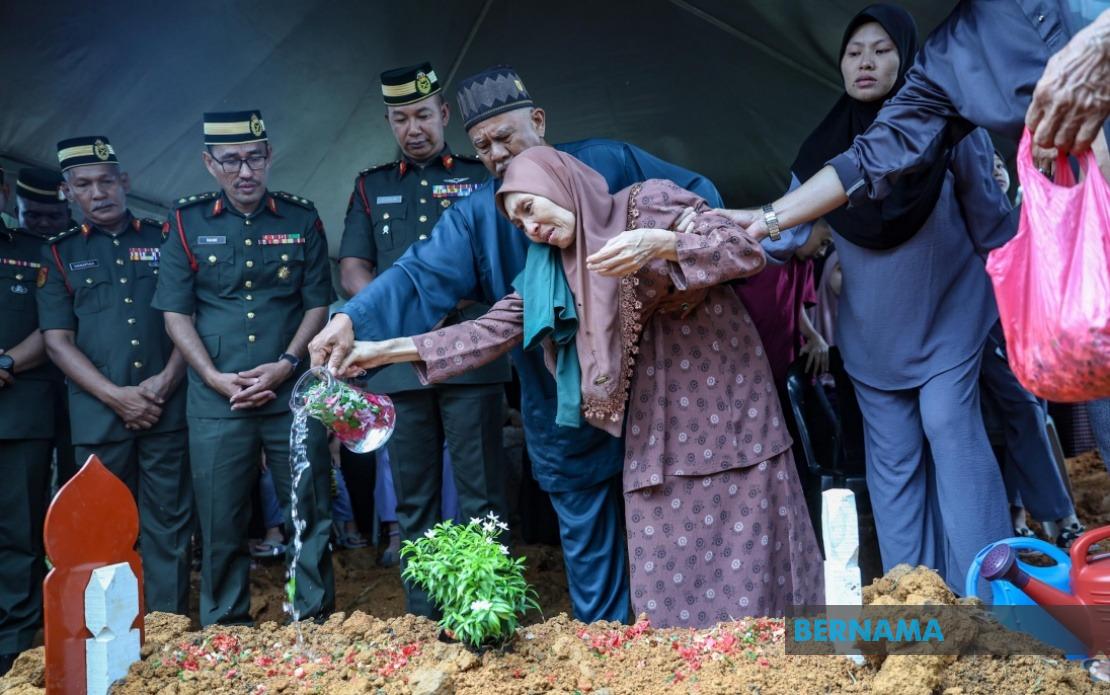
Private Siti Khadijah Sungip, a 24-year-old soldier with the Malaysian Army's Royal Engineer Regiment, was buried with full military honours at Taman Sri Lambak Muslim Cemetery in Kluang on June 17. Her death came just hours after a tragic explosion during grenade throwing exercises at Hobart Camp in Gurun, Kedah, marking a sobering reminder of the inherent risks in military training operations across Southeast Asia's defence forces.
The funeral service, held at 1.15 pm, drew a large gathering that reflected the deep respect afforded to fallen military personnel within Malaysia's armed forces community. Family members, relatives, friends, and army colleagues assembled to pay their final respects in an atmosphere heavy with grief and ceremony. The presence of senior military figures underscored the significance of the occasion and the institution's commitment to honouring its members who make the ultimate sacrifice in service to the nation.
Brigadier General Datuk Zulhelmy Masdar, Commander of the 7th Brigade at Mahkota Camp, officially presented the Jalur Gemilang to Private Siti Khadijah's father, Sungip Jais, 65, in a ceremonial handover that represents the army's formal acknowledgement of the family's loss and the soldier's contribution. This symbolic gesture carries profound meaning within Malaysian military culture, recognizing both the individual's service and the nation's debt to those who serve in uniform. The flag presentation ceremony serves as a bridge between the institutional military and the bereaved family, acknowledging their shared burden.
The sequence of events following the fatal incident reveals the procedural protocols that accompany military casualties in Malaysia. Private Siti Khadijah's body underwent post-mortem examination at Sultanah Bahiyah Hospital in Alor Setar, with the examination concluding at approximately 2.30 am. From there, her remains were transported back to her family's residence in Taman Sri Lambak, arriving at 12.10 pm accompanied by Lieutenant Muhammad Lutfil Hadi Osman and four members of her unit from the First Squadron of the Royal Engineer Regiment stationed at Sangro Camp in Taiping, Perak.
The religious observances that followed the body's arrival reflected the importance of Islamic rites in Malaysian military funeral practices. Private Siti Khadijah was brought to the Darul Iman Mosque for funeral prayers, which were conducted by Major Mohd Azlan Shah Abdul Razak from the TDM Field Engineering Institute. These spiritual proceedings provided her family and comrades with an opportunity to offer their prayers and seek solace through faith during this devastating time.
The incident itself occurred at 10.57 am on June 16 at the training range at Hobart Camp, when an explosion during grenade exercises caused catastrophic injuries to multiple personnel. Both Private Siti Khadijah and Corporal Norazmi Abu Bakar, who served with the Sixth Battalion of the Royal Malay Regiment, sustained severe injuries from the blast. Despite rapid evacuation efforts to Sultan Abdul Halim Hospital in Sungai Petani, both soldiers succumbed to their injuries en route to the medical facility, indicating the severity of the explosion.
The tragedy raises critical questions about training safety protocols within Malaysia's military establishment. Grenade throwing exercises represent standard components of infantry and engineer training regimes across armed forces globally, yet incidents like this underscore the inherent dangers present even in routine military operations. The involvement of the Royal Engineer Regiment specifically highlights that such risks extend beyond traditional combat roles to encompass specialized military disciplines where personnel handle explosive ordnance as part of their daily responsibilities.
For Malaysia's defence sector and regional military forces, this incident serves as a stark illustration of the occupational hazards faced by military personnel during training phases. The loss of trained personnel, particularly those with specialized engineering expertise, represents both a human tragedy and an operational loss to institutional capability. Private Siti Khadijah's death, along with Corporal Norazmi's, constitutes a loss of experienced military assets at a time when Southeast Asian defence forces are increasingly operational across diverse security challenges.
The incident also raises broader considerations regarding equipment safety, training supervision protocols, and risk management procedures at military installations across the region. While preliminary reports indicate the explosion occurred during target range activities, a comprehensive investigation would typically follow such events to identify contributing factors and implement preventive measures. Such investigations are standard practice within professional military establishments, aimed at reducing future casualty risks and improving operational safety standards.
The participation of military personnel in the funeral service, extending from junior ranks to senior officers like Brigadier General Zulhelmy Masdar, reflects the institutional solidarity that characterizes professional armed forces. This collective acknowledgement of loss reinforces military culture and demonstrates to serving personnel that their sacrifice and that of their fallen comrades will be recognized and honoured. Such practices contribute to unit cohesion and morale during difficult periods.
For the broader Malaysian public and regional observers, this incident underscores the genuine risks that military personnel undertake daily, extending beyond active combat to encompass training activities and peacetime operations. The presence of Private Siti Khadijah and Corporal Norazmi among the armed forces' ranks represented diverse backgrounds and specializations, reflecting the inclusive nature of contemporary Southeast Asian defence forces. Their loss represents a tragedy not merely for their families and units, but for a nation that depends upon the sacrifice and dedication of trained military professionals.
Moving forward, this incident will likely prompt reviews of training procedures at Hobart Camp and potentially across other Malaysian military installations. The investigation into the precise causes of the explosion, whether resulting from equipment malfunction, procedural error, or other factors, will inform future safety improvements. Such institutional learning processes, while unable to reverse the tragedy, serve to honour the memory of fallen soldiers by working to prevent similar incidents and protecting future generations of military personnel from comparable fates.

%22%2F%3E%3C%2Fpattern%3E%3C%2Fdefs%3E%3Crect%20width%3D%22100%25%22%20height%3D%22100%25%22%20fill%3D%22url(%23ph40buhg)%22%2F%3E%3Crect%20width%3D%22100%25%22%20height%3D%22100%25%22%20fill%3D%22url(%23ph40buhp)%22%2F%3E%3Ctext%20x%3D%2250%25%22%20y%3D%2250%25%22%20text-anchor%3D%22middle%22%20dominant-baseline%3D%22central%22%20fill%3D%22rgba(255%2C255%2C255%2C0.95)%22%20font-family%3D%22Georgia%2C%20'Times%20New%20Roman'%2C%20serif%22%20font-weight%3D%22700%22%20font-size%3D%22320%22%20letter-spacing%3D%22-0.02em%22%3EGRS%3C%2Ftext%3E%3C%2Fsvg%3E)