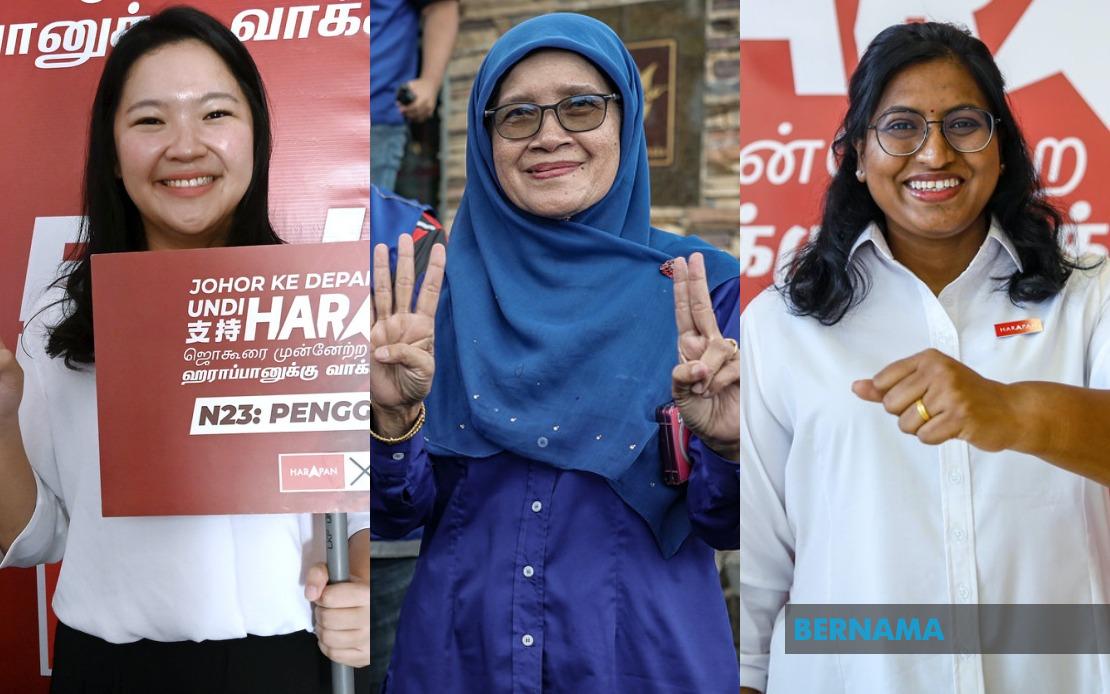
The 16th Johor State Election delivered a meaningful outcome for women's representation in the state legislature, with ten female candidates capturing assembly seats despite competing in a field where their gender remained a decided minority. Seven of the successful candidates represented Barisan Nasional, while their three counterparts campaigned under the Pakatan Harapan banner, a distribution that broadly mirrored the overall coalition performance across Johor's 56 constituencies.
The seven triumphant BN women spanned multiple districts across the state, demonstrating that female leadership appeal transcends geographical boundaries within Johor's diverse electoral landscape. Nadhirah Afiqah Abdull Rahim secured Serom in her maiden electoral contest, overturning a straightforward two-opponent scenario where she defeated Perikatan Nasional's Mahfidz Omar and Pakatan Harapan's Ahmad Nazari Abd Hamid by accumulating 9,406 votes. Nor Rashidah Ramli's triumph in Parit Raja proved particularly significant, as her expanded mandate of 13,576 votes—roughly triple the 4,219-vote margin achieved in the previous 2022 state election—signalled a meaningful consolidation of BN support in that division. Alwiyah Talib's victory in Endau represented her third consecutive win at that constituency, a demonstration of electoral durability that extended across three competing opponents in a competitive four-way race.
Among the remaining BN victors, Norlizah Noh in Johor Lama produced what observers termed a commanding performance, capturing 16,344 additional votes above her runner-up in a triangular contest that included the election's youngest participant. Fauziah Misri similarly dominated proceedings in Penawar, securing a 15,776-vote plurality in another three-candidate race. Chan San San's conquest of Johor Jaya carried particular symbolic weight, as that traditionally Democratic Action Party stronghold had long been considered unfavourable terrain for BN representation, yet Chan amassed 35,971 votes to overcome both her PH rival and independent challengers. Hasrunizah Hassan's successful defence of Pulai Sebatang in a direct encounter with her Pakatan Harapan opponent demonstrated not only her personal electoral strength but also an improvement of 6,325 votes compared to her 2022 performance.
On the opposition benches, Pakatan Harapan's three female victors maintained their party's representation in strategically important constituencies. In Penggaram, 28-year-old Felicia Poh Rui Ling executed a successful defence against Barisan Nasional's Boo Chin Liong, prevailing by 4,137 votes in a bilateral contest that underscored the continued viability of younger PH female candidates. Chu Poh Yee retained Mengkibol for the coalition, maintaining her parliamentary seat by accumulating 4,213 votes above her BN rival Yap Zhi Peng. Kartiyaini Jeyapalan, a practising lawyer representing her hometown of Skudai, navigated a more congested electoral arena comprising four competing candidates from varying political persuasions and secured the seat with a commanding 15,280-vote majority, reaffirming Pakatan Harapan's hold on that urban constituency.
The broader context of female electoral participation reveals both progress and persistent structural limitations within Johor's political environment. The 34 women contestants represented approximately one-fifth of the total candidate field, a proportion that indicates incremental expansion of female candidacy relative to historical patterns, yet simultaneously underscores how male candidates dominated the nomination process with 138 positions. This imbalance raises questions about party machinery decision-making and whether internal selection procedures genuinely prioritise gender diversification or merely accommodate tokenistic female presence within electoral contests.
The victory rate of roughly 29 percent among female candidates—ten successes from 34 attempts—merits comparison against overall election outcomes and male candidacy performance. Barisan Nasional's commanding 48-seat capture from 56 contested constituencies provided a particularly favourable environment for its seven female representatives, whilst Pakatan Harapan's retention of eight seats through its three female victors suggests that female candidates performed comparably to male counterparts within each coalition's broader electoral machinery. Such parity in performance effectiveness contradicts assumptions that female candidacy necessarily disadvantages political formations or that voters demonstrably discriminate against women contestants based on gender considerations.
The victories achieved by these women carry implications extending beyond Johor's state parliament. Malaysian political parties at federal level increasingly confront internal and external pressure regarding gender representation in both candidate nomination and actual parliamentary composition. Johor's demonstrated capacity to elect ten female assemblypeople suggests that voter readiness for female leadership exists across varied demographic and geographic contexts within Southeast Asia's largest states. The relative performance of Barisan Nasional's female contingent, particularly the upset victory in traditionally opposition territory like Johor Jaya, indicates that effective female candidates can mobilise electoral support transcending conventional coalition voting patterns.
Looking forward, the results raise strategic questions for Johor's principal political organisations. Barisan Nasional's superior female representation outcome may incentivise further expansion of female candidacy, particularly in constituencies where sitting female assemblewomen have demonstrated replicable electoral success. Conversely, Pakatan Harapan faces pressure to identify and nurture additional female candidates capable of challenging incumbency and expanding the coalition's female parliamentary presence beyond current levels. Both coalitions might examine whether their female victors possess distinctive organisational approaches, community engagement methodologies, or policy emphases that distinguish them from unsuccessful counterparts and thereby merit broader emulation.
The election results simultaneously highlight generational dimensions within female electoral participation. Felicia Poh's youth and Kartiyaini Jeyapalan's professional background as a practising lawyer introduce diverse female representation models to Johor's legislature, potentially reshaping expectations regarding female political leadership credentials and pathways toward elected office. These varied professional and demographic profiles among successful candidates suggest that contemporary voters increasingly evaluate candidates according to individual competency criteria rather than gender-based categorical assessments.
From a Southeast Asian perspective, Johor's electoral outcomes contribute to evolving regional narratives regarding female political participation in Malaysia's electoral democracy. While absolute female representation figures remain modest, the demonstrated electability of individual female candidates across diverse constituencies and political affiliations indicates measurable progress toward more inclusive electoral participation. Malaysian policymakers and party strategists observing these results may discern both opportunity and necessity in advancing female candidacy as both democratic principle and electoral strategy.

