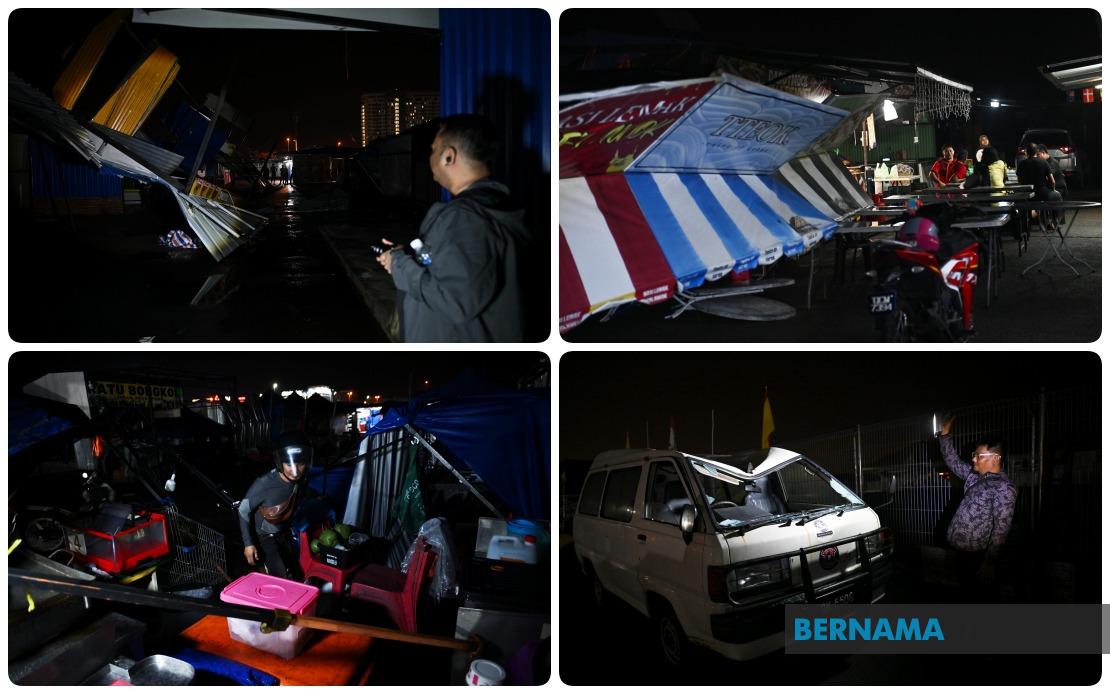
A powerful thunderstorm that swept through Kuching on the weekend has dealt a devastating blow to the N6 Metrocity 2 Youth Night Market, forcing its temporary closure after infrastructure collapsed and vendors suffered substantial financial losses. The sudden meteorological event, which struck during peak trading hours, left more than 40 trader stalls severely damaged out of approximately 300 operating lots, making it one of the most destructive natural disasters to impact the popular night market venue.
The violence of the storm became apparent when strong winds tore through the market site with such force that canopy structures were ripped away and sent flying through the air. Traders present at the scene described harrowing moments as they scrambled to escape, fearing they would be struck by the airborne structures. Mohamad Faisal, a 42-year-old vendor, recounted how he and other stallholders abandoned their positions and fled to safety as the winds intensified. The chaos erupted precisely when visitor numbers typically peak on weekend evenings, adding to the danger as panicked traders navigated the tumultuous conditions.
The immediate aftermath revealed the scale of destruction across the market. Canopy frames that form the backbone of the outdoor trading infrastructure were completely demolished, while sales equipment including cooking appliances, water containers, and merchandise sustained significant damage. Traders who have operated at the venue for roughly a decade estimate they have collectively incurred losses approaching RM2,000, with individual vendors facing repair and replacement costs ranging from RM2,000 to RM5,000 depending on the size and construction of their canopies alone, before accounting for damaged equipment and spoiled stock.
Hamzah Hassan, deputy chairman of the N6 Metrocity 2 Youth Night Market management committee, characterized the incident as unprecedented in severity compared to previous natural disasters affecting the site. The damage extended beyond individual trader stalls to encompass essential community infrastructure, with the main stage, management office, and electrical supply cables all suffering structural collapse or failure. This widespread destruction highlighted the market's vulnerability to extreme weather and raised questions about the adequacy of protective measures and emergency preparedness protocols currently in place.
The economic ripple effects will likely be felt throughout the vendor community for months to come. Many traders operate on narrow profit margins typical of informal sector enterprises, and the sudden loss of both inventory and equipment represents a substantial financial shock. For established vendors who have invested years building customer bases at the site, the forced closure also means temporary loss of income during the recovery and reconstruction period. The market management has signalled openness to receiving financial assistance and support from relevant government ministries, elected representatives, and cooperative organizations to alleviate the burden on affected hawkers.
The Malaysian Meteorological Department had issued a thunderstorm warning between 5 pm and 9 pm on the day of the incident, covering multiple areas across Sarawak including Kuching, Serian, Siburan, Samarahan, Simunjan, Kapit, and Song. However, the intensity and destructive force of the storm appears to have exceeded initial forecasts or preparedness expectations. This raises important questions about weather forecasting accuracy and the need for more granular warnings that specify potential damage levels and advise closure of outdoor markets when dangerous conditions are anticipated.
The incident underscores broader vulnerabilities in Sarawak's informal economy, where night markets serve as vital commercial engines for thousands of micro-entrepreneurs and small business operators. These venues provide affordable trading platforms and generate substantial foot traffic from residential communities, yet typically operate with minimal structural reinforcement against extreme weather. The concentration of vendors in close proximity means that single catastrophic events can simultaneously impact large numbers of livelihoods, creating localized economic shocks that ripple through entire trading communities.
For Malaysian policymakers and local authorities, the Kuching incident should prompt urgent review of building codes and safety standards applicable to outdoor markets and temporary commercial structures. Comparable markets throughout Southeast Asia face similar weather-related risks, particularly during monsoon seasons and periods of atmospheric instability. Investment in reinforced infrastructure, early warning systems, and mandatory closure protocols during severe weather warnings could significantly reduce the human and economic costs of such events.
The recovery process for N6 Metrocity 2 Youth Night Market will require coordinated efforts involving market management, municipal authorities, and supporting government agencies. Beyond immediate damage assessment and emergency repairs, this represents an opportunity to implement structural improvements and safety upgrades that enhance resilience to future storms. Community-level support from cooperatives and local organizations will be essential in helping individual traders rebuild their stalls and restore operations, particularly for those with limited insurance coverage or financial reserves to absorb such losses.

