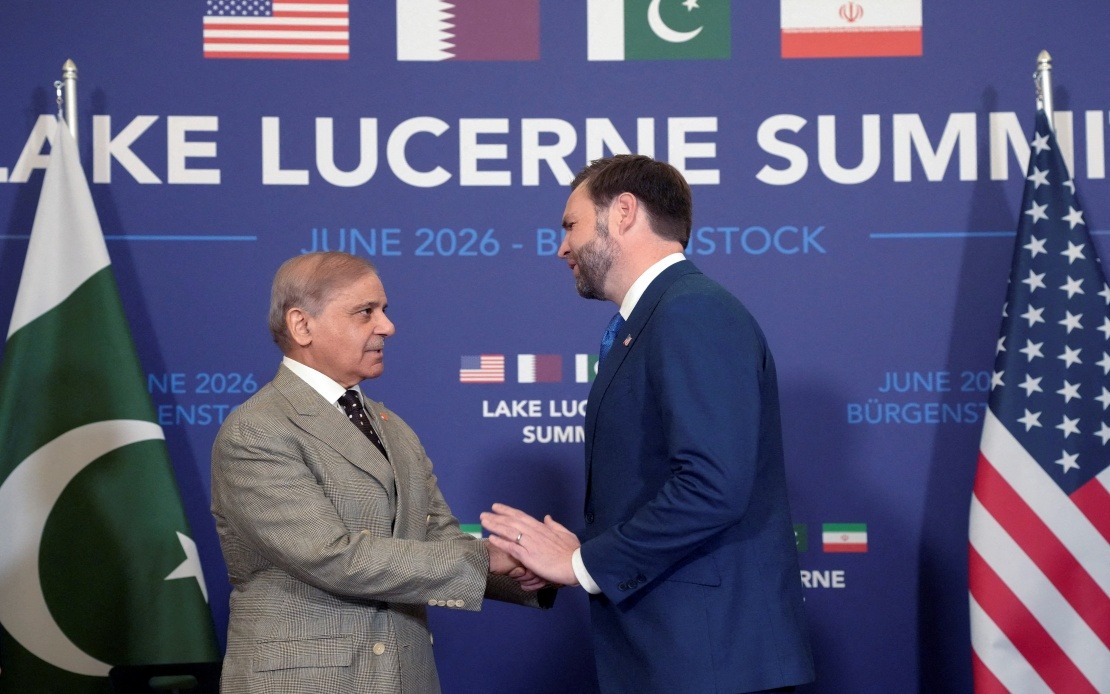
A significant diplomatic engagement between American and Pakistani leadership unfolded in Burgenstock, Switzerland, on Sunday, with Vice President JD Vance hosting Pakistan's Prime Minister Shehbaz Sharif and Army Chief Field Marshal Asim Munir. The bilateral meeting took place on the margins of broader multilateral negotiations aimed at resolving the escalating military tensions between the United States and Iran. Special Envoys Steve Witkoff and Jared Kushner joined Vance in greeting the Pakistani delegation, signalling the importance the White House attaches to Pakistan's role in regional stabilization efforts during this critical juncture.
The timing of the bilateral discussion carries particular weight within the context of ongoing talks involving multiple stakeholders. Technical-level negotiations involving Iran, the United States, Pakistan, and Qatar convened simultaneously at the Swiss resort, marking a coordinated diplomatic push to address the military hostilities that commenced on February 28. The decision to conduct these discussions behind closed doors underscores the sensitivity surrounding the negotiations and the need for frank exchanges without public scrutiny that might complicate diplomatic breakthroughs.
For Pakistan, engagement at this level reflects its strategic position as both a mediator and stakeholder in broader Middle Eastern affairs. The country's involvement in these talks positions it as a bridge between competing interests, leveraging its relationships with both the United States and Iran. Pakistan's military establishment, represented by Field Marshal Asim Munir, holds particular significance in these discussions, given the Pakistan Army's historical role in shaping the nation's foreign and security policies. The inclusion of both the civilian leadership under Prime Minister Sharif and military brass demonstrates the unified approach Pakistan is adopting toward these negotiations.
The substantive achievements underlying these talks became apparent when reports emerged that Iran and the United States had executed a memorandum of understanding during the preceding weekend, formally codifying terms to end military hostilities initiated in late February. This agreement establishes concrete mechanisms for de-escalation, including provisions for the United States to lift its naval blockade and for Iran to resume shipping operations through the Strait of Hormuz, a critical waterway through which roughly one-third of global seaborne traded oil passes. The restoration of normal maritime commerce through this chokepoint carries implications far beyond bilateral US-Iran relations, affecting energy security and supply chain stability across Asia and globally.
Iran's nuclear programme emerged as a central component of the broader settlement framework. Under the agreement's terms, Tehran commits to forgo acquisition of nuclear weapons, though the technical specifics of verification and implementation remain subject to further negotiation. The parties designated a 60-day window for concluding a comprehensive agreement addressing Iran's nuclear activities, creating both opportunity and pressure for reaching consensus on mechanisms that satisfy security concerns while respecting Iran's stated civilian energy requirements.
For Iran, the prospective lifting of comprehensive sanctions represents the primary incentive driving negotiation. These restrictions have crippled the Iranian economy, constraining its ability to access international markets, secure financing, and repatriate revenues from hydrocarbon exports. The sanctions regime has also impeded humanitarian access to medicines and medical equipment, contributing to hardship for ordinary Iranians. Relief from these economic restrictions would transform Iran's fiscal position, though implementation would likely proceed in phases tied to verification of compliance with nuclear undertakings.
The involvement of Pakistan and Qatar as mediators reflects the pragmatic multilateral approach the Biden administration has pursued in managing this confrontation. Both nations maintain relationships across regional divides and possess credibility with various stakeholders. Pakistan's role is particularly significant given its historical ties to Iran, its strategic relationship with the United States, and its influence within military and intelligence circles throughout South Asia. Qatar, as a financial and diplomatic hub, has similarly cultivated relationships enabling it to facilitate dialogue when direct bilateral channels face obstacles.
For Southeast Asian observers and policymakers, the stabilization of US-Iran tensions carries substantial implications. Regional economies depend heavily on predictable energy flows through the Strait of Hormuz, and any resumption of military escalation risks disrupting oil supplies and spiking energy costs. Malaysia, as a petroleum-producing nation, and the broader ASEAN bloc, as energy-intensive developing economies, maintain keen interest in establishing stable trading conditions across the Indian Ocean and Persian Gulf. Uncertainty regarding Middle Eastern security has already influenced regional investment and trade patterns, making the successful conclusion of these negotiations consequential for Asian economic prospects.
The multi-layered nature of these discussions—simultaneous bilateral meetings alongside technical working groups—reflects the complexity of the underlying issues and the necessity of managing multiple constituencies and interests. American policymakers must balance reassurance of regional allies concerned about Iranian capabilities with acknowledgment of Iranian security interests and economic requirements. Pakistan's mediation role requires calibrating its messaging to maintain credibility with both Washington and Tehran whilst advancing its own regional security agenda. The narrow 60-day window for nuclear negotiations suggests recognition among participants that momentum must be maintained to prevent diplomatic fatigue or the emergence of spoiler dynamics.
The successful navigation of these talks would represent a significant diplomatic achievement, potentially altering the regional security landscape in ways that reduce military risks and create space for economic cooperation. Conversely, breakdown in negotiations could precipitate renewed escalation, with severe consequences for global energy markets, international stability, and the credibility of multilateral diplomatic mechanisms. The Burgenstock meetings represent a critical juncture where patient negotiation, genuine commitment to compromise, and sustained high-level engagement offer the most realistic pathway toward sustainable peace.