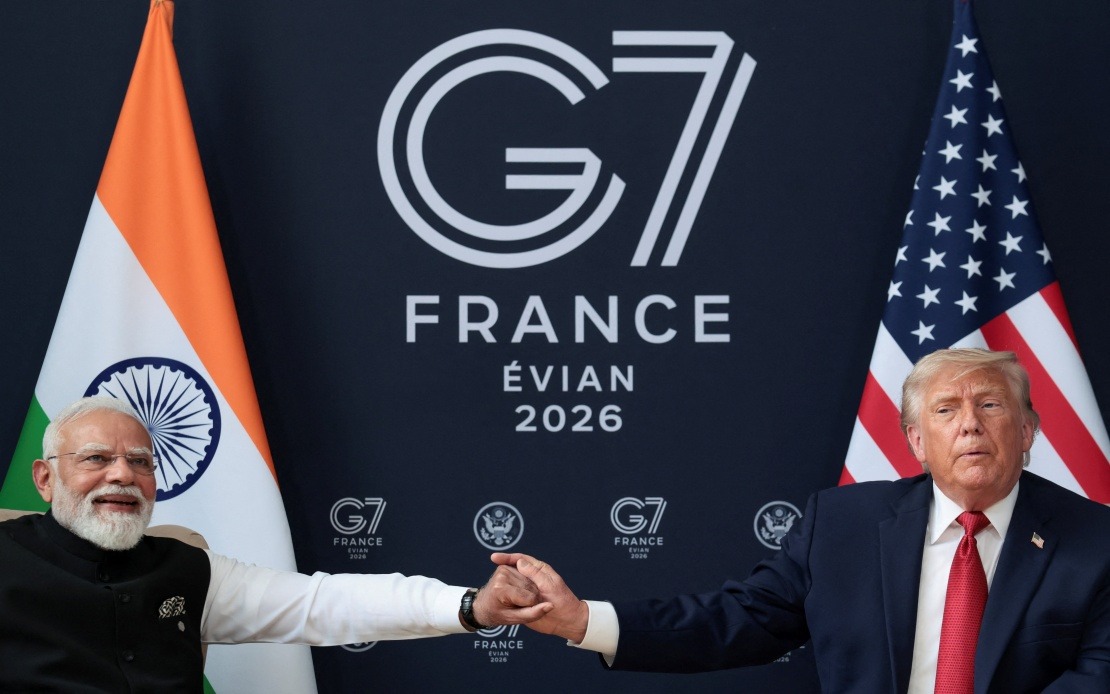
The United States and India have announced a major breakthrough in their protracted trade negotiations, marking the most significant momentum in bilateral commerce talks in recent months. Following discussions between US President Donald Trump and Indian Prime Minister Narendra Modi at the Group of Seven summit in Evian, France, both governments have publicly committed to accelerating efforts towards completing a comprehensive trade agreement that addresses long-standing grievances on both sides.
India's External Affairs Ministry formally acknowledged the progress in a statement released after the G7 meeting, noting that the two leaders took "particular satisfaction" in the advancement of negotiations towards an interim bilateral trade agreement. The statement further indicated that both governments have instructed their trade officials to prioritise completing a pact that balances the interests of both nations while delivering meaningful commercial benefits for businesses and consumers across the two countries.
The commitment comes at a critical juncture for US-India relations, which have been strained by tariff disputes and trade imbalances over recent years. Trump's characterisation of Modi as "one of the toughest" negotiators—a comment made with evident respect rather than criticism—underscores the intensity of discussions between the two parties. The American president's observation that Modi, despite his polished appearance, possesses the tenacity of "a killer" in negotiations, reflects the complexity and hard-nosed approach both sides have adopted in pursuing their respective interests.
The trajectory of US-India trade relations over the past year illustrates the volatility that has defined their commercial relationship. Earlier in 2025, the Trump administration imposed substantial tariffs on Indian goods, including a base rate of 25 per cent alongside an additional 25 per cent penalty specifically targeting Indian purchases of Russian oil. These measures represented a significant escalation in trade tensions and prompted extensive backchannel negotiations aimed at finding common ground. The February interim agreement, under which the US reduced tariffs to 18 per cent, represented the first major concession and signalled both parties' willingness to negotiate despite underlying tensions.
The appointment of US Trade Representative Jamieson Greer to visit India in the coming week signals the accelerated pace of negotiations going forward. Greer's presence in New Delhi will provide an opportunity for detailed technical discussions with Indian trade officials, likely focusing on sector-specific concerns, tariff schedules, and regulatory harmonisation between the two economies. Such high-level envoy visits typically precede breakthrough agreements and suggest that both governments believe a finalised deal is within reach within a reasonable timeframe.
For Malaysia and other Southeast Asian nations, the resolution of US-India trade tensions carries substantial implications. A normalised trade relationship between two of Asia's largest economies would reduce regional economic uncertainty and potentially strengthen the broader Indo-Pacific trade architecture. Given Malaysia's significant trade relationships with both the United States and India, any tariff escalation or trade conflict directly affects Malaysian exporters and supply chains that depend on smooth commerce across the Indian subcontinent and towards American markets.
The interim agreement reached in February provided a template for what a more comprehensive deal might entail. By reducing tariffs from the punitive 25 per cent level to 18 per cent, that accord created space for negotiators to explore deeper sectoral agreements. Agricultural products, intellectual property protections, and digital trade have emerged as key areas of contention, with the US seeking greater market access for American farmers and technology companies while India has advocated for maintaining flexibility in its industrial policies and protecting its pharmaceutical and technology sectors.
The broader geopolitical context cannot be overlooked in assessing this trade rapprochement. The United States views India as a critical counterbalance to China's rising economic and military influence in Asia. Conversely, India values its strategic partnership with Washington as a means of strengthening its position vis-à-vis Beijing while diversifying its trading relationships away from excessive dependence on Chinese markets. A durable trade agreement thus serves both nations' strategic interests beyond the immediate commercial benefits.
Meanwhile, India's concerns regarding tariffs on oil purchases from Russia reflect the complex balancing act New Delhi must maintain between its historical ties to Moscow and its deepening strategic alignment with Washington. The additional penalty tariff targeting Russian oil imports represented a particularly sensitive pressure point, as India has long relied on Russian energy supplies and resisted what it perceived as American efforts to dictate its foreign policy. That the US agreed to reduce this penalty as part of the interim February arrangement suggests Washington recognises India's legitimate energy security concerns.
The path forward remains challenging despite the announced progress. Both nations must navigate significant differences on agricultural subsidies, services trade, and intellectual property standards. India's emphasis on protecting its domestic industries while pursuing development goals contrasts with American expectations for greater market liberalisation. Moreover, questions surrounding tariffs on specific sectors—such as automotive components, pharmaceuticals, and textiles—will require detailed negotiation and potential compromises from both sides.
Regional observers will monitor the coming weeks closely as Greer's mission unfolds and negotiations intensify toward completing a comprehensive accord. The successful conclusion of a balanced trade agreement would signal that even during periods of broader geopolitical tension and trade nationalism, major economies can identify mutual interests and reach pragmatic compromises. For Southeast Asia, such an outcome would provide welcome stability in the region's trade environment and reinforce the notion that disagreements need not inevitably lead to prolonged economic conflict.

%22%2F%3E%3C%2Fpattern%3E%3C%2Fdefs%3E%3Crect%20width%3D%22100%25%22%20height%3D%22100%25%22%20fill%3D%22url(%23ph40buhg)%22%2F%3E%3Crect%20width%3D%22100%25%22%20height%3D%22100%25%22%20fill%3D%22url(%23ph40buhp)%22%2F%3E%3Ctext%20x%3D%2250%25%22%20y%3D%2250%25%22%20text-anchor%3D%22middle%22%20dominant-baseline%3D%22central%22%20fill%3D%22rgba(255%2C255%2C255%2C0.95)%22%20font-family%3D%22Georgia%2C%20'Times%20New%20Roman'%2C%20serif%22%20font-weight%3D%22700%22%20font-size%3D%22320%22%20letter-spacing%3D%22-0.02em%22%3EGRS%3C%2Ftext%3E%3C%2Fsvg%3E)