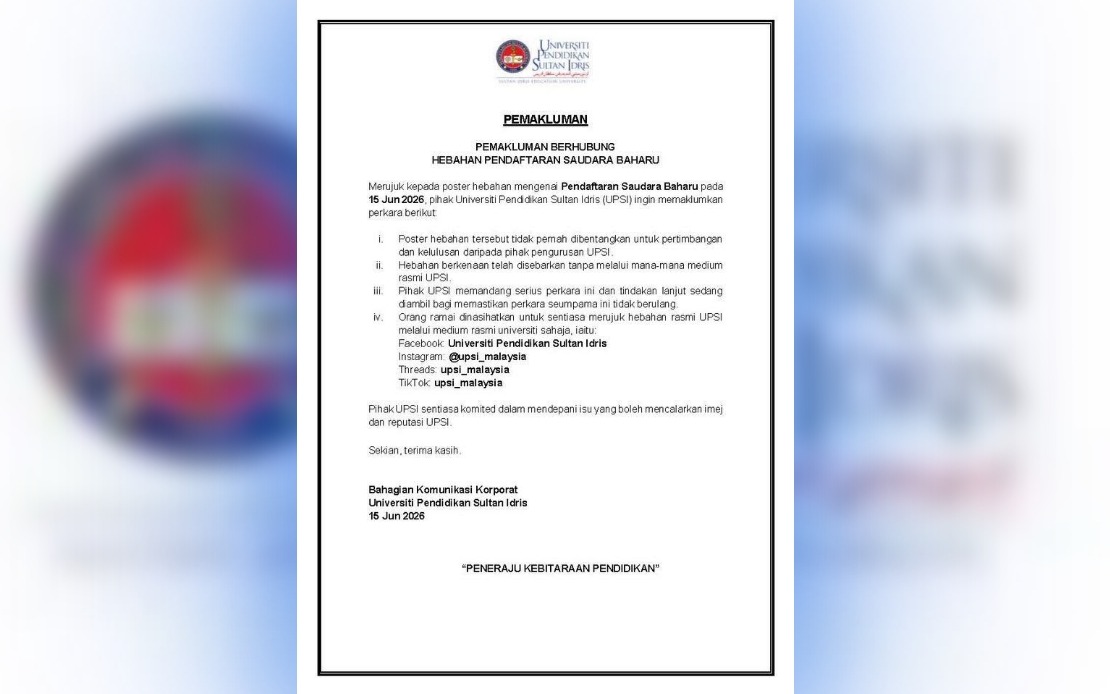
Universiti Pendidikan Sultan Idris (UPSI) has moved swiftly to distance itself from a controversial poster about registering 'saudara baharu' or newly converted Muslims that gained significant traction across social media platforms in mid-June. The institution issued a clarification through its official social media channels, emphasising that the June 15-dated poster never reached the university's administrative body for evaluation or approval, nor was it distributed through any recognised UPSI communication platform.
The emergence of the poster without institutional authorisation has raised concerns about how information can be misattributed to educational institutions in the digital age. Universities increasingly find themselves at the centre of viral content disputes where materials bearing their name or reputation circulate widely before official verification occurs. In this case, the rapid spread of the poster across social media networks created a potential reputational risk that required immediate institutional response.
UPSI's statement acknowledged the seriousness with which the university treats such incidents, signalling that internal investigations and preventative measures would be implemented to forestall similar occurrences. The institution's emphasis on the distinction between unofficial and official channels reflects broader concerns within Malaysian higher education about managing institutional communications in an era where anyone with internet access can create and amplify content claiming university affiliation.
The university has instructed members of the public to rely exclusively on announcements disseminated through UPSI's verified official mediums when seeking authoritative information about university matters. This guidance addresses the broader challenge of distinguishing legitimate institutional communications from unauthorised content that may exploit the university's brand or reputation for various purposes.
UPSI's commitment to safeguarding its institutional image highlights the vulnerability of organisations to reputational damage through viral misinformation. Educational institutions, which depend heavily on public trust and stakeholder confidence, face particular pressure to respond quickly and decisively when their names become associated with controversial or unverified content. The swift denial and clarification issued by UPSI exemplifies institutional crisis management in the social media era.
The incident underscores growing challenges Malaysian universities face in an information ecosystem where content spreads faster than verification mechanisms can operate. Institutional communications teams must now contend with the reality that unverified materials claiming university affiliation can reach thousands of people within hours, potentially shaping public perception before official responses materialise.
For Malaysian stakeholders and parents considering university enrolment, the episode serves as a reminder to verify information through official institutional channels rather than relying on social media posts or unconfirmed sources. Universities increasingly recommend checking official websites, calling administrative offices directly, or consulting verified social media accounts when seeking reliable information about institutional policies or announcements.
The broader context of this incident reflects ongoing debates within Malaysian society about the regulation of religious content and the institutional frameworks governing such communications. Educational institutions, as spaces where diverse student populations interact, maintain particular responsibility for ensuring that any materials associated with religious or conversion-related matters receive appropriate institutional oversight and approval.
UPSI's case demonstrates how institutional reputation in Malaysia's digital landscape requires constant vigilance and rapid response protocols. The university's proactive statement and promise of further action aim to reassure stakeholders that institutional integrity remains intact and that management takes seriously any attempts to exploit the university's name or standing without proper authorisation.


%22%2F%3E%3C%2Fpattern%3E%3C%2Fdefs%3E%3Crect%20width%3D%22100%25%22%20height%3D%22100%25%22%20fill%3D%22url(%23ph40buhg)%22%2F%3E%3Crect%20width%3D%22100%25%22%20height%3D%22100%25%22%20fill%3D%22url(%23ph40buhp)%22%2F%3E%3Ctext%20x%3D%2250%25%22%20y%3D%2250%25%22%20text-anchor%3D%22middle%22%20dominant-baseline%3D%22central%22%20fill%3D%22rgba(255%2C255%2C255%2C0.95)%22%20font-family%3D%22Georgia%2C%20'Times%20New%20Roman'%2C%20serif%22%20font-weight%3D%22700%22%20font-size%3D%22320%22%20letter-spacing%3D%22-0.02em%22%3EGRS%3C%2Ftext%3E%3C%2Fsvg%3E)