Hanoi police have formally charged two executives in connection with a major smuggling operation involving frozen chicken feet valued at more than US$13 million, authorities announced on Friday. The investigation revealed an elaborate scheme in which hundreds of shipping containers of poultry products from countries with active disease outbreaks were imported under false pretences, then systematically distributed throughout Vietnam's domestic food supply rather than processed for re-export as mandated by law.
The two accused are Nguyen Thi To Loan, aged 47, who directly operated ABF Food Import-Export JSC based in Ninh Binh Province, and Trang Tuyet Ngoc, aged 45, who held a senior position as head of the assistant department at An Binh Group. Both individuals have reportedly confessed to all charges brought against them. Hanoi police have proceeded with formal charges under Article 188 of the 2015 Penal Code, which addresses smuggling offences. The case highlights significant regulatory gaps in Vietnam's food import and disease control systems, with implications for food safety across Southeast Asia.
The illicit operation spanned a three-year window from 2023 through 2026, during which ABF imported a staggering 339 containers of frozen chicken feet. Throughout this period, Loan and her associates meticulously documented these shipments on customs declarations as goods intended solely for processing and subsequent re-export, adhering to the technical requirements of import paperwork while fundamentally violating their underlying obligations. This deception proved effective in circumventing standard quarantine and disease-prevention protocols that would ordinarily apply to poultry products originating from countries experiencing ongoing avian influenza or other contagious poultry diseases.
Under Vietnamese law, frozen poultry products imported from nations with documented active poultry disease outbreaks face strict limitations. These products may enter Vietnamese territory exclusively for industrial processing operations with the explicit purpose of re-export to third-party nations. Domestic sale of such materials is categorically prohibited under law, reflecting international standards designed to prevent disease transmission into national food chains. The legal framework recognises that even properly handled, disease-free poultry products from affected regions require enhanced oversight when destined for domestic consumption.
Instead of adhering to these legal requirements, Loan orchestrated an extensive distribution network with Ngoc's assistance. The frozen chicken feet, totalling more than 10,000 metric tonnes according to investigators, were systematically diverted to food-service businesses across multiple provinces. Documented distribution points included establishments in Hanoi, Cao Bang, Ninh Binh, Quang Ninh and numerous other regions throughout Vietnam. This widespread dispersal meant that the potentially disease-contaminated poultry products entered the supply chains of restaurants, food manufacturers, and institutional food services serving thousands of consumers across the country.
The financial scale of the operation underscores both its commercial sophistication and the degree of regulatory failure. Investigators calculated the total value of imported goods at over VNĐ347 billion, equivalent to approximately US$13 million at current exchange rates. Significantly, no import duties whatsoever were paid on these substantial shipments, suggesting either deliberate evasion or collusion with customs officials. The absence of proper tariff payments compounds the criminal nature of the scheme, indicating systematic fraud against state revenue in addition to food safety violations.
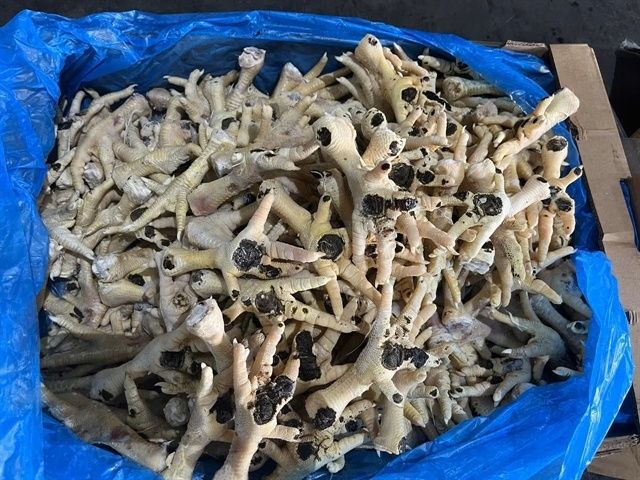
The scope of accumulated contraband became apparent during coordinated raids on cold-storage facilities linked to the smuggling network. Authorities uncovered more than 2,000 metric tonnes of frozen chicken feet stored in warehouses, representing inventory awaiting distribution or already processed for sale. At the An Viet 2 freezer facility located in Hanoi's Quang Minh Industrial Zone, investigators recovered over 1,000 metric tonnes of product. Of particular concern, approximately 260 metric tonnes had expired and exhibited visible deterioration including mold growth and foul odours, yet appeared to have been staged and prepared for ongoing distribution to commercial purchasers. This discovery raises alarming questions about the condition of products already sold to food businesses and consumed by the public.
A subsequent raid at the THL cold-storage warehouse in Lang Son Province, located in the country's northern region, yielded an additional 1,030 metric tonnes of frozen chicken feet. The geographic distribution of storage facilities across multiple provinces illustrates the organised nature of the distribution infrastructure. The investigation has revealed a sophisticated logistics operation designed to mask the true origin and intended purpose of the imported goods, moving products through multiple storage points and intermediaries before final delivery to restaurants and food manufacturers.
The case presents serious implications for food safety and disease prevention throughout Vietnam and potentially across Southeast Asia. The distribution of poultry products from disease-affected regions into domestic consumption chains creates measurable public health risks, particularly regarding avian influenza transmission. Food-service establishments and manufacturing facilities that purchased these products may have unknowingly exposed consumers to foodborne pathogens. Contact tracing and product recalls, if implemented, could prove extremely difficult given the three-year timeframe and the extensive geographic dispersal of affected establishments.
Hanoi police indicate that the investigation remains ongoing, with authorities continuing to identify and evaluate the roles of additional individuals and organisations potentially implicated in the smuggling network. The structure of the operation, involving coordination between import companies, distribution entities, and multiple warehouse facilities, suggests the involvement of numerous personnel beyond the two primary suspects. Investigators are examining whether other company executives, warehouse operators, customs officials, or transportation intermediaries knowingly participated in the scheme or failed in their regulatory duties.
The discovery raises significant questions about the effectiveness of Vietnam's customs enforcement and quarantine procedures. The successful importation and distribution of 10,000 tonnes of contraband poultry products over three years suggests systemic weaknesses in documentation verification, physical inspection protocols, or inter-agency coordination among food safety authorities. International observers and trading partners may view this case as indicative of broader compliance risks in Vietnamese agricultural imports, potentially affecting the nation's trade relationships and food export certifications.
For Malaysian readers and businesses, this case underscores the importance of rigorous supply chain verification when sourcing food products from Vietnam or other regional suppliers. Food importers and restaurants should implement enhanced due diligence regarding the origin of poultry products and the legitimacy of import documentation. The incident also demonstrates how sophisticated smuggling operations can penetrate customs systems and potentially contaminate regional food supplies. Regional food safety coordination mechanisms may require strengthening to prevent similar incidents from affecting multiple Southeast Asian nations simultaneously.