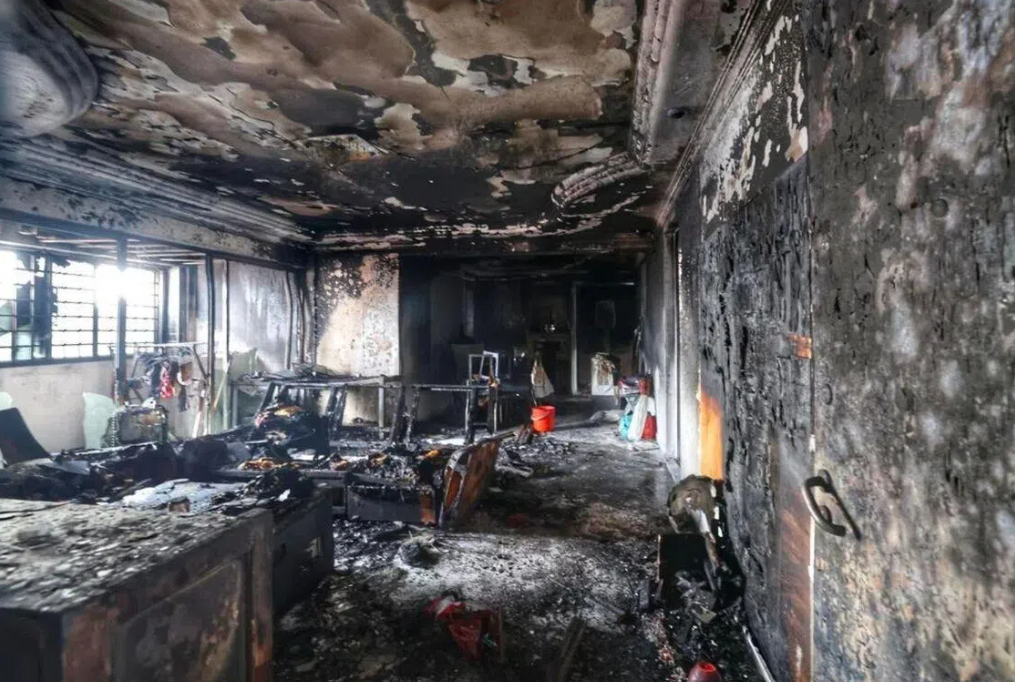
An early morning fire at a 13th-storey Housing and Development Board flat in Singapore's Jurong West district has left two people requiring hospitalisation after dramatic nighttime rescue efforts by emergency services. The blaze erupted at Block 842 Jurong West Street 81 around 3.35am on June 17, with the Singapore Civil Defence Force responding rapidly to contain and extinguish the flames that had engulfed the living room of the residential unit.
When SCDF personnel arrived at the smoke-filled apartment, firefighters had to navigate through dense smoke to reach occupants trapped inside. The responders deployed water jets to suppress the fire, which was ultimately brought under control. Four family members from the affected unit were conveyed to Singapore General Hospital for medical assessment and treatment, while the two individuals who required direct rescue are understood to have sustained burn-related injuries. An additional 40 residents from neighbouring units were evacuated from the block as a precautionary measure to ensure their safety whilst firefighting operations were underway.
Investigations by the SCDF point to an electrical origin in the living room as the likely cause of the fire. This finding aligns with broader fire safety concerns across residential high-rise buildings in Singapore, where faulty electrical systems and improper use of power outlets remain persistent risk factors. The specific circumstances that led to the electrical fault have not been disclosed, but preliminary assessment suggests the incident originated from within the living room rather than external sources.
Accounts from neighbours paint a harrowing picture of the incident's discovery and the heroic actions that likely prevented greater tragedy. An 18-year-old student living directly above the affected unit was awake playing games when he detected smoke filtering upwards through the gaps and windows below his apartment. Demonstrating quick thinking and courage, he immediately went downstairs and began forcefully knocking on neighbours' doors despite finding the entrance extremely hot to touch, urging residents to evacuate the building. He then rushed back home to alert his own family before the situation could deteriorate further.
The young man's mother subsequently contacted police and the SCDF, setting the emergency response in motion. His account also highlighted the severity of injuries sustained by residents in the unit. He recalled that a young woman from the burning apartment appeared at his door asking to borrow towels to treat her father's wounds, her own hair singed and face blackened with soot from the intense heat. Another occupant he observed displayed severe burns across his back and arms, with skin visibly blistered and reddened from thermal injury.
Photographic evidence captured by Lianhe Zaobao journalists who visited the scene around 4pm that same day revealed the extent of damage inflicted by the fire. The unit's interior walls and ceiling bore heavy blackening from smoke and flames, whilst all windows had been shattered, likely from the intense heat or firefighting efforts. The visual devastation underscored how rapidly such fires can spread and intensify within confined residential spaces, particularly in multi-storey buildings where smoke can rise quickly between floors.
Neighbours' observations also provided insight into the scale of the emergency response deployed. A resident on the 12th floor reported seeing at least five fire engines positioned around the base of the block, reflecting the SCDF's commitment to resource allocation for high-rise fire incidents. Such visible presence serves both a functional purpose in fighting the fire and a reassurance function for anxious residents witnessing the emergency unfold.
In response to this incident and broader fire safety concerns, the SCDF has reiterated critical prevention measures for the public. Residents are urged to avoid overloading electrical outlets and to habitually switch off appliances when they are not in active use, particularly devices that generate substantial heat or draw significant electrical current. The agency emphasises the importance of using only appliances and electrical plugs that bear the Safety Mark certification, a credential issued by Singapore's Consumer Product Safety Office to indicate compliance with rigorous safety standards.
Additional warnings focus on battery-powered devices and rechargeable equipment, which pose particular risks when charging is left unattended or sustained over extended periods. The SCDF advises against leaving such devices charging overnight or for long durations, a practice that has contributed to numerous residential fires across Southeast Asia. This guidance reflects growing awareness of lithium-ion battery hazards and the need for consumer vigilance in managing modern household electronics.
The incident arrives amid a concerning upward trajectory in residential fire incidents across Singapore. According to the SCDF's latest annual statistics released in February, the total number of fires increased by 3 per cent from 1,990 in 2024 to 2,050 in 2025. More significantly, residential buildings accounted for more than half of all fires during this period, with 1,051 fires recorded in homes and apartments. This trend underscores the vulnerability of densely housed urban populations and the critical importance of fire prevention practices at household and community levels.
For Malaysian readers, the Singapore incident offers sobering lessons relevant to our own high-density residential environments. Many Malaysian housing estates, particularly older blocks in Kuala Lumpur and other urban centres, share similar structural characteristics and electrical infrastructure challenges as Singapore's HDB flats. The emphasis on proper electrical maintenance, consumer awareness of fire risks, and rapid community response mechanisms applies equally to Malaysian neighbourhoods.
The involvement of an alert teenager in preventing greater harm also highlights the role of community vigilance in fire safety. In Malaysia, where many families live in compact apartments and terrace houses in close proximity, neighbours remaining alert to signs of fire—unusual smells, smoke, sounds of distress—can literally mean the difference between rescue and tragedy. Public education campaigns and fire drills in residential communities, as practised in Singapore, merit consideration for adoption in Malaysian housing schemes.


%22%2F%3E%3C%2Fpattern%3E%3C%2Fdefs%3E%3Crect%20width%3D%22100%25%22%20height%3D%22100%25%22%20fill%3D%22url(%23ph40buhg)%22%2F%3E%3Crect%20width%3D%22100%25%22%20height%3D%22100%25%22%20fill%3D%22url(%23ph40buhp)%22%2F%3E%3Ctext%20x%3D%2250%25%22%20y%3D%2250%25%22%20text-anchor%3D%22middle%22%20dominant-baseline%3D%22central%22%20fill%3D%22rgba(255%2C255%2C255%2C0.95)%22%20font-family%3D%22Georgia%2C%20'Times%20New%20Roman'%2C%20serif%22%20font-weight%3D%22700%22%20font-size%3D%22320%22%20letter-spacing%3D%22-0.02em%22%3EGRS%3C%2Ftext%3E%3C%2Fsvg%3E)