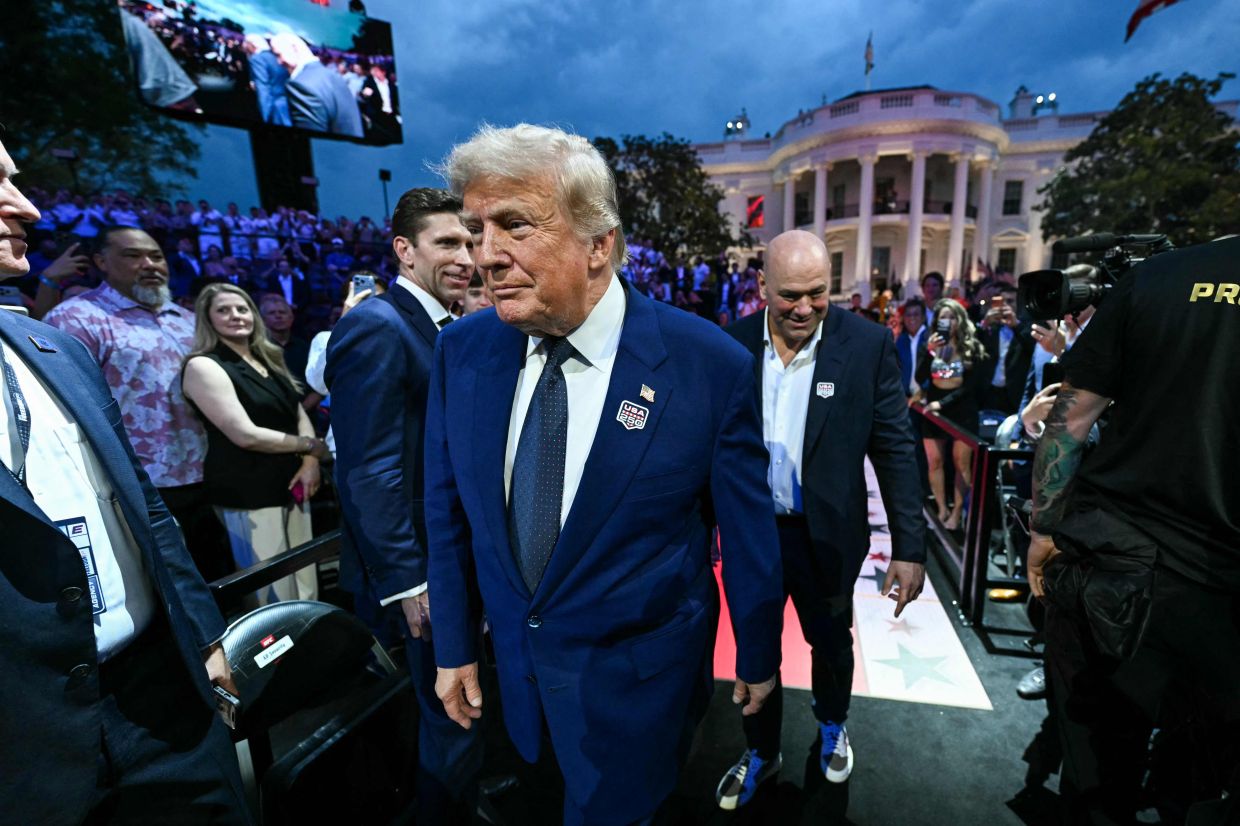
Donald Trump marked his 80th birthday Sunday evening with an unconventional entertainment spectacle on the South Lawn of the White House, hosting a series of Ultimate Fighting Championship bouts that combined the violent intensity of mixed martial arts with the symbolic weight of the nation's most famous residence. The event, which kicked off just before 8:30pm in Washington, represents a significant departure from the traditional decorum typically associated with official White House functions, signalling how thoroughly Trump has reimagined the role of the presidency and its venues.
The fighting matches took place inside a striking architectural structure nicknamed the "Claw," a nearly 100-foot-tall cage arena that dwarfs the White House itself and accommodates 4,300 seated spectators, with an additional estimated 120,000 observers expected to watch from the nearby Ellipse via free lottery-distributed tickets. The sheer scale of the installation, which Trump suggested in a TikTok video might warrant permanent placement, reflects the ambition and theatricality that has become the hallmark of his political style. The administration later clarified that dismantling of the structure would commence at 10am Monday, though Trump's initial musing about permanence sparked considerable discussion about the transformation of America's most symbolically important grounds.
The gathering drew a notably eclectic assemblage of power brokers and cultural figures, including Meta Platforms CEO Mark Zuckerberg, Paramount Skydance CEO David Ellison, Treasury Secretary Scott Bessent, and members of Trump's immediate family. Podcast host Joe Rogan, whose platform has cultivated substantial influence among younger male voters who constituted a key demographic in Trump's 2024 election victory, provided live commentary throughout the evening. The inclusion of active-duty military personnel and Medal of Honor recipients, along with televised coverage extending to military bases including Okinawa, underscored an effort to frame the event as patriotic celebration rather than mere entertainment.
The UFC connection runs deeper than surface-level spectacle, reflecting a deliberate cultivation of the sport's devoted fan base. The Ultimate Fighting Championship, owned by TKO Group Holdings Inc., attracts a predominantly young male audience that overwhelmingly supported Trump during his recent election campaign. In recognition of this alignment, his administration has moved swiftly to formalize the relationship, with both the State Department and Federal Bureau of Investigation establishing formal partnership agreements with the organization. This institutionalisation of what was historically a fringe sport demonstrates how the Trump administration intends to reshape official relationships around cultural touchstones that resonate with core supporters.
Despite the star-studded attendance and official embrace, the event encountered substantial public resistance. A June 5 YouGov poll revealed that 51 percent of surveyed Americans disapproved of hosting the fights at the White House, while merely 27 percent expressed approval, suggesting that the president's celebration strategy does not command widespread endorsement across the broader electorate. The Public Integrity Project filed legal action characterising the event as a "volcano of corruption," arguments that proved unsuccessful in court but nonetheless highlighted concerns about the commingling of commercial entertainment, government resources, and presidential celebration.
The financial architecture surrounding the event further illustrates the entanglement of private enterprise and official functions. UFC reportedly invested over US$60 million to stage the Sunday fights, covering all direct costs according to White House assertions, though more than seven federal agencies allocated "significant resources and manpower" to the production, according to court filings. While UFC President Dana White publicly characterised the event as a financial loss for the organisation, other company executives suggested different revenue calculations. The Trump-family venture World Liberty Financial contributed an additional US$250,000 in bonus payments to the top two fighters, blending family business interests with the official celebration.
Sponsor participation further illustrated the commercial dimensions of the spectacle. The UFC Freedom 250 website listed major brands including Crypto.com and Dodge's Ram truck division, transforming a presidential birthday celebration into a vehicle for corporate brand amplification. This arrangement reflects how modern political events increasingly function as marketing platforms, with commercial entities gaining unprecedented access to audiences assembled under official auspices. The calculation of exposure value against promotional benefit reveals the sophisticated commercial machinery now operating within the framework of presidential activities.
The venue transformation itself represented a dramatic departure from historical precedent. The South Lawn has traditionally hosted ceremonial events of carefully measured formality, including the annual Easter Egg Roll and Congressional Picnic. Former President Joe Biden erected a temporary ice rink, yet even that modest installation pales against the architectural dominance of the Claw arena. The structure's assertion of physical presence on the landscape, towering above the iconic residence itself, symbolises a fundamental recalibration of how executive power expresses itself through the nation's symbolic spaces. This visual domination extends beyond mere aesthetics to suggest competing visions about appropriate use of public grounds.
The promotional framing connected the birthday celebration to a broader commemorative agenda. Trump positioned the event as part of the nation's 250th anniversary celebrations, a narrative thread that includes a commemorative gold coin bearing his likeness, an extensive fair planned for the National Mall, and an August IndyCar race through Washington streets. This framework attempts to elevate personal celebration into patriotic observance, merging individual milestone recognition with national historical commemoration in ways that blur boundaries between private and public domains.
The event's timing carries additional diplomatic significance, with Trump departing immediately afterward for France to meet with Group of Seven leaders, reportedly carrying a UFC championship belt as part of his baggage. The juxtaposition of the White House fighting spectacle against imminent serious international negotiations with allied nations underscores the unpredictable tone-setting that characterises Trump's approach to the presidency. Regional implications for Southeast Asia and Malaysia remain indirect but significant: the demonstrated influence of unconventional entertainment on American political culture, combined with Trump's embrace of direct engagement with corporate interests previously considered marginal to official statecraft, suggests an administration willing to fundamentally restructure traditional diplomatic and cultural protocols in ways that could reverberate across international relationships and alliance structures.
%22%2F%3E%3C%2Fpattern%3E%3C%2Fdefs%3E%3Crect%20width%3D%22100%25%22%20height%3D%22100%25%22%20fill%3D%22url(%23ph40buhg)%22%2F%3E%3Crect%20width%3D%22100%25%22%20height%3D%22100%25%22%20fill%3D%22url(%23ph40buhp)%22%2F%3E%3Ctext%20x%3D%2250%25%22%20y%3D%2250%25%22%20text-anchor%3D%22middle%22%20dominant-baseline%3D%22central%22%20fill%3D%22rgba(255%2C255%2C255%2C0.95)%22%20font-family%3D%22Georgia%2C%20'Times%20New%20Roman'%2C%20serif%22%20font-weight%3D%22700%22%20font-size%3D%22320%22%20letter-spacing%3D%22-0.02em%22%3EGRS%3C%2Ftext%3E%3C%2Fsvg%3E)