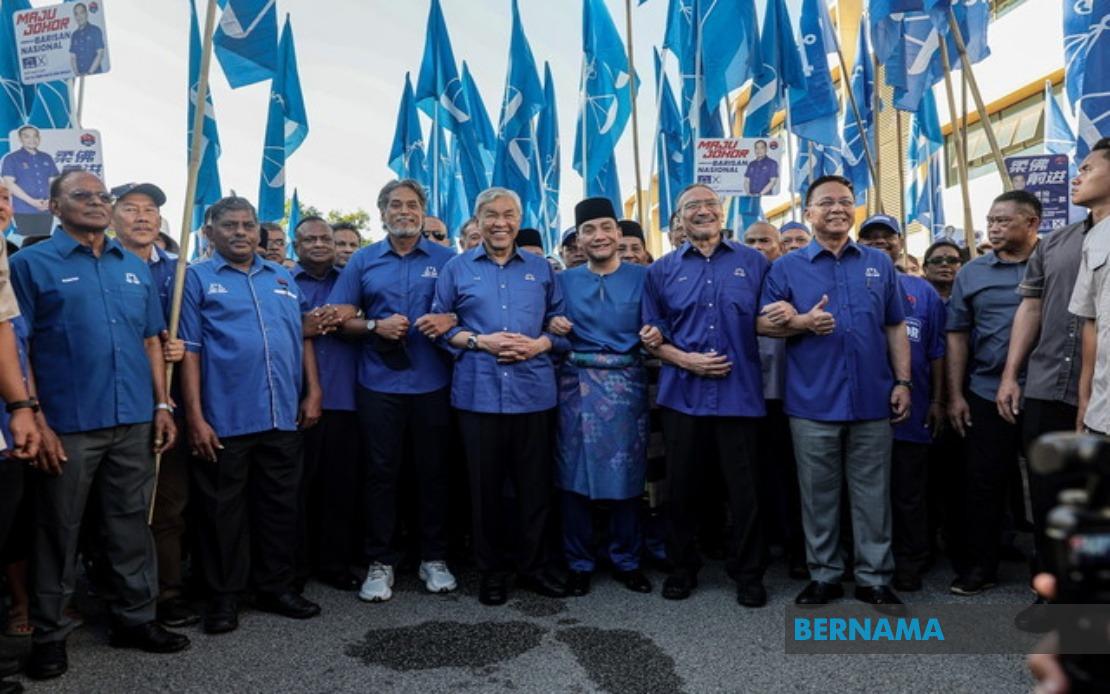
The Johor Barisan Nasional machinery displayed a show of force and cohesion on June 27 when coalition chairman Datuk Onn Hafiz Ghazi submitted his nomination papers for the state election. Arriving at the Muafakat Hall in Simpang Renggam District Council at 9.10 am, the incumbent Machap state assemblyman came flanked by some of the party's most influential figures, underscoring the significance of his candidacy to UMNO's broader electoral strategy in the southern state.
The prominent delegation accompanying Onn Hafiz sent a clear message about party priorities and internal alignment. UMNO president Datuk Seri Dr Ahmad Zahid Hamidi, who carries substantial weight within the party machinery, made the journey to witness the filing personally. His presence signalled presidential-level endorsement for Onn Hafiz's campaign and reflected the central party leadership's investment in the election outcome. Alongside him were Sembrong MP Datuk Seri Hishammuddin Tun Hussein and Khairy Jamaluddin, both experienced political operators whose attendance indicated cross-generational party support for the nominee.
The inclusion of former Johor Menteri Besar Datuk Seri Hasni Mohammad in the entourage carried particular symbolic weight. As a predecessor in state leadership, his endorsement demonstrated continuity within Johor's political establishment and highlighted the transition of power and influence within the coalition structure. Such carefully orchestrated displays of unity are rarely accidental in Malaysian politics and typically reflect extensive coordination among senior party figures to project strength during crucial electoral moments.
The nomination filing itself occurred within the formal framework established for the 16th Johor state election, a poll that carries significance beyond state-level politics. Johor remains one of Malaysia's most politically consequential states, both demographically and strategically. Control of the state assembly directly influences the configuration of federal-level power dynamics and the broader narrative around which coalition commands grassroots support across the country.
What unfolded at the nomination centre extended beyond the formal submission of papers. Supporters had gathered in numbers around the Simpang Renggam District Council venue, creating an impromptu display of partisan enthusiasm. Dressed in party colours and carrying banners and flags, these supporters represented the grassroots mobilisation that undergirds electoral campaigns. Such scenes are common during nomination filing periods but serve an important psychological function—they reinforce to observers, media, and other political actors that the candidate and their party possess active supporter networks prepared to campaign.
The visible party colours and campaign paraphernalia scattered throughout the venue created a backdrop that local media documented and transmitted to broader audiences. In Malaysia's competitive electoral environment, these visual elements become part of the narrative surrounding a candidate's electoral prospects. The crowd's composition and enthusiasm level become fodder for post-filing analysis among political observers seeking to assess momentum and support levels.
Onn Hafiz's nomination as an incumbent assemblywoman seeking reelection carries particular implications for Barisan Nasional's broader strategy in Johor. As the Machap representative, he would be defending an existing seat rather than attempting to capture new territory. Incumbent seats represent significant assets in any election, combining the advantage of name recognition, existing constituent relationships, and the ability to point toward legislative accomplishments during the previous term.
The timing of the nomination filing and the deliberate assembly of senior leadership figures reflected broader electoral calculations within UMNO and Barisan Nasional regarding resource allocation and messaging. High-profile figures do not typically attend routine nomination submissions unless the party regards a particular contest as strategically important or the candidate as a priority for leadership attention. The investment of Ahmad Zahid Hamidi's personal time and political capital suggested Onn Hafiz's seat held more than local significance.
For Malaysian political observers, particularly those tracking Johor developments, the composition of the delegation provided readable signals about internal party dynamics. The presence of figures from different factional orientations within UMNO—should such divisions exist—might suggest efforts toward unity in the face of electoral competition. Alternatively, the carefully curated group might reflect leadership preferences regarding visible party unity during a campaign period when internal divisions could undermine electoral performance.
The Simpang Renggam nomination process represented just one moment within the broader electoral calendar, yet the gathering of top-tier UMNO and Barisan Nasional figures transformed a routine administrative exercise into a political statement. Such nominations typically occur across numerous constituencies over a defined filing period, each generating their own dynamics. However, when senior national leadership allocates time to attend a specific filing, it communicates priority and confidence in both the candidate and the electoral prospects.
Moving forward, the campaign that follows this nomination will test whether the visible unity and leadership support translates into electoral success. The constituency of Machap and the broader Johor electorate will ultimately determine whether Onn Hafiz's reelection bid succeeds. Nevertheless, the demonstrated backing from Ahmad Zahid Hamidi and other senior figures has already created a preliminary narrative suggesting Barisan Nasional considers this contest winnable and worthy of resource investment, a calculation that itself shapes subsequent campaign dynamics and supporter expectations throughout the election period.

