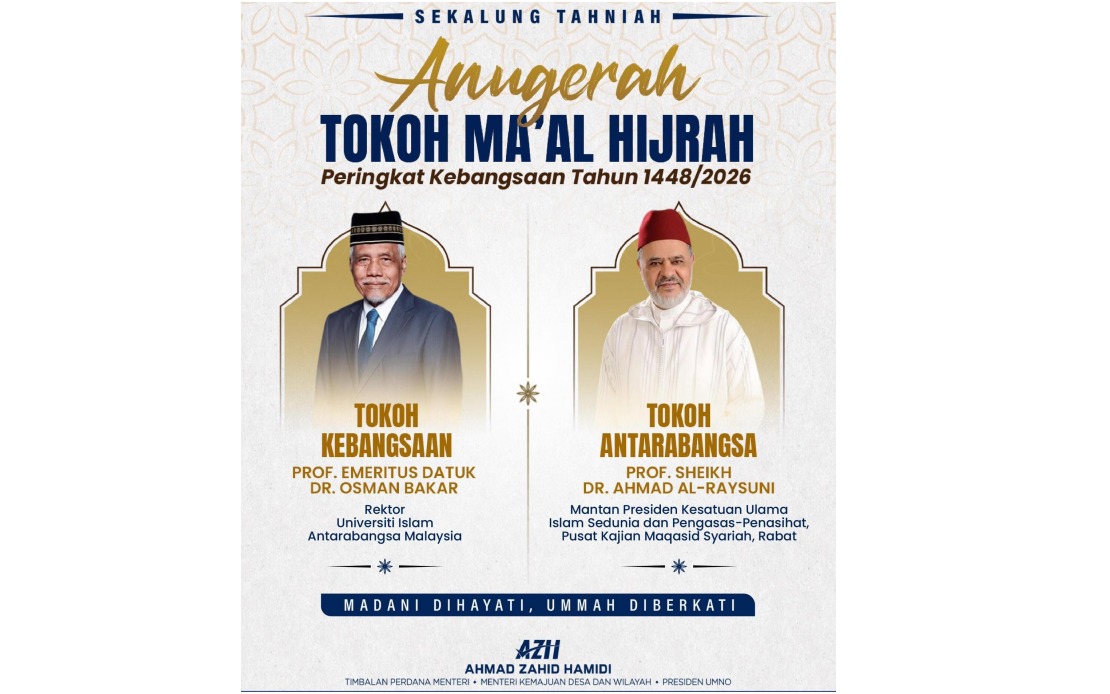
Malaysia's Deputy Prime Minister Datuk Seri Dr Ahmad Zahid Hamidi has urged the nation's Muslim community to view the accomplishments of this year's Tokoh Maal Hijrah award recipients as a model for personal and collective development, stressing that their recognition should motivate broader efforts towards knowledge-seeking, community engagement and the advancement of Islamic civilisation.
The two recipients—Prof Emeritus Datuk Dr Osman Bakar, who claimed the national award, and Prof Sheikh Dr Ahmad Al-Raysuni from Morocco, who received the international honour—were selected during the national-level Maal Hijrah celebration held at Masjid Putra in Putrajaya. The Sultan of Perak, Sultan Nazrin Shah, formally conferred the awards alongside cash prizes, trophies and certificates of appreciation.
In his remarks shared via social media, Ahmad Zahid highlighted the profound impact both recipients have exerted in strengthening the Muslim community, elevating scholarly standards and disseminating Islamic values characterised by compassion, intellectual rigour and tangible benefit to society. The deputy prime minister framed their achievements as exemplars of the kind of contribution the ummah requires in contemporary times, particularly as Muslim-majority societies navigate complex developmental challenges.
Ahmad Al-Raysuni, a prominent Islamic jurisprudence specialist based in Morocco, brings significant international standing to the award, underscoring Malaysia's recognition of Islamic scholarship beyond its borders. His selection reflects a deliberate effort to celebrate Muslims globally who have advanced Islamic thought and practice in meaningful ways. The inclusion of an international laureate alongside a domestic honouree broadens the award's scope and reinforces the transnational character of Islamic knowledge production and community building.
Simultaneously, fellow Deputy Prime Minister Datuk Seri Fadillah Yusof echoed similar sentiments, emphasising that the awards should galvanise all Malaysians—not merely Muslims—to sustain their dedication to public service and national progress. Fadillah's framing extended the relevance of the recipients' work beyond the Islamic sphere, positioning their contributions as integral to Malaysia's wider developmental agenda.
Crucially, Fadillah recontextualised the concept of Maal Hijrah itself, moving beyond its conventional historical reading as the Prophet Muhammad's migration from Mecca to Medina. Instead, he presented it as an enduring philosophical framework embodying sacrifice, collective cohesion, forbearance and unwavering commitment to constructive transformation. This interpretive approach demonstrates how traditional Islamic concepts continue to inform contemporary Malaysian governance narratives and policy rhetoric.
The deputy prime minister called for sustained endeavours to strengthen national unity, deepen religious faith and expand charitable undertakings in service of both the ummah's welfare and Malaysia's national prosperity. His statements reflect a broader Malaysian political discourse that intertwines Islamic values with secular developmental objectives, a balancing act characteristic of governance in a Muslim-majority multireligious democracy.
For Malaysian readers, the awards carry particular significance given the country's position as a centre of Islamic learning and governance in Southeast Asia. The recognition of Osman Bakar, an accomplished academic and intellectual figure within Malaysia, underscores the nation's capacity to produce scholars of international calibre. His achievement serves as a benchmark for excellence within Malaysian Islamic academia and demonstrates pathways through which intellectual rigour and community engagement can intersect productively.
The timing of this recognition also reflects Malaysia's ongoing efforts to position itself as a bridge between Islamic scholarship and contemporary governance challenges. By celebrating individuals who have dedicated themselves to elevating knowledge standards and spreading Islamic values across diverse contexts, the awards implicitly endorse a vision of Islam that embraces intellectual inquiry, social progress and inclusive community development rather than insularity or doctrinal rigidity.
The Tokoh Maal Hijrah awards programme itself represents a strategic investment in recognising and incentivising excellence within Islamic fields across Malaysia and the broader Muslim world. By conferring high-profile national recognition—complete with monetary prizes and formal state participation—the Malaysian government signals its commitment to supporting scholarship, thought leadership and community contributions aligned with Islamic principles.
For the broader Southeast Asian context, these awards highlight how Malaysia continues to assert intellectual and cultural leadership within the region's Islamic sphere. The selection of international recipients demonstrates a commitment to recognising excellence wherever it flourishes, strengthening Malaysia's standing as a credible arbiter of Islamic scholarly achievement rather than a parochial centre focused solely on domestic accomplishment.
Both deputy prime ministers' statements stress continuity and ongoing commitment rather than one-off celebration. Their calls for sustained knowledge-seeking, community service and values-based development suggest that the awards function not merely as ceremonial recognition but as catalysts for broader institutional and individual transformation. This perspective positions each year's recipients as exemplars whose work should inform ongoing policy priorities and public engagement strategies.
Ultimately, the awards ceremony and subsequent political commentary reveal how Malaysia's leadership consciously leverages Islamic concepts and scholarly recognition to advance simultaneously its religious, educational and national development agendas, while also fostering regional intellectual networks and cross-border collaboration within the Muslim world.

%22%2F%3E%3C%2Fpattern%3E%3C%2Fdefs%3E%3Crect%20width%3D%22100%25%22%20height%3D%22100%25%22%20fill%3D%22url(%23ph40buhg)%22%2F%3E%3Crect%20width%3D%22100%25%22%20height%3D%22100%25%22%20fill%3D%22url(%23ph40buhp)%22%2F%3E%3Ctext%20x%3D%2250%25%22%20y%3D%2250%25%22%20text-anchor%3D%22middle%22%20dominant-baseline%3D%22central%22%20fill%3D%22rgba(255%2C255%2C255%2C0.95)%22%20font-family%3D%22Georgia%2C%20'Times%20New%20Roman'%2C%20serif%22%20font-weight%3D%22700%22%20font-size%3D%22320%22%20letter-spacing%3D%22-0.02em%22%3EGRS%3C%2Ftext%3E%3C%2Fsvg%3E)