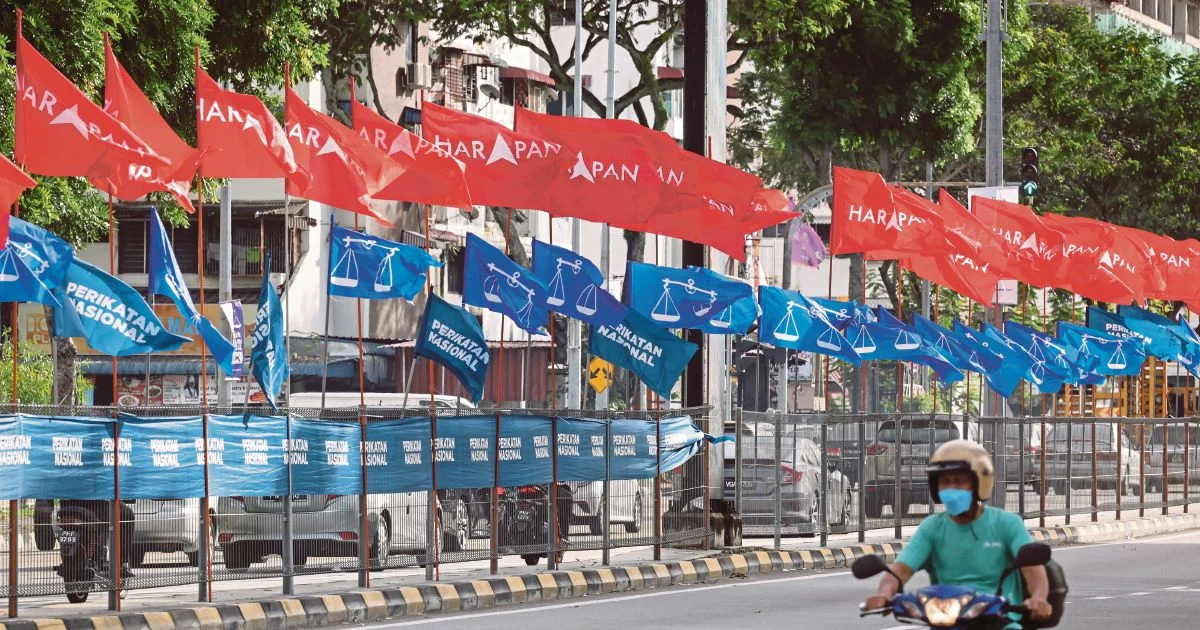
The electoral landscape in Johor is shaping up for a historically competitive showdown as three major political coalitions prepare to contest nearly 60 percent of the state's legislative seats simultaneously. Barisan Nasional, Pakatan Harapan and Perikatan Nasional have all confirmed their participation in the upcoming Johor state election, with projections indicating that all three will go head-to-head in 33 of the 56 available seats across the southern state. The concentration of three-cornered contests signals an exceptionally fragmented political environment, marking a departure from previous electoral cycles when Johor witnessed more straightforward two-way battles.
The emergence of three-way competition across nearly half of Johor's constituencies reflects the fundamental realignment of Malaysian politics following the 2022 general election and subsequent political developments. Perikatan Nasional's strengthened position after its strong showing in the 15th federal election has emboldened the coalition to mount aggressive campaigns throughout Johor, traditionally viewed as a Barisan Nasional stronghold. Simultaneously, Pakatan Harapan's consolidation under its five-party structure means the coalition arrives at Johor polls with greater unity than in previous state contests, creating a genuine three-way competitive dynamic that campaign strategists across all three coalitions must now navigate.
For Barisan Nasional, defending its dominance in Johor represents a critical test of organizational strength and grassroots mobilization capacity. The coalition has governed Johor continuously since Malaysia's independence, and the state remains a crucial economic and political powerhouse within the federation. However, the presence of competing campaigns on 33 fronts simultaneously poses logistical and financial challenges that will strain BN's resources across multiple constituencies. The coalition's ability to maintain support while facing simultaneous pressure from both Pakatan Harapan and Perikatan Nasional will offer crucial insights into BN's electoral viability heading toward the next federal election.
Pakatan Harapan's participation in such a high number of three-way contests carries its own strategic complexities. The coalition's federal government experience and policy platform provide ideological differentiation, yet competing in 33 seats where victory margins might prove narrow due to vote splitting creates inherent risks. The composition of Johor's electorate—spanning urban centers, industrial zones and rural constituencies—means Pakatan Harapan must craft messaging that resonates simultaneously with different demographic groups while withstanding the organizational resources both Barisan Nasional and Perikatan Nasional can deploy.
Perikatan Nasional's aggressive contestation across 33 seats underscores the coalition's determination to establish a permanent presence in Johor politics beyond its traditional strongholds in the north. The coalition's combined organizational capacity from its constituent parties, particularly UMNO splinter elements and Islamic-oriented formations, provides a foundation for challenging in marginal constituencies. However, achieving meaningful breakthroughs in seats controlled by Barisan Nasional requires translating electoral rhetoric into effective ground operations and persuading Johor voters to shift allegiances—a task considerably more demanding than consolidating existing support bases.
The concentration of three-cornered contests across 33 constituencies carries significant implications for electoral outcomes across the state. Vote fragmentation becomes a dominant mathematical factor when three organized campaigns compete simultaneously for the same pool of voters. Constituencies that might have shown clear preference patterns in binary contests now enter complex terrain where victory might hinge on comparatively modest vote margins. This creates unpredictability that polling and prediction exercises must grapple with, as historical voting patterns offer limited guidance when the competitive configuration changes so fundamentally.
Regionally, Johor's election assumes importance extending beyond state boundaries. The state's geographic position as Malaysia's southern gateway, its economic significance as a manufacturing and logistics hub, and its substantial population make electoral outcomes here resonant across neighboring Selangor and the federal territories. Moreover, Johor has historically served as a testing ground for broader political trends, and a three-way contest of this scale provides early indicators of how Malaysian voters are responding to the reconfigured political landscape established since 2022.
For ethnic and religious communities within Johor, the three-way competition introduces new dimensions to representation and advocacy. The presence of multiple coalitions offering competing platforms on education, religious affairs, economic policy and social welfare means community leaders must evaluate which coalition's approach aligns with constituent interests. This expanded choice could enhance democratic representation but also risks dividing previously consolidated voting blocs if community preferences fragment across multiple coalitions.
The financial dimension of contesting 33 three-way races cannot be understated. Campaign spending across constituencies, candidate recruitment and organizational deployment require substantial resources that all three coalitions must mobilize. For smaller parties within each coalition, contributing meaningfully to 33 separate contests demands capacity that not all component organizations possess, potentially creating internal coalition tensions as stronger parties dominate nominations and resource allocation.
Electoral observers and political analysts across Southeast Asia will monitor Johor's contest closely as a barometer of Malaysian democratic vitality. The sophistication with which three major coalitions manage simultaneous campaigns, communicate distinct visions and compete for voter support reflects the maturity of Malaysia's democratic processes. Johor's election will test whether Malaysian voters can effectively evaluate competing platforms and make informed choices when faced with genuine three-way contestation across so much of the state's electoral map.
As candidates finalize their preparations and nominations proceed toward the official election date, the fundamental question confronting all three coalitions remains unchanged: which combination of organizational capacity, policy messaging, community connections and voter mobilization will prove decisive when nearly 60 percent of Johor's electorate faces three serious competitive choices in their respective constituencies. The answer will reshape Johor's political trajectory and offer crucial insights into Malaysia's broader political future.

