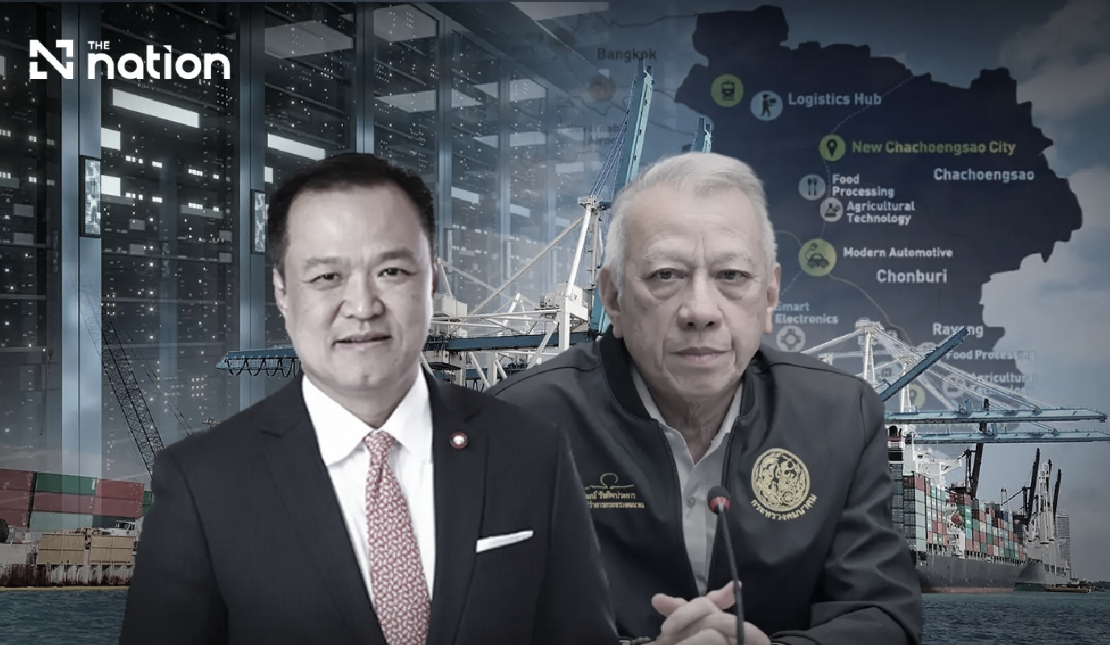
Thailand's Prime Minister Anutin Charnvirakul has taken direct operational command of the country's Eastern Economic Corridor, signalling a fundamental strategic shift in how the kingdom intends to market itself to foreign investors. The transfer of authority, which stripped Deputy Prime Minister and Transport Minister Phiphat Ratchakitprakarn of his supervisory role over the EEC, was formalised through Prime Minister's Office orders signed on June 15 and immediately took effect. This restructuring represents more than a routine administrative reshuffle; it reflects Bangkok's recognition that the corridor's traditional positioning as a heavy manufacturing hub no longer suffices in an era of rising resource constraints and evolving global supply chains.
Anutin's decision to personally lead the EEC initiative positions him as the figurehead responsible for attracting multinational investment and presenting Thailand's development narrative to international audiences. The Prime Minister intends to leverage the EEC as Thailand's primary calling card when pitching projects to foreign investors, a role that underscores the government's commitment to making this initiative a centrepiece of its economic policy. By taking direct control, Anutin signals that EEC revitalisation falls within his personal portfolio and reflects his vision for Thailand's economic trajectory. This level of prime ministerial engagement typically indicates that the government views the corridor as strategically vital to broader national objectives.
The catalyst for repositioning the EEC centres on recognising that traditional heavy industry development faces mounting operational hurdles. Both electricity and water supply constraints have created cost barriers that make the corridor less attractive as a manufacturing destination compared to competing regional sites. These resource limitations have forced policymakers to acknowledge that relying primarily on industrial production—the corridor's foundational purpose—no longer represents viable long-term strategy. Rather than attempting to expand infrastructure capacity, which would require massive capital investment and take years to implement, the government has opted for a lateral strategic move: presenting the same geographic asset through different sectoral lenses that better align with contemporary global priorities.
Food security has emerged as a cornerstone of the EEC's reinvention, reflecting both regional strengths and global market dynamics. Thailand's eastern provinces possess established competitive advantages in livestock production, fisheries operations, agricultural cultivation, and horticultural export. The government's assessment recognises that food security has become an increasingly prominent concern for governments worldwide, particularly in developed nations facing demographic pressures and supply chain vulnerabilities exposed by recent global disruptions. By positioning the EEC as a reliable hub for food production and processing, Bangkok aims to attract investment from countries seeking to diversify their agricultural supply sources and secure long-term food availability. This pivot leverages existing capabilities rather than attempting to build entirely new industrial capacity.
Data centre development represents the second pillar of the EEC's rebranding, addressing a global industry segment experiencing explosive growth. The cryptocurrency boom, artificial intelligence expansion, and cloud computing proliferation have created unprecedented demand for computing infrastructure facilities. Data centres generate substantial employment, require minimal land area relative to their economic output, and attract high-value technology companies seeking locations with reliable power and connectivity. Thailand's location within Southeast Asia positions it strategically for serving the broader regional market, while relative political stability and developed telecommunications infrastructure offer advantages over alternatives. The government has recognised this opportunity and begun structural preparations to accommodate the sector's requirements.
To facilitate data centre expansion, Thailand's Energy Ministry has begun implementing regulatory frameworks specifically designed for the sector. The creation of electricity user category Type 9 represents a targeted approach to managing data centres' exceptional power demands. Facilities classified under this category will pay premium electricity tariffs reflecting their consumption levels, ensuring that power costs are transparently allocated and that investment decisions incorporate realistic operational expenses. This regulatory clarity provides the certainty that multinational data centre operators require when evaluating deployment locations. By establishing a dedicated tariff category rather than forcing data centres into existing user classifications, the government demonstrates understanding of the sector's distinctive characteristics.
Phiphat's relinquishment of EEC authority followed discussions between the Deputy Prime Minister and Anutin, according to government sources, though the circumstances surrounding the decision merit close examination. Official statements insisted that no political conflict precipitated the restructuring, and that Phiphat himself proposed returning the portfolio to prime ministerial control due to persistent friction between the EEC Office and the Board of Investment. However, Phiphat's public comments indicated he received no advance notification of the orders, which were simply read aloud during the Cabinet meeting for acknowledgement. This procedural detail suggests potential coordination challenges or communication gaps within the executive leadership. The explanation that Phiphat voluntarily surrendered authority due to coordination challenges requires careful scrutiny, as such characterisations sometimes mask more complex power dynamics within government coalitions.
The timing and framing of the EEC transfer may obscure deeper administrative tensions. The government explicitly denied that the reshuffle reflected disputes over the long-delayed three-airport high-speed rail project, a contentious initiative where Phiphat had taken positions on contract modification that potentially diverged from prime ministerial preferences. This preemptive denial actually draws attention to the topic it claims to dismiss. The rail project, which has languished since a concession agreement with Asia Era One in 2019, has generated sustained controversy over proposed amendments to the payment model. Phiphat previously resisted shifting from a traditional build-then-pay arrangement to a staged payment model tied to construction progress. By simultaneously denying that EEC control and rail project disputes are connected, while simultaneously explaining that Anutin personally ordered that the contract not be amended, government sources inadvertently highlight the potential intersection between these issues.
Questioning around a proposed Disneyland development within the EEC further illustrates the philosophical differences emerging between leadership figures. Anutin reportedly questioned whether the project would actually materialise, citing the absence of feasibility studies demonstrating that potential returns would justify the required investment. This scepticism represents prudent fiscal governance, questioning whether tourism-oriented megaprojects generate sufficiently attractive returns for public sector involvement. The fact that the Prime Minister raised these concerns suggests that previous EEC oversight had pursued projects without similarly rigorous economic evaluation. The repositioning under Anutin's control implies that future EEC development will receive more stringent return-on-investment scrutiny and that projects must demonstrate genuine economic viability rather than simply possessing headline appeal.
For Malaysia and the broader Southeast Asian region, Thailand's EEC repositioning carries competitive implications. As a CLMV-adjacent economy with established infrastructure advantages, Thailand's efforts to attract food security and data centre investment will create competition for similar projects across the region. Malaysian policymakers should note that Thailand is actively rebranding underutilised regional assets through sectoral diversification rather than accepting regional decline. This approach mirrors strategies that successful development corridors employ when facing structural constraints. Southeast Asia's interconnected supply chains mean that any significant shift in where multinational companies locate food processing or computing infrastructure affects regional distribution patterns. The success of Thailand's repositioning will depend heavily on execution capacity and whether the government can deliver the promised infrastructure reliability and regulatory clarity that multinational investors demand.
The reframing also reflects broader recognition that development corridors cannot rely indefinitely on static sectoral positioning. As regional labour costs rise and environmental standards tighten, traditional heavy manufacturing becomes less viable in emerging markets. Successful corridors must evolve toward higher-value activities and sectors aligned with global megatrends. Thailand's pivoting toward food security and data centres demonstrates understanding that competitive advantage derives from addressing contemporary global priorities rather than pursuing yesterday's industrial models. This strategic flexibility may prove more important than specific sectoral choices. The success of Anutin's EEC initiative will ultimately hinge on whether this repositioning translates into actual investment flows, measurable employment creation, and genuine economic growth for Thailand's eastern provinces.

%22%2F%3E%3C%2Fpattern%3E%3C%2Fdefs%3E%3Crect%20width%3D%22100%25%22%20height%3D%22100%25%22%20fill%3D%22url(%23ph40buhg)%22%2F%3E%3Crect%20width%3D%22100%25%22%20height%3D%22100%25%22%20fill%3D%22url(%23ph40buhp)%22%2F%3E%3Ctext%20x%3D%2250%25%22%20y%3D%2250%25%22%20text-anchor%3D%22middle%22%20dominant-baseline%3D%22central%22%20fill%3D%22rgba(255%2C255%2C255%2C0.95)%22%20font-family%3D%22Georgia%2C%20'Times%20New%20Roman'%2C%20serif%22%20font-weight%3D%22700%22%20font-size%3D%22320%22%20letter-spacing%3D%22-0.02em%22%3EGRS%3C%2Ftext%3E%3C%2Fsvg%3E)