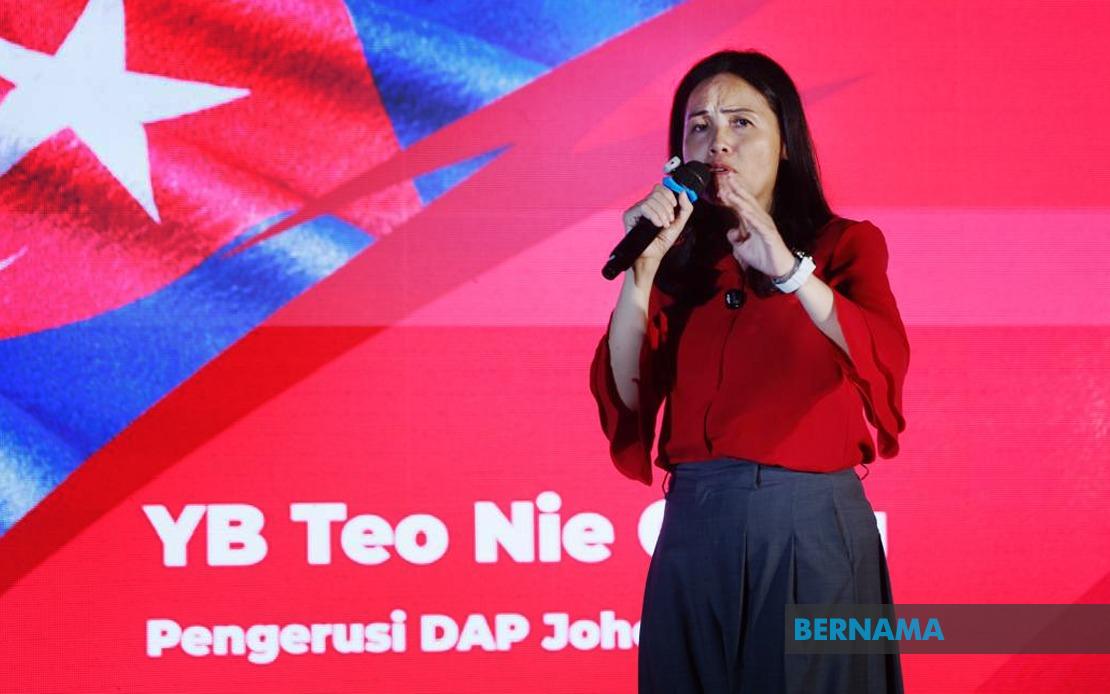
At a Pakatan Harapan rally in Paloh tonight, Johor DAP chairman Teo Nie Ching mounted a direct challenge to her state government's decision to create appointed state assemblymen positions, expressing reservations about how such appointments might compromise the integrity of Malaysia's democratic processes. The criticism from Teo, who doubles as National DAP Wanita chairman and Deputy Communications Minister, strikes at the heart of ongoing debates about representation and accountability within state legislatures across Malaysia.
Teo's concerns centre on the fundamental question of whether appointed positions can truly serve the public interest when their occupants have not undergone the electoral scrutiny that voters ordinarily impose. She argued that allowing administrators to select assemblymen without democratic ratification creates potential pathways for patronage and reduces the transparency that citizens expect from government institutions. This line of argument carries particular weight in Malaysian politics, where public confidence in institutions has been uneven and demands for accountability have grown louder in recent years.
Speaking during a campaign event for Paloh state constituency, Teo pressed the state administration for clearer explanations about the intended purpose of these appointed positions. She posed pointed questions about the selection criteria and beneficiaries, hinting at broader concerns about how political alliances—particularly the substantial support PAS provided during the recent state election—might influence appointment decisions. The implicit suggestion that appointed positions could function as a form of political reward or coalition maintenance underscores anxieties about whether such mechanisms serve systemic needs or factional interests.
The Johor State Legislative Assembly formally endorsed the appointment mechanism on May 7 when it passed amendments allowing for up to five assemblymen to be appointed rather than elected. State authorities framed this measure as a means to strengthen the assembly's overall composition and functional capacity, yet the practical implications remain contested among opposition politicians and civil society observers. Malaysia's state assemblies operate within constitutional frameworks that generally privilege democratic election, making such departures worthy of scrutiny from both principled and pragmatic perspectives.
Despite her criticism of the appointment mechanism, Teo used the Paloh rally to defend the broader track record of the Unity Government at federal level, arguing that meaningful structural reforms have been implemented through the Malaysia MADANI agenda despite inevitable imperfections. She acknowledged that no administration can claim perfection, yet insisted that tangible improvements have materialised through systematic efforts rolled out across multiple government terms and departments. This position reflects DAP's balancing act within the federal coalition, where the party must simultaneously maintain credibility as a reform advocate while defending its participation in the government.
Among the achievements Teo highlighted were guarantees that all SPM students achieving ten A grades would secure matriculation places regardless of their socioeconomic background, a policy that removes a historical barrier to tertiary progression for high-performing students from lower-income households. Additionally, the government has expanded educational opportunities for students with Unified Examination Certificate qualifications, broadening pathways for those educated in vernacular systems. These moves carry particular resonance within Chinese Malaysian communities, which have historically invested heavily in education as a mechanism for social mobility.
Funding for Chinese independent schools received particular emphasis in Teo's remarks, with allocations rising to RM20.16 million in the current year compared to RM12 million during the previous administration's final year. This substantial increase reflects political commitments made to vernacular education constituencies and demonstrates how resource allocation can signal governmental priorities. For Malaysian education stakeholders monitoring federal-state coordination on school funding and autonomy, such figures provide indicators of systemic commitment to pluralistic educational provision.
Teo characterised these reforms as investments in institutional capacity and social equity rather than mere electoral promises, framing them within longer-term nation-building objectives. She emphasised that democratic reform operates as a gradual process requiring sustained effort across multiple election cycles and policy domains, inviting voters to view the 2026 general election not as a referendum on instantaneous transformation but as an opportunity to maintain momentum toward systemic improvement. This narrative attempts to manage voter expectations while rallying support for continued Unity Government participation.
The Johor state election scheduled for Saturday will determine representation across 56 state constituencies, with approximately 2.7 million registered voters expected to participate. The election serves as a significant early test of voter sentiment in one of Malaysia's most politically dynamic states, where transitions between different ruling coalitions have occurred within recent election cycles. Results will provide indicators of how constituencies respond to both state-level governance records and federal administration performance.
Teo's simultaneous criticism of the appointed assemblymen mechanism and defence of Unity Government achievements illustrates the complex positioning required of coalition partners attempting to maintain distinct party identities while defending collective governance records. The tension between advocating for democratic strengthening and participating in government structures that may constrain electoral competition reflects broader challenges facing Malaysia's political system as it negotiates between institutional innovation and democratic principle.

