Tengku Datuk Seri Aishah, the elder sister of Pahang's reigning monarch Al-Sultan Abdullah Ri'ayatuddin Al-Mustafa Billah Shah, was interred at the Royal Mausoleum in Pekan on Wednesday with full state honours. The 69-year-old royal passed away at a Kuala Lumpur hospital late Tuesday evening, prompting the royal household to arrange funeral rites befitting her status within the sultanate's hierarchy.
The funeral proceedings commenced in the nation's capital, where Tengku Datuk Seri Aishah's remains were brought to the Khalid bin Al-Walid Mosque along Jalan Padang Tembak for the initial prayer service. Following the ceremony, the body was transported via aircraft from Subang Air Base to Pahang, reflecting the significance accorded to her passing within royal circles. The transfer to the state capital marked the beginning of the final stages of her funeral observance, with arrangements coordinated to ensure proper Islamic rites and state protocol were observed throughout the process.
Upon arrival in Pekan, the remains were conveyed to the Sultan Ahmad 1 Mosque, where they arrived at 1:25 pm. A second prayer ceremony was conducted after the zuhur prayers, allowing the royal family, government officials, and state dignitaries to pay their respects. The gathering underscored the significance of Tengku Datuk Seri Aishah's position within the royal hierarchy and her connections to Pahang's ruling establishment, drawing prominent figures from both the sultanate and neighbouring states.
Al-Sultan Abdullah led the funeral proceedings alongside Tengku Ampuan of Pahang Tunku Azizah Aminah Maimunah Iskandariah and Tengku Mahkota of Pahang Tengku Hassanal Ibrahim Alam Shah, their presence emphasising the centrality of the occasion within the sultanate's calendar. State representatives, including Melaka Yang Dipertua Negeri Tun Mohd Ali Rustam and Pahang Menteri Besar Datuk Seri Wan Rosdy Wan Ismail, were also in attendance, demonstrating the cross-state dimensions of the royal family's networks and the broader recognition of Tengku Datuk Seri Aishah's standing.
Following the prayers at Sultan Ahmad 1 Mosque, the cortege proceeded to the adjoining Royal Mausoleum where the burial ceremony was enacted with full ceremonial honours. Pahang Mufti Datuk Dr Asmadi Mohamed Naim presided over the recitation of Yasin, the concluding chapter of the Quran traditionally recited at Islamic funerals, followed by tahlil and prayers that honoured the departed. These traditional Islamic observances, combined with state protocol, ensured that Tengku Datuk Seri Aishah received a burial befitting her royal lineage and familial standing.
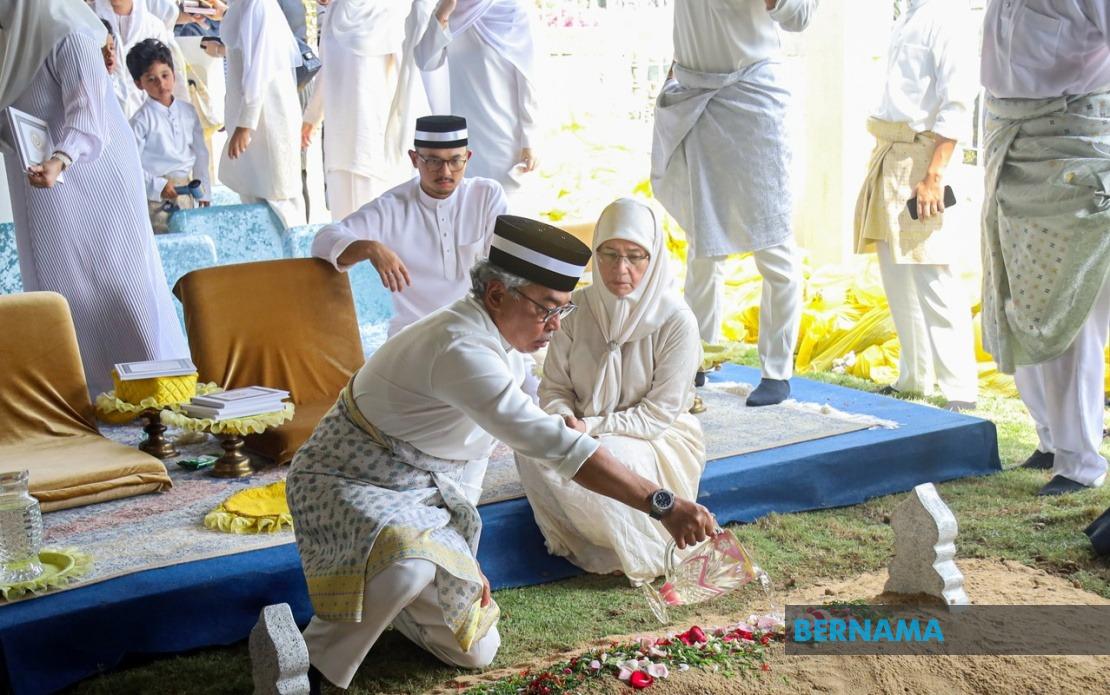
The final moments of the ceremony witnessed Al-Sultan Abdullah and Tunku Azizah performing the tender ritual of sprinkling rose water and scattering flowers upon the grave, a gesture that conveyed both familial affection and formal respect. These acts, conducted in the presence of assembled dignitaries and officials, represented the personal dimension of loss within the formal architecture of state mourning. The symbolic actions underscored the dual nature of royal funerals—simultaneously intimate family occasions and significant state events that carry implications for the broader political and social fabric of the sultanate.
Tengku Datuk Seri Aishah's passing represents the loss of an elder member of Pahang's royal household, a figure who would have held institutional memory spanning decades of the sultanate's political and social evolution. Her burial at the Royal Mausoleum in Pekan places her among generations of royal predecessors, securing her position in the permanent landscape of Pahang's royal heritage. The location of her interment, adjacent to the Sultan Ahmad 1 Mosque, reflects the integration of spiritual observance and royal commemoration that characterises Malaysia's sultanate system.
From a constitutional perspective, the death and funeral observances of senior royal figures such as Tengku Datuk Seri Aishah carry significance beyond the immediate family circle. Members of extended royal households often serve advisory roles within the sultanate's governance structures, and their passing can prompt reflection on succession planning and the continuity of institutional knowledge. The presence of government officials at the funeral, including representatives from another state, signalled the interconnected nature of Malaysia's federal system and the respect accorded to the Pahang sultanate within the broader national framework.
The ceremony also highlighted the continuing importance of Islamic rites within Malaysia's constitutional monarchy framework. The participation of the Pahang Mufti and the emphasis on Quranic recitations and Islamic prayers demonstrated how Malaysia's royal families navigate the intersection of constitutional monarchy, Islamic observance, and state protocol. For Malaysian and regional observers, such occasions provide insight into how the sultanate system integrates modern governance structures with religious traditions and familial obligations.

