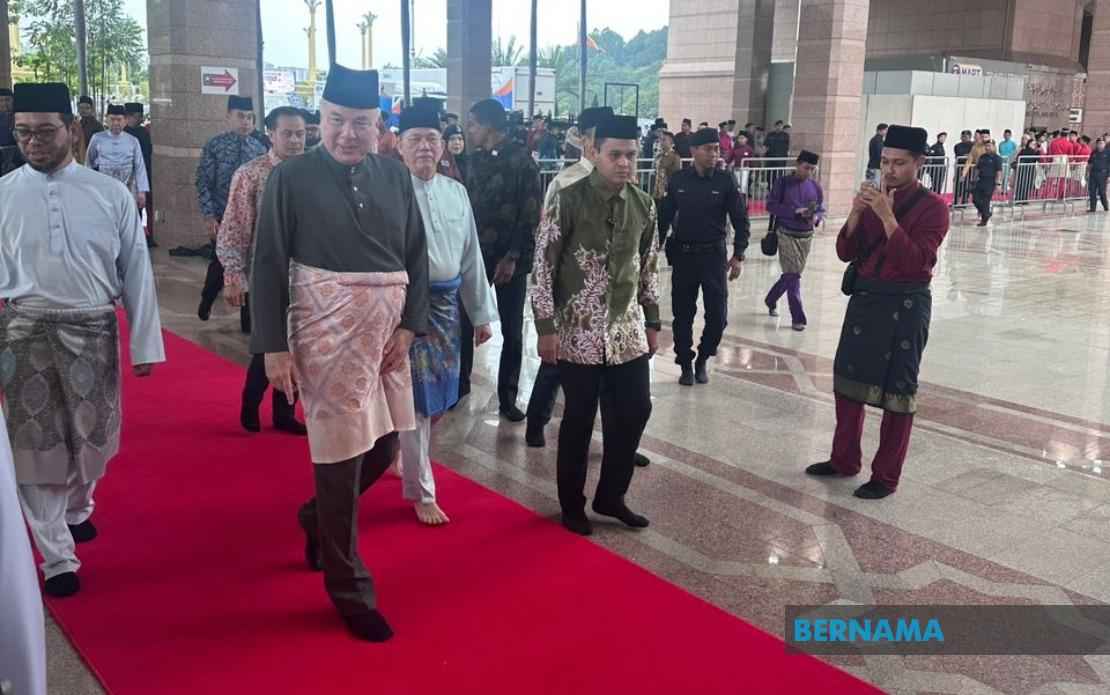
In a significant address at the National Level Maal Hijrah 1448 Celebration in Putrajaya, Deputy Yang di-Pertuan Agong Sultan Nazrin Shah delivered a stern message to the nation's leadership, cautioning against the dangers of reckless governance driven by personal sentiment and emotional reaction. The Sultan's remarks, delivered before approximately 5,000 attendees at the Putra Mosque, highlighted the destructive consequences that arise when public officials prioritise immediate political advantage over measured, well-considered policy formulation. His Royal Highness argued that when leaders surrender to impulse and abandon careful analysis, the resulting decisions inevitably impose substantial hardship on ordinary citizens who bear the burden of ill-conceived choices.
The Sultan emphasised that sound governance requires leaders to exercise deliberation, intellectual discipline, and restraint in their decision-making processes. Rather than succumbing to pressure or emotional currents, effective leaders must ground their choices in rigorous analysis and forward-thinking strategy. This principle, Sultan Nazrin suggested, carries particular weight in the Malaysian context, where diverse populations and complex socioeconomic challenges demand nuanced, thoroughly considered responses. The requirement for calm, measured leadership stands in contrast to populist impulses that seek quick fixes to intricate problems, an implicit critique resonating with ongoing debates about governance standards across Southeast Asia.
Drawing parallels to the Islamic calendar's Maal Hijrah event, Sultan Nazrin presented historical examples demonstrating the value of strategic foresight and meritocratic decision-making. He referenced Prophet Muhammad's selection of Abdullah bin Uraiqit as a guide during the migration to Medina, noting that the Prophet appointed a non-Muslim based purely on his demonstrated expertise, reliability, and trustworthiness. This historical anecdote carries contemporary significance, suggesting that effective governance transcends sectarian considerations and demands leaders recognise competence regardless of personal background. For Malaysia, a multiethnic and multireligious society, such principles offer a framework for bridging communal divides and building inclusive institutions based on merit rather than identity politics.
The Sultan articulated a vision of national greatness extending beyond mere preservation of historical accomplishments. Rather, he contended, truly great nations leverage past experiences as instructive lessons, extracting wisdom from both successes and failures to construct progressively more resilient and prosperous futures. This forward-looking orientation challenges complacency and demands continuous self-examination at the institutional level. In the Southeast Asian context, where several nations grapple with development challenges and institutional reform, Sultan Nazrin's emphasis on learning from history while advancing boldly into the future provides an alternative framework to both nostalgic romanticism and uncritical progressivism.
Central to the Sultan's message was an extended meditation on sacrifice as a foundational element of national advancement and civilisational progress. His Royal Highness defined sacrifice not merely as loss or material deprivation, but as a conscious subordination of personal interest to collective good—a willingness to endure hardship, relinquish comfort, and face adversity in pursuit of elevated objectives. This conception of sacrifice carries profound implications for Malaysia's developmental trajectory, suggesting that sustained progress demands commitment extending beyond electoral cycles and partisan advantage. The Sultan expressed concern that the spirit of sacrifice appears increasingly attenuated within the Muslim community and, by extension, broader Malaysian society, frequently reduced to rhetorical flourish devoid of substantive commitment.
The Sultan's remarks on sacrifice resonate particularly in contemporary Malaysia, where persistent political instability and factional competition have arguably eroded the sense of shared national purpose. His warning that sacrifice must transition from abstract principle to lived practice challenges all segments of society—political leadership, civil service, business communities, and ordinary citizens—to reassess their commitment to collective welfare. The emphasis on sacrifice as a prerequisite for institutional strength and societal resilience offers a corrective to purely transactional or mercenary approaches to public service that have characterised portions of Malaysian political life.
Unity emerged as a second pillar of Sultan Nazrin's vision, grounded in historical precedent and contemporary necessity. The Sultan drew inspiration from the Medina Charter, an early Islamic document establishing principles of coexistence among diverse religious and ethnic communities through mechanisms of tolerance and impartial governance. This historical reference carries direct relevance to Malaysia's constitutional framework, which similarly attempts to accommodate religious and ethnic plurality through carefully calibrated institutional arrangements. The Sultan's invocation of the Medina Charter suggests that enduring unity does not require homogeneity but rather demands just, inclusive governance capable of earning legitimacy across communal boundaries.
The Sultan articulated explicitly that national success depends fundamentally on citizens' willingness to cooperate across lines of difference, maintain mutual respect, and coexist harmoniously despite variations in ethnicity, culture, and religious belief. This formulation, presented in the context of recent episodes of communal tension and polarisation in Malaysia, implicitly addresses contemporary fractures within the national fabric. By grounding such exhortations in Islamic historical sources and international Islamic civilisational achievements, the Sultan lends religious and civilisational authority to secular principles of pluralism and coexistence—an approach potentially bridging religious and secular constituencies.
Crucially, Sultan Nazrin reframed the observance of Maal Hijrah as something transcending mere calendrical commemoration or nostalgic historical reflection. Rather, he presented the occasion as an opportunity for collective introspection, a moment for reviewing past failures and awakening consciousness regarding contemporary challenges. This reinterpretation challenges Muslims and Malaysians broadly to move beyond ritualistic observance toward substantive self-examination and ethical recommitment. The Sultan warned against the spiritual and intellectual hazards posed by uncritical immersion in worldly preoccupations, arguing that such absorption threatens individual and collective capacity for moral discernment.
The presence of Deputy Prime Minister Datuk Seri Fadillah Yusof and Minister in the Prime Minister's Department (Religious Affairs) Dr Zulkifli Hasan lent official weight to the Sultan's pronouncements, suggesting receptiveness within government circles to these messages about governance and national cohesion. Yet the gap between exhortation and implementation remains substantial. Sultan Nazrin's call for measured, strategic leadership; embrace of meritocratic principles; cultivation of sacrificial spirit; and commitment to unity across difference all implicitly critique aspects of contemporary Malaysian governance.
For regional observers, the Sultan's address illuminates broader patterns within Southeast Asia regarding the tension between democratic forms and governance quality, between rhetorical commitment to unity and actual institutional practice, and between short-term political incentives and long-term national development. His emphasis on wisdom, prudence, and strategic planning over emotional reaction and hasty decision-making strikes at fundamental challenges confronting multiple Southeast Asian democracies attempting to navigate complex development trajectories while managing plural societies.
The Sultan's message ultimately constitutes both diagnosis and prescription: diagnosis of leadership shortcomings and societal fragmentation, prescription of renewed commitment to principled governance, sacrificial citizenship, and inclusive unity. Whether Malaysia's political leadership will translate these exhortations into sustained institutional reform remains an open question, but the Sultan's intervention signals that traditional authority figures continue viewing themselves as custodians of national conscience and moral standards in Malaysia's constitutional order.


%22%2F%3E%3C%2Fpattern%3E%3C%2Fdefs%3E%3Crect%20width%3D%22100%25%22%20height%3D%22100%25%22%20fill%3D%22url(%23ph40buhg)%22%2F%3E%3Crect%20width%3D%22100%25%22%20height%3D%22100%25%22%20fill%3D%22url(%23ph40buhp)%22%2F%3E%3Ctext%20x%3D%2250%25%22%20y%3D%2250%25%22%20text-anchor%3D%22middle%22%20dominant-baseline%3D%22central%22%20fill%3D%22rgba(255%2C255%2C255%2C0.95)%22%20font-family%3D%22Georgia%2C%20'Times%20New%20Roman'%2C%20serif%22%20font-weight%3D%22700%22%20font-size%3D%22320%22%20letter-spacing%3D%22-0.02em%22%3EGRS%3C%2Ftext%3E%3C%2Fsvg%3E)