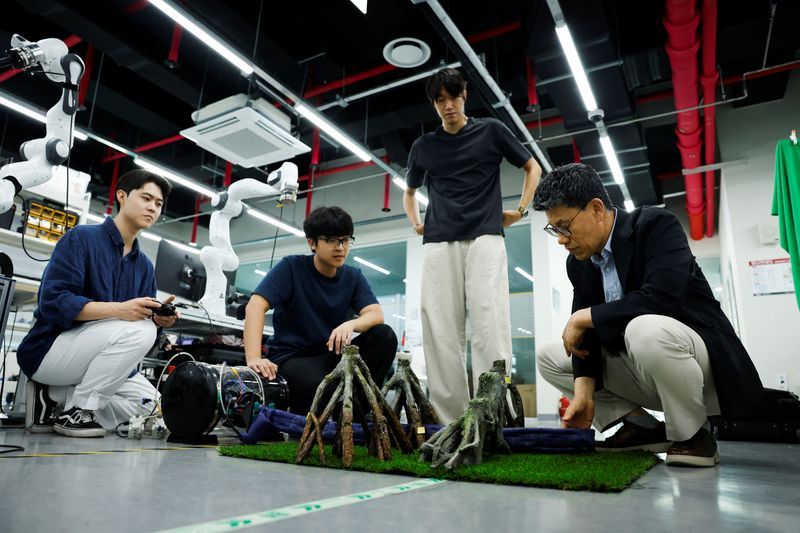
Scientists collaborating between South Korea's prestigious KAIST university and Stanford University in California have demonstrated a novel robotic clothing system that dresses the wearer without manual assistance or the need for the person to remain stationary. The breakthrough, unveiled in Daejeon, represents a significant advancement in wearable robotics and could transform how protective equipment is deployed in high-demand environments such as semiconductor manufacturing facilities and emergency response scenarios.
The core innovation leverages soft, air-pressurised tubular structures—dubbed "vines" by the research team—that are woven directly into the fabric of the garment. When activated, compressed air flows through these pneumatic channels, causing them to expand and contract in a coordinated manner that gradually envelops the wearer's body. The mechanism mimics the climbing behaviour of ivy plants, advancing by extending from its tip rather than repositioning its entire structure, which enables the system to maintain stability as it conforms to the human form regardless of body movement.
The inspiration for the technology emerged from an everyday frustration experienced by postdoctoral researcher Kim Nam Gyun at KAIST. While cycling during a sudden downpour, he envisioned a raincoat that could be donned without interrupting his journey or using his hands. This practical problem became the catalyst for developing a solution that transforms the potential of robotics from the laboratory into real-world applications where users need swift protective coverage without sacrificing mobility or safety.
The dressing process represents a remarkable engineering feat, completing a full suit deployment in approximately ten seconds. Rather than simply sliding fabric over the body like conventional clothing, the robotic system turns the garment inside-out while it climbs along the wearer's form, a technique that ensures even coverage and secure fitting. This approach differs fundamentally from traditional robotic assistance methods, which typically require either stationary positioning or complex computational control systems to manage movement sequences.
Professor Ryu Jee-Hwan, who leads the civil and environmental engineering department at KAIST, emphasises that the vine-inspired design overcomes significant engineering challenges inherent in previous robotic clothing concepts. The system successfully navigates narrow gaps between the body and the garment, adapts its configuration to varied body contours and sizes, and functions reliably regardless of surface conditions—whether slippery, adhesive, or angled. This versatility stems from the fundamental principle that the robot grows rather than crawls, a distinction that fundamentally changes how it interacts with its environment.
The absence of complex control algorithms represents another crucial advantage, particularly for deployment in real-world scenarios where simplicity and reliability are paramount. Users need not stand perfectly still or maintain specific postures while the system operates, making it fundamentally different from existing robotic dressing solutions. This feature holds particular significance for elderly individuals, people with mobility impairments, or those in emergency situations where rapid protective equipment deployment is critical.
Beyond personal assistance applications, the technology opens new possibilities in industrial and emergency contexts where traditional dressing methods create bottlenecks or safety concerns. Semiconductor cleanroom operators, who currently spend considerable time meticulously donning protective suits to prevent contamination, could dramatically reduce preparation time. Emergency responders requiring hazardous materials suits or medical protective equipment could don their gear more rapidly and independently, enhancing both operational efficiency and personal safety during critical interventions.
The research team has published their findings in IEEE Robotics and Automation Letters, a peer-reviewed publication that validates the scientific rigour underlying their work. The publication represents formal recognition from the international robotics research community that this represents a meaningful contribution to the field. For Southeast Asian readers, this development carries particular relevance given the region's substantial semiconductor manufacturing presence and growing emphasis on workplace safety and ergonomic solutions.
Ryu's observation about the balance between software and mechanical innovation speaks to a broader conversation in robotics development. While artificial intelligence and machine learning algorithms capture substantial attention and investment, this project demonstrates that elegant mechanical design can deliver sophisticated functionality without necessarily requiring computationally intensive oversight. The vine robot exemplifies how biomimetic engineering—learning from nature's solutions—can produce systems that are simultaneously simpler, more reliable, and more adaptable than their software-heavy counterparts.
The practical implications extend beyond immediate commercial applications. As regional economies across Asia continue to develop manufacturing capabilities and emergency response infrastructure, technologies that enhance worker efficiency and safety without requiring extensive training or complex infrastructure become increasingly valuable. The hands-free dressing system represents exactly this category of innovation: transformative in function yet straightforward in operation. Whether in cleanroom environments across Malaysia, Singapore, and South Korea, or in emergency services throughout the region, this technology could soon become a standard component of modern protective equipment systems, reshaping how workers interact with their gear and fundamentally improving operational workflows.

