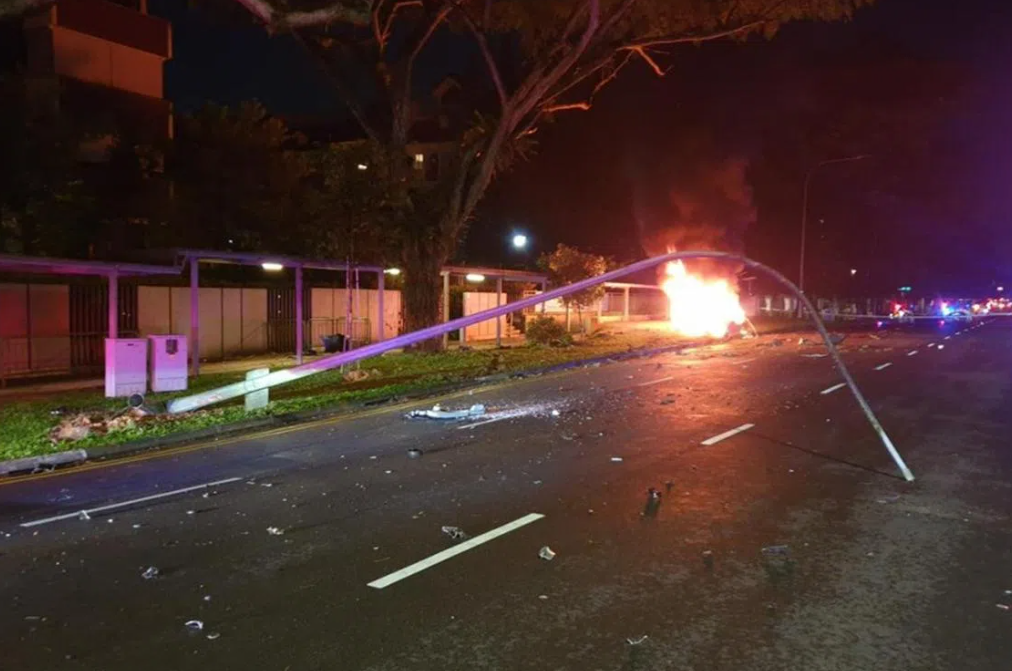
A 29-year-old man in Singapore has been formally charged with five serious traffic offences stemming from a chaotic pre-dawn incident on March 6, 2024, that endangered multiple road users and left two schoolchildren requiring hospital treatment. Aaron Tan Yao Cong faced the Singapore courts on Thursday after his vehicle struck a bus carrying young passengers, with the collision leaving his own car engulfed in flames. The charges underscore the severity with which Singaporean authorities treat repeat drink-driving offences, particularly those involving reckless behaviour that puts vulnerable road users at risk.
The incident began when Tan ignored traffic signage along Cavenagh Road near Bukit Timah Road at 5.50am, deliberately turning left instead of proceeding straight as directed. His vehicle then crossed into oncoming traffic lanes, eventually coming to a temporary halt on the left side of the two-lane roadway. The initial stop proved fleeting. Within minutes, after police arrived at the scene around 6am, Tan accelerated away from the location, initiating a brief high-speed chase through residential and commercial areas of Singapore's north-central region.
What followed was an erratic drive along Bukit Timah Road and Upper Bukit Timah Road during which Tan's vehicle reached speeds averaging 114 kilometres per hour—far exceeding safe limits for urban roads. His driving pattern during this period demonstrated a complete disregard for traffic rules and the safety of other motorists. Officers observed him weaving rapidly between lanes as he navigated the stretch between Coronation Road and Anamalai Avenue, behaviour that created significant danger for pedestrians and other vehicles in the early morning traffic.
The trajectory of the incident culminated at the junction of Sixth Avenue, where Tan allegedly failed to observe a red traffic signal and collided directly with a private bus that was executing a U-turn. The impact was forceful enough to propel his vehicle into a nearby lamp post, which triggered an immediate fire that consumed the car. Tan and three passengers travelling with him managed to escape the burning vehicle before emergency responders arrived, but his actions had already endangered additional lives.
The bus that Tan struck carried a driver and two young passengers, aged nine and ten, the latter of whom required medical evaluation following the collision. In total, five individuals—Tan, his three vehicle occupants, and the bus driver—were transported to hospital for treatment. The involvement of primary school-aged children underscores the indiscriminate nature of dangerous driving, which affects innocent bystanders without regard for age or vulnerability.
Laboratory analysis revealed that Tan's blood alcohol concentration stood at 148 milligrams per 100 millilitres of blood, substantially exceeding Singapore's legal driving limit of 80 milligrams per 100 millilitres. Notably, Tan initially refused to submit to a breathalyser test when arrested, a refusal that itself constitutes a separate criminal offence in Singapore's traffic legislation. The elevated blood alcohol level combined with his aggressive driving pattern points to significantly impaired judgment and motor control at the time of the incident.
Tan's criminal history compounds the severity of his current predicament. He was previously convicted in 2019 of both drink driving and driving without due care and attention, marking him as a repeat offender in these specific categories. This prior conviction triggers enhanced penalties under Singapore's sentencing framework for traffic violations. The appearance of previous convictions in court proceedings signals to judicial authorities that standard rehabilitative measures have already failed with this individual, justifying more stringent punitive responses.
The charges formally laid against Tan encompass five distinct violations: drink driving, dangerous driving causing hurt, leaving a vehicle in a position likely to endanger other road users, failing to cooperate with breath specimen testing, and driving against the flow of traffic. Each charge carries its own sentencing matrix. For drink driving as a repeat offender, Tan faces potential imprisonment of up to two years and fines reaching $20,000 Singapore dollars. The dangerous driving causing hurt charge carries parallel penalties of up to two years' jail, fines to $10,000, or both, with repeat offenders facing enhanced fines of $20,000.
Additional charges address the specific reckless acts during the incident. Allowing his vehicle to rest in a position creating danger to others carries potential penalties of three months' jail, $1,000 in fines, or both. His refusal to provide a breath sample at the roadside can result in six months' imprisonment, fines of $5,000, or both, with repeat offenders subject to a year's jail and $10,000 in fines. The driving against traffic direction charge carries a three-month jail term and $1,000 fine, escalating to six months and $2,000 for repeat offenders.
Tan is scheduled to return to Singapore's courts on July 16 for further proceedings. He has not yet indicated whether he intends to enter guilty pleas to any of the five charges, meaning the case could progress either through negotiated resolution or full trial. The outcome will depend on evidentiary presentation, witness testimony from the bus driver and passengers, surveillance footage from the collision scene, and potentially expert evidence regarding vehicle reconstruction and blood alcohol analysis.
The incident carries implications beyond Tan's individual legal jeopardy. It reflects broader challenges facing traffic authorities in Singapore and across Southeast Asia regarding repeat drink-driving offenders and the ineffectiveness of previous convictions in deterring dangerous behaviour. The presence of schoolchildren among the victims adds emotional resonance to public discourse around road safety, potentially influencing both prosecutorial approach and judicial sentencing considerations. Parents and educators in the region may view this case as emblematic of systemic risks posed by impaired drivers to their children's safety during routine transportation.
For Malaysian readers, the case offers instructive contrast with local drink-driving enforcement and sentencing practices. While both jurisdictions maintain legal alcohol limits for driving, Singapore's combination of mandatory breath testing, enhanced penalties for repeat offenders, and serious charges for dangerous driving causing injury creates a notably stringent enforcement regime. The case demonstrates how a single morning's poor decisions—compounded by prior conviction and evident alcohol impairment—can result in serious criminal jeopardy, hospitalisation of innocent parties, and decades-long legal consequences for the offender.

%22%2F%3E%3C%2Fpattern%3E%3C%2Fdefs%3E%3Crect%20width%3D%22100%25%22%20height%3D%22100%25%22%20fill%3D%22url(%23ph40buhg)%22%2F%3E%3Crect%20width%3D%22100%25%22%20height%3D%22100%25%22%20fill%3D%22url(%23ph40buhp)%22%2F%3E%3Ctext%20x%3D%2250%25%22%20y%3D%2250%25%22%20text-anchor%3D%22middle%22%20dominant-baseline%3D%22central%22%20fill%3D%22rgba(255%2C255%2C255%2C0.95)%22%20font-family%3D%22Georgia%2C%20'Times%20New%20Roman'%2C%20serif%22%20font-weight%3D%22700%22%20font-size%3D%22320%22%20letter-spacing%3D%22-0.02em%22%3EGRS%3C%2Ftext%3E%3C%2Fsvg%3E)