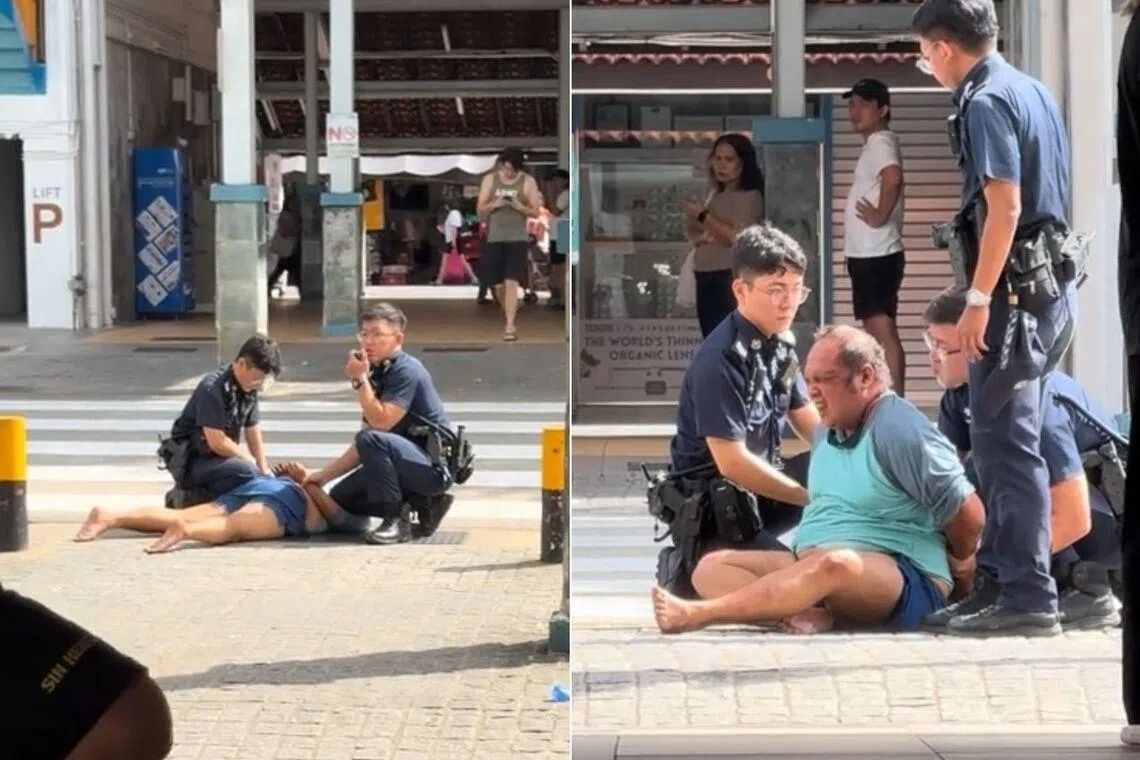
A 36-year-old man was arrested in Singapore's Toa Payoh district on Sunday, June 28 morning following an incident that escalated from a public disturbance into an assault on a uniformed police officer. The confrontation unfolded at a coffee shop located in Block 184 Toa Payoh Central, where authorities responded to reports of disruptive behaviour shortly before 10 am. What began as a routine police intervention would result in charges related to both lewd conduct and violence against law enforcement personnel.
Singapore's police force received the initial call for assistance at approximately 9.45 am that Sunday, after receiving notification that a man was causing a disturbance within the coffee shop premises. Officers dispatched to the location found the individual acting in a manner that prompted formal police intervention. Rather than complying with officers' directives during the arrest process, the man escalated the situation by striking one of the responding officers directly in the face, an action that would form the basis of assault charges against him.
The 36-year-old was subsequently placed under arrest and charged with two principal offences: committing an obscene act in public and voluntarily causing hurt to a public servant with the intent to obstruct that officer from performing his lawful duties. The charge of deliberately injuring a police officer carries serious implications under Singapore's legal framework, as assaults on law enforcement personnel are treated with considerable severity to protect the safety of those maintaining public order. The obscene act charge reflects the nature of the initial disturbance that prompted the police response.
Videographic evidence of the incident circulated online through TikTok user Kee Wee Shang, who captured footage showing two police officers restraining the barefooted man on the ground during the arrest. The videos documented the scene as officers worked to secure the individual and prevent further disruption. Additional footage posted by the same user showed a third police officer present at the location, with the man subsequently appearing in handcuffs as officers led him away from the coffee shop premises. The presence of eyewitness recordings, now accessible through social media platforms, highlights how public incidents in urban Singapore are increasingly documented and shared among online audiences in real-time.
The 19-year-old police officer who was struck suffered minor injuries in the altercation and was transported to hospital in conscious condition. Despite the nature of the assault, the officer's injuries were classified as minor, though the incident nonetheless represents a clear breach of public decorum and respect for law enforcement authority. The swift medical attention and relatively stable condition of the injured officer reflected the responding units' capacity to manage the situation and ensure necessary care.
The incident underscores the risks faced by Singapore's police personnel during routine public order interventions, particularly in settings where individuals may be experiencing emotional distress or behavioural difficulties. The escalation from a coffee shop disturbance to a physical assault on an officer illustrates how situations can deteriorate rapidly without appropriate de-escalation. For Malaysian and Southeast Asian audiences, this case serves as a reminder of the challenges encountered by law enforcement across the region when responding to public disturbances in commercial establishments frequented by the general population.
Singapore's strict approach to offences involving violence against police officers reflects the city-state's broader commitment to maintaining robust public order and protecting those charged with enforcement responsibilities. The seriousness with which authorities treat assaults on law enforcement personnel sends a clear message regarding expectations for civic behaviour and respect for the authority vested in police forces. Such incidents, though not frequent in Singapore's relatively safe urban environment, are handled with procedural rigour and deliberate legal consequences.
Police investigations into the matter remain ongoing as of the time of reporting, with authorities continuing to gather additional evidence and statements related to the incident. The investigative process will likely examine the initial disturbance, the circumstances that prompted police attendance, the conduct during the arrest procedure, and medical documentation of the officer's injuries. The fact that investigations are still proceeding indicates that charges may potentially be expanded or refined as additional information emerges during the inquiry phase.
The incident also reflects the digital nature of crime reporting in contemporary Singapore, where bystander footage captured through mobile devices becomes part of the public record almost instantaneously. This democratisation of documentation has implications for how law enforcement agencies operate in public spaces and how incidents are perceived and discussed by wider audiences. For police forces across Southeast Asia, including Malaysia, the prevalence of eyewitness video recording presents both challenges and opportunities in terms of transparency and accountability.

