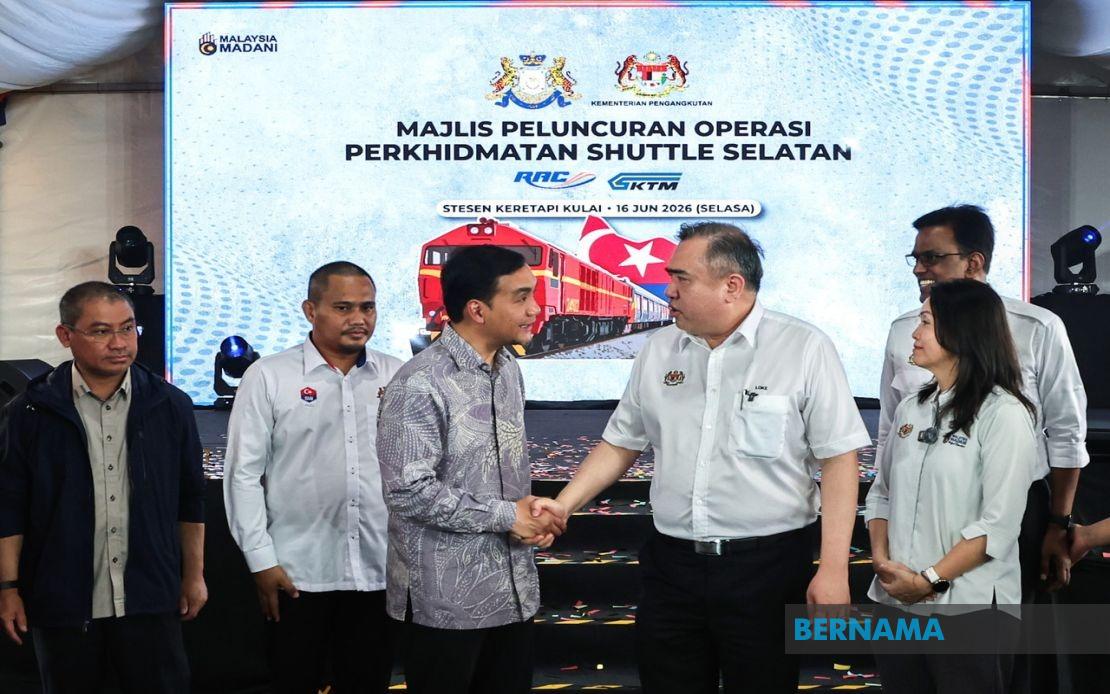
Malaysia's Transport Ministry formally launched the Shuttle Selatan rail service on June 16, unveiling an infrastructure initiative designed to knit together three vital nodes in Johor's economic landscape: Kulai, JB Sentral and Pasir Gudang. Transport Minister Anthony Loke presided over the ceremony at Kulai KTM station, flanked by Johor Menteri Besar Datuk Onn Hafiz Ghazi and other regional officials. The venture targets over two million residents across these areas, signalling the government's determination to reshape commuter patterns in one of Malaysia's most industrially dynamic states.
The shuttle system begins operations on two principal routes that form the backbone of its initial network. The first connects Kulai and JB Sentral in both directions, while the second links Kempas Baru with Pasir Gudang, serving the industrial and port-adjacent precincts of the region. Each journey promises substantial time savings: travellers moving between Kulai and JB Sentral can expect approximately 40 minutes of transit time, whilst the Kempas Baru to Pasir Gudang corridor operates on a similar timeframe, spanning 40 to 45 minutes. These modest journey durations reflect the service's design philosophy—offering a genuine alternative to private vehicle use for workers commuting between residential quarters and employment centres.
The ministry has crafted an expansion roadmap that extends well beyond the current operating footprint. Future development envisages stretching the rail network southward from Paloh through Kulai by way of Kluang, Renggam and Layang-Layang, potentially unlocking connectivity across a broader swathe of southern Johor. Additionally, three new stations are earmarked for construction: Taman Daya, Bandar Baru Sri Alam and Pasir Putih. This deliberate station proliferation reflects a recognition that public transport succeeds only when it offers genuine proximity to residential and commercial nodes, reducing the walk times that deter commuters in developing transit systems.
To address the persistent challenge of first and last-mile connectivity—the journey from home or workplace to the transit station—the government has assembled a complementary ecosystem of services. Feeder bus networks will operate at designated terminals, coordinated through the Bas.My digital platform to ensure seamless transfers. A dedicated shuttle service operates from Kempas Baru, whilst park-and-ride facilities at AEON Bandar Dato' Onn provide motorists with a dignified exit point from vehicle-dependent commuting. Such measures acknowledge that rail infrastructure alone cannot transform travel behaviour; integration with other transport modes remains essential.
A financial incentive strategy aims to overcome the inertia that keeps commuters wedded to private transport. The government has distributed 3,000 Commuter MADANI Shuttle Selatan Cards free of charge to Johor residents, each loaded with RM50 credit enabling unlimited travel for a specified period. This subsidy mechanism, funded through more than RM150,000 allocated by the Railway Assets Corporation (RAC), represents a calculated investment in behavioural change. By removing upfront cost barriers, policymakers seek to generate ridership momentum during the critical launch window when consumer habits remain malleable.
Johor's economic trajectory provides compelling context for this infrastructure commitment. As one of Malaysia's fastest-expanding states, Johor has attracted substantial industrial investment, logistics operations, port development and educational expansion in recent years. The transport bottlenecks that accompany rapid economic growth threaten to undermine competitiveness if unaddressed. Shuttle Selatan explicitly targets the arterial challenge: it bridges residential concentrations, commercial city centres and the sprawling industrial zones that increasingly define Johor's economic geography. By smoothing commuter flows, the service aims to sustain Johor's appeal to both workers and investors.
The venture exemplifies the institutional coordination required for modern public transport deployment. The Transport Ministry, Keretapi Tanah Melayu Berhad (KTMB) and the Railway Assets Corporation worked in concert to conceptualise and execute Shuttle Selatan, pooling technical expertise and operational resources. This inter-agency collaboration signals a maturing approach to transport governance, moving beyond siloed departmental efforts toward integrated ecosystem thinking. For other Malaysian states contemplating rapid transit expansion, the Shuttle Selatan model offers practical lessons in how entities can align incentives and coordinate interventions.
The timing of this launch reflects a broader policy shift toward prioritising public transport as an alternative to the private vehicle dominance that characterises most Malaysian urban areas. Persistent congestion, air quality degradation and urban sprawl have prompted policymakers to view transit infrastructure as strategic economic and environmental necessity rather than peripheral social service. Shuttle Selatan positions itself as part of this larger transition, offering commuters tangible reasons to abandon personal vehicles. The subsidised travel cards and integrated feeder services represent practical implementation of rhetoric around modal shift.
From a Malaysian and Southeast Asian perspective, Shuttle Selatan occupies a significant niche within the broader regional discussion of urban mobility solutions. Cities across Southeast Asia grapple with congestion and air pollution intensified by rising motorisation rates. The shuttle model—quick, relatively affordable, integrated with complementary transport modes—offers a potentially replicable template for mid-sized urban regions that lack the density or fiscal capacity for massive metro systems like those in Bangkok or Singapore. If Shuttle Selatan demonstrates operational and financial sustainability, peer cities and states throughout the region may view it as a viable pathway toward more sustainable transport futures.
The success metric for Shuttle Selatan extends beyond passenger volumes and revenue figures. The service represents a test of whether Malaysian transport authorities can architect systems that genuinely compete with private vehicle convenience. The subsidised cards, feeder bus networks and park-and-ride facilities collectively signal an understanding that market forces alone will not shift entrenched commuting habits. Whether these incentives prove sufficient to achieve meaningful modal shift—and whether the wider public accepts rail-based travel as normal practice rather than marginal option—will shape transport policy discussions across Johor and beyond. The launch ceremony marks the beginning of an experiment whose outcomes carry implications for how Malaysia approaches the integration of economic growth with liveable, sustainable urban development.

%22%2F%3E%3C%2Fpattern%3E%3C%2Fdefs%3E%3Crect%20width%3D%22100%25%22%20height%3D%22100%25%22%20fill%3D%22url(%23ph40buhg)%22%2F%3E%3Crect%20width%3D%22100%25%22%20height%3D%22100%25%22%20fill%3D%22url(%23ph40buhp)%22%2F%3E%3Ctext%20x%3D%2250%25%22%20y%3D%2250%25%22%20text-anchor%3D%22middle%22%20dominant-baseline%3D%22central%22%20fill%3D%22rgba(255%2C255%2C255%2C0.95)%22%20font-family%3D%22Georgia%2C%20'Times%20New%20Roman'%2C%20serif%22%20font-weight%3D%22700%22%20font-size%3D%22320%22%20letter-spacing%3D%22-0.02em%22%3EGRS%3C%2Ftext%3E%3C%2Fsvg%3E)