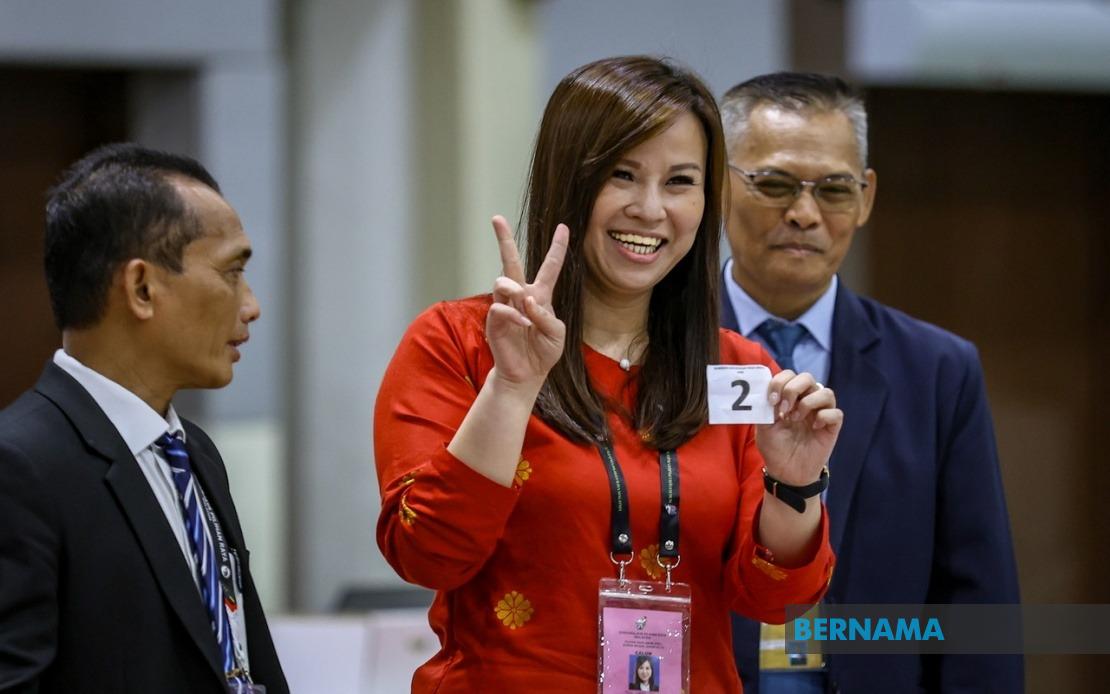
Pakatan Harapan's Sharon Teo is making her case to voters in the Permas state constituency by zeroing in on two foundational issues that residents repeatedly bring up during her ground outreach: the quality of local roads and the adequacy of public welfare provisions. As chief of the Johor Amanah Women's Youth (Warda), Teo has framed these concerns as central to her campaign message ahead of the 16th Johor state election scheduled for July 11, with early voting set for July 7. Her emphasis on tangible infrastructure improvements signals a bid to move the conversation away from broader party narratives and toward bread-and-butter governance issues that directly affect daily life in the constituency.
Teo's background as a parliamentary aide in the Pulai constituency under the late Amanah deputy president Salahuddin Ayub gives her experience navigating the machinery of state politics, though she is now attempting to translate that experience into a successful state-level candidacy. During the nomination proceedings held at Dewan Muafakat in Taman Mawar, she underscored that road safety and condition represent a priority concern that cannot be deferred. This framing reflects a strategic calculation: infrastructure deficits are difficult for any incumbent to defend credibly, and focusing on physical repair and maintenance sidesteps more ideological terrain where the governing coalition might hold advantage.
The Permas constituency, which lies within the Pasir Gudang parliamentary constituency, encompasses 113,963 eligible voters for the state election. This voter population puts Permas in the mid-range of Johor's state seats in terms of electorate size, making it a genuinely competitive ground where strong local engagement can move outcomes. Teo has indicated that a full policy manifesto outlining her vision and mission for the constituency will be released in coming days, suggesting that the campaign organisation intends to present a comprehensive rather than ad-hoc set of proposals to constituents.
Meanwhile, the incumbent Baharudin Mohamed Taib, representing Barisan Nasional, retained the seat in the previous state election in 2022 and is now tasked with holding territory in what appears to be a more challenging political environment. Baharudin has adopted a notably cautious public posture, characterising the contest as genuinely difficult and rejecting any appearance of complacency. His statement that each opponent brings distinct strengths reflects an acknowledgment that the political terrain has shifted since 2022, requiring more disciplined ground operations and messaging discipline from the ruling coalition.
Barisan Nasional's organisational and resource advantages remain substantial, yet Baharudin has chosen not to launch a personal manifesto separate from the coalition's broader campaign platform. This decision suggests either confidence in the BN's unified messaging or a calculated judgment that personalised pledges might expose him to greater scrutiny. Instead, he intends to anchor his campaign to the coalition's overarching vision, a strategy that ties his electoral fortunes directly to public perception of BN governance at state and national levels.
The electoral contest in Permas is shaping up as a genuine four-way battle, an outcome increasingly common in Malaysian state and parliamentary politics. Beyond Teo and Baharudin, the field includes T. Vela representing Perikatan Nasional and Dr Zamil Najwah from Parti Bersama Malaysia. The presence of two opposition-aligned or independent challengers fractures the anti-BN vote, potentially advantaging the incumbent coalition if those votes split relatively evenly. However, if either Teo or Vela emerges as a unified opposition standard-bearer, the dynamics could shift considerably.
The Perikatan Nasional presence through Vela reflects the continued relevance of the Islamist-nationalist coalition in Johor politics, a state where PAS maintains significant grassroots organisation despite losing the federal government in 2022. PAS's capacity to mobilise voters, particularly in smaller towns and semi-rural areas, means that the PN challenge cannot be dismissed as nominal even in urban-leaning constituencies. Parti Bersama Malaysia, by contrast, is a newer entrant to the Malaysian political landscape, and its performance in Permas will serve as an indicator of whether the party can translate whatever organisational capacity it possesses into meaningful electoral traction.
For Malaysian and Southeast Asian observers, the Permas contest exemplifies several broader trends reshaping electoral politics in Malaysia. The fragmentation of voter choice across multiple parties reflects declining confidence in two-coalition frameworks and rising space for smaller parties and independent candidacies. The emphasis by Teo on localised infrastructure and welfare concerns reflects a wider recognition among opposition parties that many voters prioritise competence and service delivery over grand ideological claims. Meanwhile, Baharudin's implicit acknowledgment of electoral vulnerability, despite the structural advantages of incumbency and coalition machinery, underscores how even dominant ruling parties cannot assume automatic victory in individual contests.
The Johor state election as a whole carries significance beyond that state's borders. Johor remains Malaysia's most populous state and represents a critical battleground for Pakatan Harapan's attempts to rebuild credibility following the 2022 federal election and subsequent political instability. A strong PH performance in Johor would signal recovery of momentum in the country's most populous peninsular state, whereas a setback would suggest that the coalition's appeal remains fragile outside urban centres. For Barisan Nasional, Johor is essential territory: the coalition's capacity to hold traditional strongholds in the state will determine whether it can credibly position itself as a national alternative to the federal government.
The early voting window on July 7 and main polling day on July 11 will determine whether Teo's focus on practical governance issues gains traction with constituents, whether Baharudin's coalition machinery can overcome electoral headwinds, and what role the PN and Bersama candidates play in reshaping the contest's outcome. For the broader Malaysian electorate, the Permas results will offer valuable signals about the durability of existing alignments and the shifting terrain of state-level competition.

