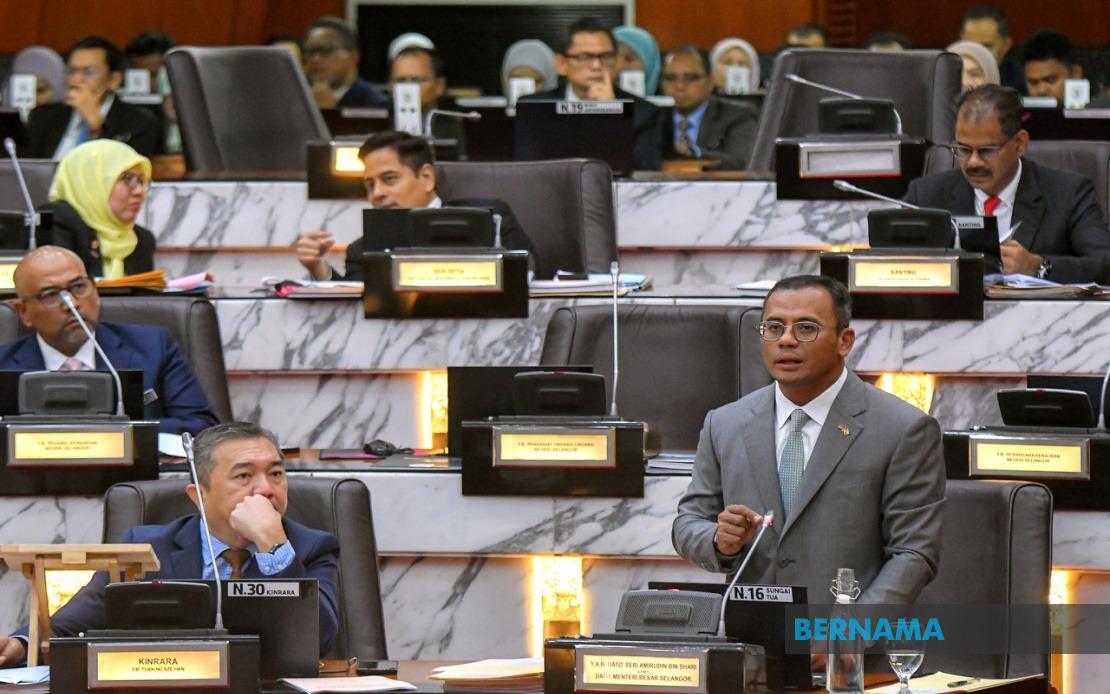
The Selangor government is moving forward with plans to significantly expand access to its flagship higher education support scheme, with Menteri Besar Datuk Seri Amirudin Shari announcing that the state will increase HPIPT recipients from the current 3,000 to as many as 5,000 in the coming year. The decision reflects growing pressure on the state to accommodate rising demand for the RM1,000 study incentive, which provides crucial financial support to students pursuing tertiary qualifications.
During the Selangor State Legislative Assembly sitting, Amirudin disclosed that the state government had received more than 5,000 applications for the scheme in both 2025 and the preceding year, far exceeding the number of available grants. This persistent gap between demand and supply prompted state officials to reassess the programme's capacity and determine whether Selangor's fiscal position could sustain a larger beneficiary pool. The surge in applications underscores the financial pressures facing families seeking to fund higher education, particularly among middle and lower-income households in the state.
Amirudin suggested that the expansion target could potentially reach between 5,000 and 6,000 recipients, pending a detailed review of Selangor's revenue position. Notably, the state had previously extended the incentive to 5,000 recipients in an earlier iteration of the programme, and restoring that threshold appears feasible within the 2027 Budget framework. This represents a reversal of sorts, as the government grapples with the tension between fiscal constraints and growing social expectations for educational support.
Beyond simply increasing recipient numbers, the Selangor government is undertaking a more comprehensive overhaul of the HPIPT administration. State officials are examining the application timeline to provide students with adequate opportunity to submit their claims after receiving confirmation of admission from tertiary institutions. Currently, the window between admission notification and the application deadline may be restrictive, particularly for students who do not receive their acceptance letters until later in the academic calendar year.
Most ambitiously, the state is exploring the possibility of opening HPIPT applications twice annually rather than maintaining a single annual cycle. This reform would address a perennial challenge in student financing: the reality that students enroll at higher education institutions at different points in the calendar year, not merely during traditional intake periods. By introducing biannual application rounds, Selangor could ensure that latecomers and mid-year enrollees are not automatically excluded from funding support through no fault of their own.
The HPIPT itself is accessible to a broad spectrum of students pursuing various academic pathways. Beneficiaries include those enrolled at both public and private higher education institutions that meet recognition standards. Notably, the scheme extends beyond conventional bachelor's programmes to encompass diploma qualifications and Level 4 Skills Certificate holders, reflecting the state's recognition that vocational and technical pathways are equally valuable as degree-level study. This inclusive approach acknowledges Malaysia's need for skilled workers across multiple credential levels.
For Malaysian context, Selangor's expansion signals the mounting pressure that state governments face to provide targeted social support in education, a domain traditionally dominated by federal initiatives. As cost of living pressures mount and family incomes stagnate in real terms, state-level interventions have become increasingly politically salient. Selangor's willingness to allocate additional resources to student support demonstrates how state governments are attempting to differentiate themselves through welfare provisions.
The timing of this announcement also reflects broader demographic and economic patterns. As tertiary education participation rates rise across Malaysia, the absolute number of students seeking financial assistance increases correspondingly. Yet public universities remain capacity-constrained, forcing more students toward private institutions where fees are substantially higher. State incentive schemes like HPIPT become increasingly important in making private education financially viable for households that cannot otherwise afford tuition fees.
The expansion carries implications beyond Selangor itself. As the wealthiest and most urbanised state in Malaysia, Selangor's educational investment sets benchmarks against which other state governments are measured. Should the HPIPT expansion proceed as planned, it may create political pressure on other states to enhance their own higher education support schemes. Simultaneously, it highlights disparities in state capacity to fund such programmes, with less economically developed states potentially unable to match Selangor's commitments.
The administrative reforms contemplated—particularly the biannual application cycle—represent evidence-based policymaking that addresses real friction points in the current system. Rather than simply injecting more money into an unchanged structure, the state is attempting to make the scheme more responsive to actual student enrolment patterns. This reflects lessons learned from programme implementation and suggests a more sophisticated approach to educational welfare policy than simple year-on-year budget increases.
Looking forward, the success of the expanded HPIPT will depend heavily on effective communication and awareness campaigns. Many eligible students may remain unaware of the scheme or uncertain about application procedures. As the recipient pool grows, ensuring equitable distribution across demographics and geographic areas within Selangor will become increasingly important to avoid accusations of favouritism or unequal access.
The expansion also underscores an ongoing tension in Malaysian higher education policy: balancing demand for student financial aid against the imperative for quality assurance and institutional strengthening. While increasing HPIPT recipients addresses immediate student financial distress, policymakers must simultaneously ensure that the institutions receiving these funds are delivering quality education justifying the public investment. This dual challenge will likely preoccupy state officials as they implement the expanded programme.

