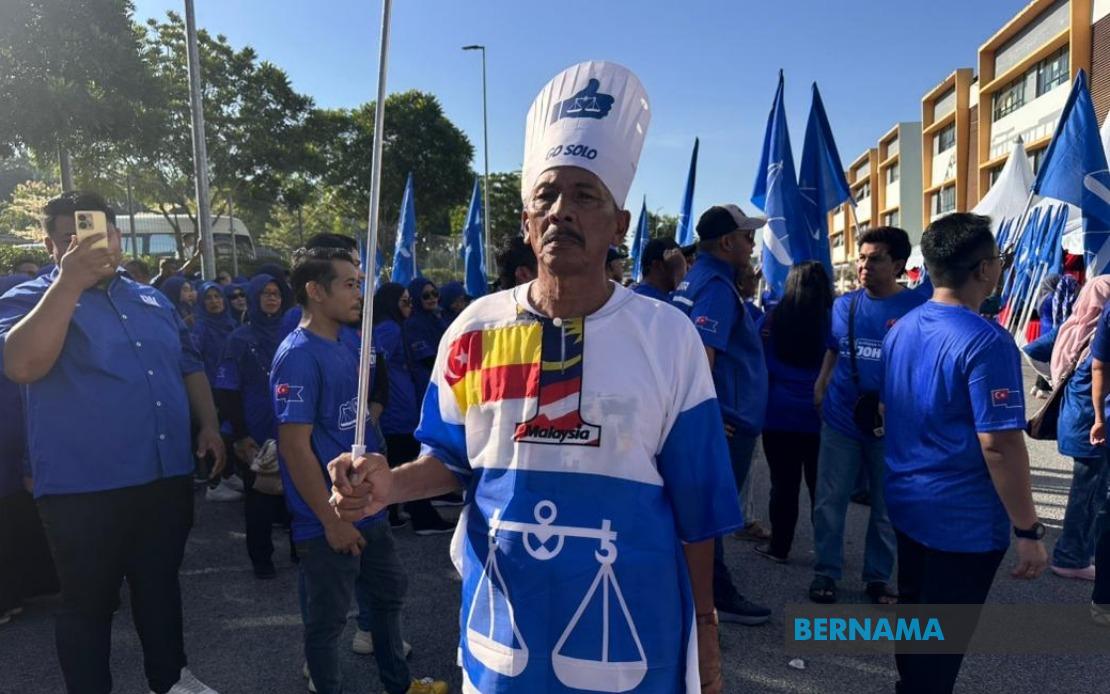
Demonstrating the depth of grassroots support that can drive electoral campaigns across state lines, a retired civil servant from Selangor made the journey to Johor on June 27 to attend the nomination process for the 16th state election, specifically to back Barisan Nasional leaders and Menteri Besar Onn Hafiz Ghazi. The 68-year-old's decision to travel hundreds of kilometres and tap into his retirement savings underscores the personal investment some voters make in political contests that extend far beyond their home constituencies.
Alias Samad arrived at the Dewan Muafakat venue in Simpang Renggam District Council well before the proceedings began, positioning himself at the nomination centre by 7 am. His distinctive appearance immediately caught the attention of observers and media personnel present at the event. The retiree had commissioned a custom-tailored outfit in white and blue, incorporating the Barisan Nasional party logo alongside the Selangor state flag—a visible statement of allegiance that bridged his home state with his chosen destination.
The financial commitment Samad made to undertake this journey reveals the genuine enthusiasm some supporters harbour for particular political figures. Beyond the RM50 investment in tailoring his campaign outfit, the former civil servant withdrew more than RM500 from his personal savings to cover the full costs of his participation. This amount encompassed not only the travel expenses required to reach Johor from Selangor but also his accommodation and meals throughout his stay—a substantial sum for a pensioner living on a fixed retirement income.
Father to twelve children, Samad's participation in the nomination day reflects how political engagement can mobilise voters across generational lines and across Malaysia's state boundaries. His presence at the event serves as a compelling human-interest angle to the broader electoral narrative unfolding in Johor, where established political figures continue to command support from citizens in neighbouring states. The fact that such cross-state participation occurs suggests that certain political personalities transcend purely regional appeal and develop followings that reach into other parts of the country.
Samad's motivation for making this journey originated from a personal connection forged months earlier when Onn Hafiz campaigned in his hometown area of Sungai Tawar, Sabak Bernam. That visit by the Menteri Besar to the Selangor constituency clearly left a lasting impression on the retiree, compelling him to reciprocate the gesture by travelling to support Onn Hafiz during a critical moment in the Johor electoral calendar. This reciprocal dynamic between political figures and their supporters illustrates how campaigns function as two-way exchanges rather than purely top-down communication efforts.
The Machap seat, which forms the specific focus of Onn Hafiz's re-election bid, presents a competitive electoral contest in this state election. The Menteri Besar confronts a direct challenge from Pakatan Harapan's Nor Hafiz Roslan in what has crystallised into a straight fight between these two candidates. Such one-on-one electoral contests often generate heightened attention and mobilisation, as supporters recognise the significance of securing victory in tightly contested seats. Samad's presence at the nomination venue may reflect broader awareness among Barisan supporters of the importance this particular contest holds within the larger state election framework.
The decision by a Selangor resident to travel to Johor carries subtle political implications in the context of Malaysian federalism and inter-state dynamics. While supporters frequently campaign within their home states, cross-state participation demonstrates the drawing power of prominent political figures who command respect beyond parochial state boundaries. For Onn Hafiz, whose profile extends beyond Johor through his tenure as Menteri Besar and prominence within Barisan Nasional's hierarchy, such multi-state support may reinforce perceptions of his political stature and electability.
The broader context of Malaysian electoral campaigns often features diverse forms of grassroots participation, from volunteer organisers to informal supporters like Samad who contribute through symbolic presence and personal expenditure. These individual acts of support, though they may appear modest in aggregate, collectively construct the visible manifestations of political enthusiasm that shape perceptions of campaign momentum. Media coverage of such supporters can amplify these grassroots signals, potentially influencing broader voter sentiment through exposure to compelling human narratives.
Samad's background as a former civil servant lends his participation particular weight, as retired government workers often occupy positions of respect within their communities and may serve as influential voices in local political discussions. His willingness to speak openly with journalists about his expenditure and motivations suggests a comfort with public identification with his chosen candidate, a position not all supporters feel equally empowered to adopt. In Malaysian political culture, where personal networks and community standing influence electoral outcomes, such public endorsements by respected community members carry measurable significance.
The nomination process itself marks a critical juncture in any state election cycle, serving as the formal gateway through which candidates officially enter the contest and campaign frameworks begin in earnest. For supporters like Samad, attending nomination events represents an opportunity to demonstrate support at this symbolic moment, when media attention concentrates on the official commencement of electoral activities. His early arrival and distinctive attire ensured maximum visibility during these highly publicised proceedings, effectively amplifying his individual gesture into a broader statement about Barisan Nasional's campaign energy.
Looking forward, the Machap seat will likely receive sustained attention throughout the campaign period as both Onn Hafiz and Nor Hafiz Roslan compete for voter backing. The Menteri Besar's electoral performance in this seat carries implications not only for his personal political future but also for Barisan Nasional's overall showing in the 16th Johor state election. Support mobilisation across state lines, as exemplified by Samad's participation, may contribute incrementally to building momentum that influences voting patterns among undecided electors in Johor.

