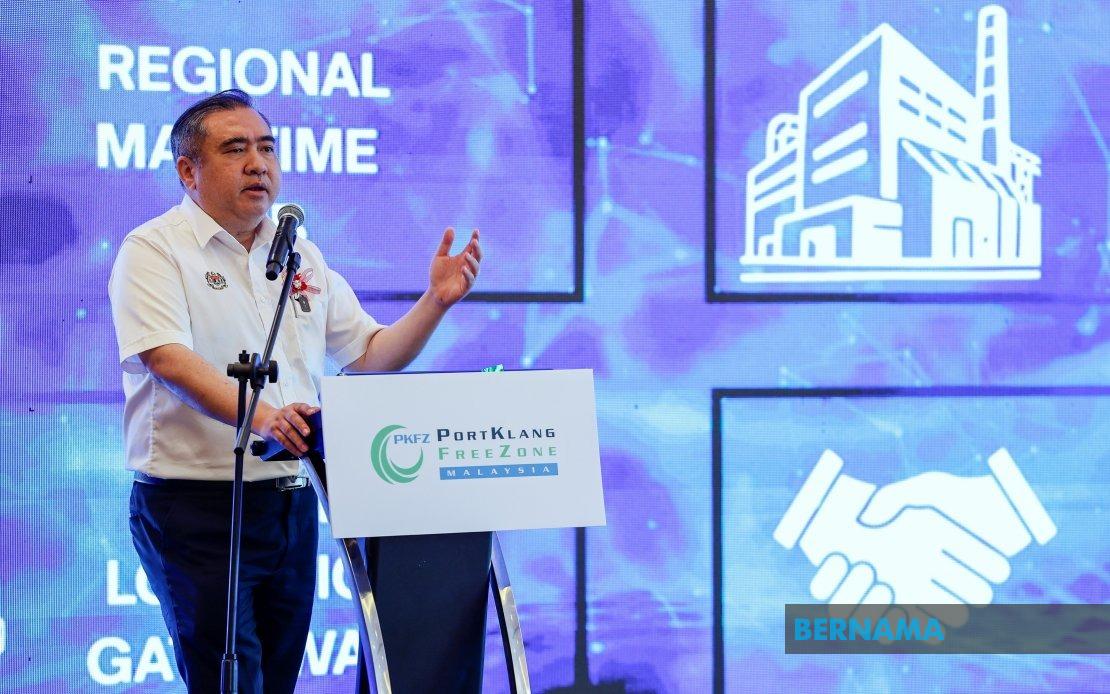
Port Klang's long-awaited third terminal is moving closer to reality as Selangor authorities and the Transport Ministry work through critical land ownership issues that have delayed the project. Transport Minister Anthony Loke confirmed that negotiations are advancing to resolve land disputes before construction can commence on the ambitious port expansion at Carey Island, with officials targeting a start date within the current year if administrative hurdles can be cleared.
The third terminal represents a significant infrastructure investment designed to strengthen Malaysia's competitive position in regional shipping and logistics. As global supply chains grow increasingly complex and port congestion becomes a recurring challenge across Southeast Asia, expanding Port Klang's capacity addresses a genuine economic need. The facility will operate under a Build-Operate-Transfer model, a framework increasingly favoured by Malaysian authorities as it allows private sector efficiency while maintaining eventual government control.
Understanding the land complexity is essential to appreciating why this project, despite high-level political backing, has not yet broken ground. Selangor's Menteri Besar Datuk Seri Amirudin Shari has identified 1,699.68 hectares earmarked for development, split between two categories of ownership. The state development corporation PKNS controls 1,011.71 hectares of seabed, while Yayasan Selangor holds title to 687.96 hectares of coastal land. This fragmented ownership structure, common in Malaysian port zones, requires careful coordination and formal agreements before a private concessionaire can proceed confidently with investment.
The project carries explicit endorsement from Malaysia's highest political levels. Prime Minister Datuk Seri Anwar Ibrahim previously instructed all relevant agencies to accelerate the third terminal's realisation, signalling its importance to the government's economic agenda. This top-down backing typically helps overcome bureaucratic delays, though as the current land-settlement phase demonstrates, even high-priority infrastructure faces real procedural constraints that cannot be simply willed away.
For Malaysian logistics and shipping operators, the third terminal's development has tangible implications. Port Klang currently handles over 13 million TEUs annually, ranking among Asia's busier container ports, yet congestion remains a consistent complaint. Additional berthing capacity at Carey Island would alleviate bottlenecks, reduce vessel waiting times, and lower transshipment costs—benefits that ripple through manufacturing and retail sectors dependent on imported components and exports.
The concession model governing development reflects international best practice, allowing specialized private operators to design, construct, and manage terminal infrastructure to modern standards. Malaysian ports have progressively adopted such arrangements, recognising that government agencies often lack the technical expertise and commercial agility required for competitive global port operations. However, the model's success hinges on clear contractual frameworks and secure property rights—precisely what the current land-settlement process aims to establish.
Beyond the third terminal itself, Port Klang's broader ecosystem is expanding. Recent ceremonies highlighted several concurrent industrial developments within the Port Klang Free Zone, including the opening of new factory facilities and logistics infrastructure representing RM566 million in cumulative investment. The PKFZ: Smart Intelligence Industrial Park launch signals the port's evolution toward higher-value operations incorporating digital supply-chain management and advanced logistics services. These complementary developments create synergies: a modernised port terminal attracts premium industrial operators, which in turn justifies further infrastructure investment.
The transport ministry is simultaneously addressing related sector challenges, particularly workforce shortages in commercial trucking. A memorandum of understanding between Port Klang Free Zone and Perhebat, the armed forces ex-servicemen's corporation, aims to channel military retirees into heavy vehicle driving roles. This initiative responds to a genuine skills gap in Malaysia's haulage industry, where driver shortages have constrained logistics capacity despite strong freight demand. By tapping the disciplined, experienced military veteran pool, authorities hope to fill positions while providing meaningful employment for retired service personnel—a solution that addresses multiple policy objectives simultaneously.
The government's March announcement of a special licensing programme for military retirees to obtain Class E heavy vehicle licenses reinforces this workforce strategy. Such targeted interventions recognise that supply-side constraints, not demand weakness, limit Malaysia's logistics capacity. As port infrastructure expands, corresponding investments in transportation human capital become equally critical to realising efficiency gains.
For Malaysian manufacturing exporters and import-dependent retailers, the timeline remains consequential. Every year the third terminal remains unbuilt represents foregone efficiency gains and continued congestion costs. However, the government's phased approach—resolving land issues first, then negotiating concession terms, finally commencing construction—reflects realistic project management rather than overly optimistic scheduling. Successful major infrastructure typically requires such patience, though it tests private sector enthusiasm for long-lead-time investments.
Regional competitors including Singapore, Thailand, and Vietnam have aggressively expanded container port capacity in recent years, partly to capture Malaysian trade diversion. Port Klang's third terminal represents a strategic response to this competitive pressure. By increasing capacity and modernising operations, Malaysia signals commitment to maintaining its role as Southeast Asia's primary transhipment hub, supporting not only national trade but also the region's broader supply-chain efficiency.
The land settlement process, while administratively tedious, ultimately protects both public and private interests. Clear ownership documentation and formal agreements between PKNS, Yayasan Selangor, and the eventual concessionaire will ensure the project proceeds on sound legal foundations. Shortcuts taken at this stage typically generate costly disputes later, so the current deliberate approach, though frustrating to impatient observers, represents prudent project governance.


%22%2F%3E%3C%2Fpattern%3E%3C%2Fdefs%3E%3Crect%20width%3D%22100%25%22%20height%3D%22100%25%22%20fill%3D%22url(%23ph40buhg)%22%2F%3E%3Crect%20width%3D%22100%25%22%20height%3D%22100%25%22%20fill%3D%22url(%23ph40buhp)%22%2F%3E%3Ctext%20x%3D%2250%25%22%20y%3D%2250%25%22%20text-anchor%3D%22middle%22%20dominant-baseline%3D%22central%22%20fill%3D%22rgba(255%2C255%2C255%2C0.95)%22%20font-family%3D%22Georgia%2C%20'Times%20New%20Roman'%2C%20serif%22%20font-weight%3D%22700%22%20font-size%3D%22320%22%20letter-spacing%3D%22-0.02em%22%3EGRS%3C%2Ftext%3E%3C%2Fsvg%3E)