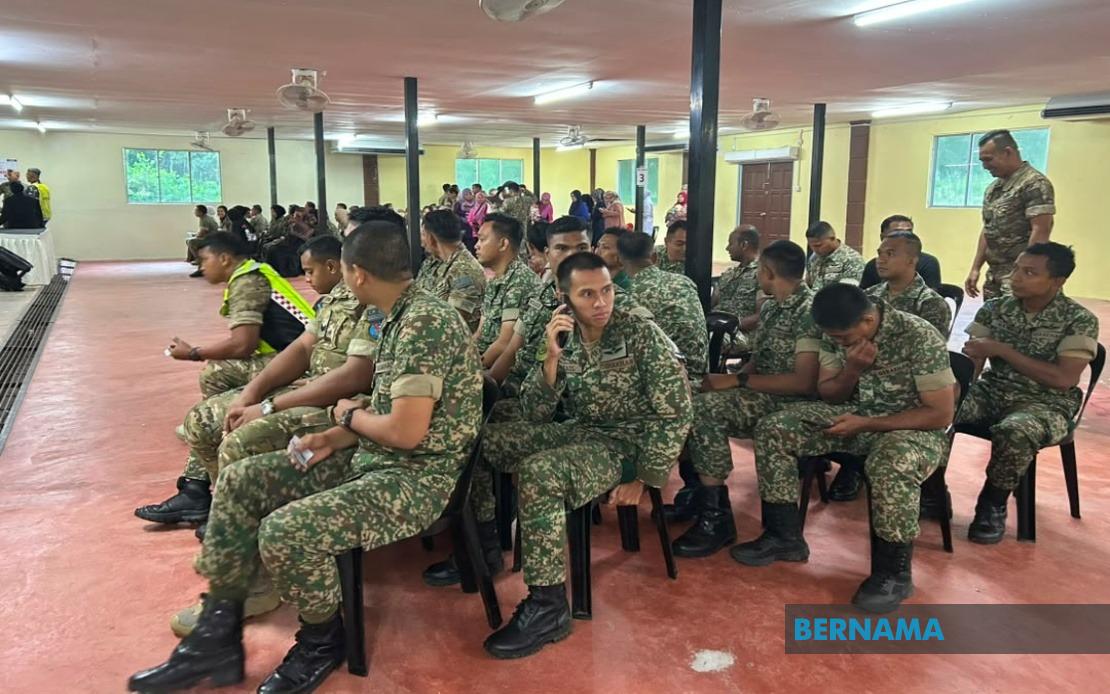
Nearly 25,000 early voters in Johor cast their ballots on Tuesday as security personnel and police officers participated in advance polling for the 16th state election, with senior government ministers emphasising the importance of fulfilling civic responsibilities with democratic integrity. The early voting process, which drew eligible members of the Malaysian Armed Forces alongside their spouses and police personnel with their families, represented a significant initial phase ahead of the main polling day scheduled for Saturday across all 56 state constituencies.
Home Minister Datuk Seri Saifuddin Nasution Ismail, who simultaneously holds the position of Pakatan Harapan secretary-general, appealed directly to early voters through social media messaging, framing their participation as both a right and an obligation bound by democratic principles. His statement emphasised that the voting exercise should be conducted with deliberation and accountability, underscoring the wider commitment to maintaining electoral integrity throughout the campaign period. Saifuddin Nasution further directed his coalition's campaign machinery to sustain engagement efforts through the final days of campaigning, calling for sustained grassroots activism and elevated discourse standards among party operatives and candidates alike.
Defence Minister Datuk Seri Mohamed Khaled Nordin similarly encouraged early voters to recognise their participation as instrumental to Johor's continued developmental trajectory. His messaging connected the act of voting to broader state-level policy objectives, suggesting that early voters bore responsibility for determining which political forces would steer the state's economic and social agenda forward. This framing placed individual voting decisions within a larger narrative of state governance and collective prosperity, resonating with voters' concerns about economic stability and infrastructure development.
Menteri Besar Datuk Onn Hafiz Ghazi, representing the ruling Barisan Nasional coalition, deployed a counter-appeal to early voters, urging them to place confidence in BN candidates as guarantors of stability, developmental progress, and public welfare provision. His statement articulated the ruling coalition's campaign positioning as custodians of continuity and institutional competence, contrasting this with implied alternatives. The Menteri Besar's emphasis on stability and welfare suggested BN was defending its governance record while appealing to voter risk-aversion regarding electoral change.
The physical mechanics of early voting involved 64 designated polling centres operating simultaneously across Johor, with staggered closure times between noon and 6 pm reflecting variations in eligible voter populations across different localities and military or police installations. The logistics demonstrated substantial administrative coordination, requiring election authorities to manage concurrent operations while maintaining security protocols appropriate for voting locations housing armed forces personnel and law enforcement officers.
The early voter composition itself carried strategic significance for both contending coalitions. The 12,041 armed forces personnel and their spouses, combined with 12,710 police officers and their families, comprised a concentrated bloc of approximately 25,000 voters drawn overwhelmingly from state institutions traditionally viewed as aligned with establishment politics. Security personnel voting early provided both coalitions with partial election returns before Saturday's main polling, offering preliminary indicators of support levels among this demographic segment.
The 16th Johor election represents a significant political contest within Malaysia's most populous state by registered voters, with both Pakatan Harapan and Barisan Nasional fielding candidates across all 56 state assembly constituencies. The total candidate slate of 172 individuals reflected competitive racing in multiple seats, suggesting either or both coalitions were defending seats while mounting offensives in opposition-held constituencies. The comprehensiveness of both coalitions' candidacy across all seats underscored the election's importance as a measure of national political sentiment within Johor's substantial electoral marketplace.
The appeals issued by the three senior political figures collectively underscored a shared commitment to procedural legitimacy and democratic norms, even as they advanced competing partisan interests. Their emphasis on peaceful, orderly, and smooth voting processes reflected both statutory electoral obligations and perceived political interests in avoiding controversy or disruption that might undermine either coalition's acceptance of results. The unified messaging around process integrity, despite fundamental partisan differences, suggested Malaysian electoral actors recognise reputational and institutional value in maintaining democratic form even during competitive contests.
For Malaysian voters and regional observers, the Johor election serves as a barometer of political opinion at a critical moment in the nation's political trajectory. The state's size, economic importance, and demographic diversity make it electorally consequential while representative of broader peninsular voting patterns. Early voting outcomes, combined with Saturday's main polling results, will provide insight into whether the post-2022 political recalibration has shifted voter preferences toward stability or generated appetite for political change within Malaysia's largest electorate.

