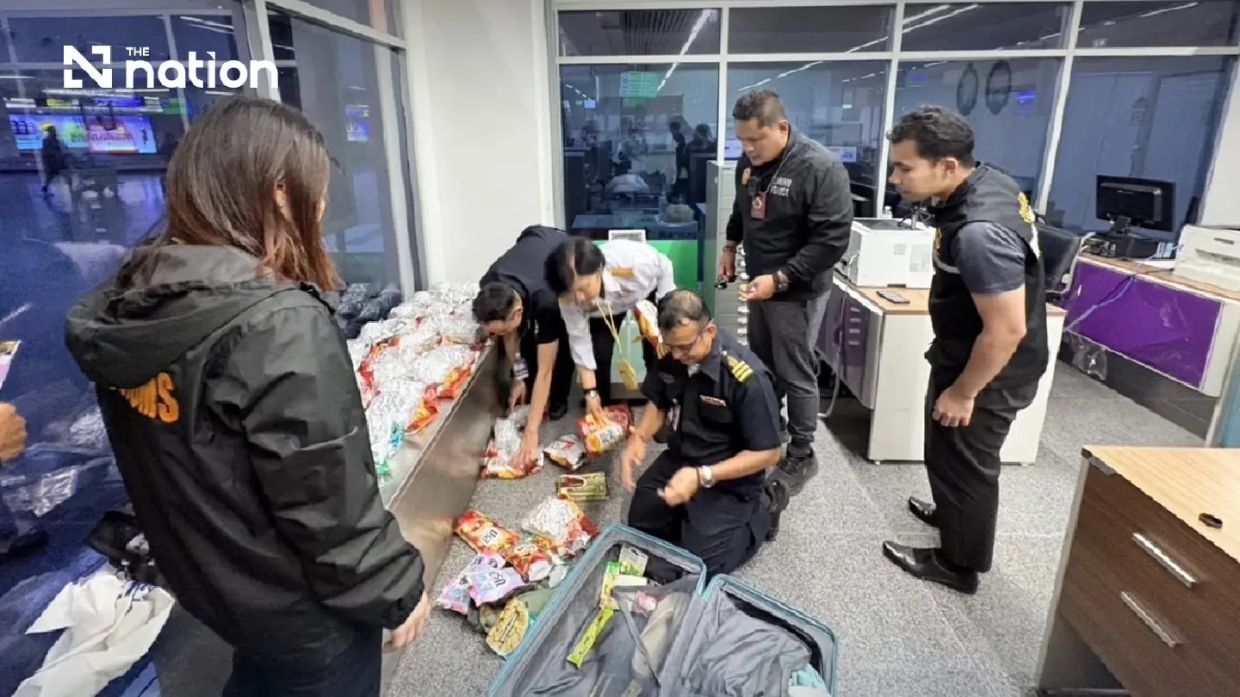
Customs authorities at Phuket International Airport have arrested a Russian national attempting to export a significant quantity of cannabis from Thailand. The July 8 incident unfolded at the international departure terminal in Mai Khao subdistrict, Thalang district, when customs officers led by Rawin Kanokakorn intercepted 30-year-old Sergei Chalabari as he prepared to leave the kingdom. The seizure represents a substantial drug trafficking operation and highlights ongoing enforcement challenges facing Thai authorities at major international gateways.
The contraband was discovered during routine baggage screening when officials examined two blue BP WORLD wheeled suitcases that together weighed eight kilogrammes. The inspection revealed meticulously packaged narcotics: 35 vacuum-sealed packages containing cannabis flowers totalling 11.4 kilogrammes, alongside 12 separate packages of cannabis resin weighing 6.2 kilogrammes combined. The total haul of 17.6 kilogrammes represents a commercially significant quantity that would command substantial value in international markets. Both suitcases and their contents were immediately secured as evidence.
During preliminary interrogation, Chalabari acknowledged ownership of both the luggage and all seized materials, eliminating any possibility of claiming ignorance or misunderstanding regarding the contraband. This admission substantially strengthened authorities' case and simplified subsequent legal proceedings. His willingness to confess likely reflects the overwhelming physical evidence and the clear circumstances under which he was apprehended, leaving little room for denial or legal maneuvering.
Thailand's drug trafficking statutes impose severe penalties for attempting to export narcotic substances without proper customs clearance. Chalabari now faces charges of attempting to smuggle goods out of the kingdom in violation of customs procedures, a classification that carries substantial prison sentences and financial penalties under Thai law. The gravity of the offence reflects both the quantity of contraband involved and the deliberate manner of concealment, which demonstrates premeditation and organised intent rather than casual possession.
The investigation transferred to Sakhu Police Station, where officers took custody of the suspect and seized materials for formal legal processing. The operation involved considerable coordination between multiple authorities, with Pol Col Salan Sankhisasanakun, superintendent of Sakhu Police Station, and Pol Lt Col Rattanawut Nukaew, deputy superintendent for investigation, overseeing the broader enforcement effort. This multi-agency approach reflects Thailand's commitment to combating drug smuggling through institutional cooperation and shared responsibility.
The case underscores persistent vulnerabilities in international travel security despite enhanced screening procedures. Phuket International Airport, Thailand's primary gateway for tourists travelling to the Andaman region, processes hundreds of thousands of passengers annually. While authorities successfully intercepted this shipment, the incident raises questions about how much contraband successfully passes through without detection and the methods employed by trafficking networks operating through Southeast Asian hubs.
Foreign nationals remain significantly represented in Thai drug smuggling cases, reflecting broader patterns of international narcotics trafficking networks utilising diverse operatives. Russian citizens have featured prominently in previous interdictions, suggesting either involvement of Russian-speaking criminal organisations or targeting of foreign nationals as expendable operatives by larger networks. The relatively modest profile and apparent limited resources of individual couriers like Chalabari contrasts sharply with the sophisticated logistics required to source, package, and coordinate international distribution.
The incident also highlights Thailand's strategic position within Southeast Asian drug trafficking routes. The kingdom serves as both a consumption market and transit point for narcotics destined for regional and international markets. Cannabis, increasingly trafficked as legalisation spreads globally, represents a growing component of regional drug smuggling alongside traditional heroin and methamphetamine operations. The professionalised packaging evident in Chalabari's suitcases suggests involvement with organised networks rather than individual entrepreneurial activity.
For Malaysian readers and regional observers, this arrest demonstrates the interconnected nature of Southeast Asian drug enforcement challenges. As neighbouring nations refine border security and airport screening protocols, smugglers adapt by utilising alternative routes and modalities. The cooperative frameworks developed through regional bodies and bilateral agreements remain essential, yet trafficking organisations consistently develop countermeasures and identify new vulnerabilities. Individual prosecutions represent tactical victories rather than strategic solutions to the underlying structural factors driving international drug trafficking through the region.
Chalabari's case will proceed through Thai judicial processes, with outcomes likely resulting in substantial imprisonment. However, the broader implications extend beyond individual consequences. The seizure demonstrates that deterrence through prosecution remains incomplete, as smuggling attempts continue despite known severe penalties and regular interdictions. Understanding the economic desperation, coercion, or incentive structures that motivated Chalabari's participation provides insight into the human dimensions of drug trafficking often obscured by statistics and enforcement announcements.

