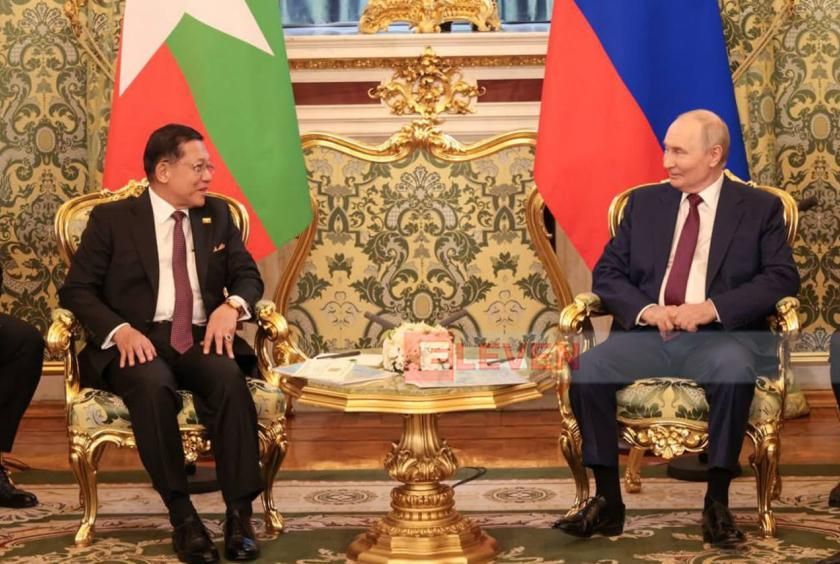
Russia has opened the door to expanded energy partnerships with Myanmar, with President Vladimir Putin pledging cooperation across offshore oil and gas exploration, liquefied natural gas exports, and nuclear power generation during talks with Myanmar President U Min Aung Hlaing in August. The declaration underscores Moscow's strategic interest in deepening ties with the Southeast Asian nation and securing a foothold in regional energy markets as Western sanctions continue to isolate Russia from traditional economic partnerships.
Putin's overture came during a joint media appearance, framed within a broader narrative of longstanding Russian–Myanmar friendship spanning decades. He positioned the Soviet Union's historical role in Myanmar's post-independence development as a foundation for contemporary cooperation, referencing infrastructure legacies from the 1950s and 1960s including hospitals and universities that continue serving the population. This rhetorical anchoring serves Moscow's aim of presenting itself not as a new power seeking leverage in the region, but as a reliable partner with proven commitment to Myanmar's development.
The energy sector emerged as the centrepiece of Russia's proposed engagement. Putin specifically highlighted potential for Russian liquefied natural gas exports to Myanmar, suggesting the gas could serve both domestic consumption and onward regional export. This proposition holds considerable significance for Myanmar, which has long struggled with energy security and infrastructure constraints. However, the feasibility of large-scale LNG imports remains contingent on Myanmar's capacity to finance such imports and develop necessary import terminals—challenges the country has grappled with in recent years.
Beyond hydrocarbon exploration, Moscow and Naypyidaw have already committed to constructing a nuclear power plant in Myanmar, with Putin describing the project as strategically vital for both nations. Nuclear development represents a particularly sensitive undertaking in Myanmar given regional sensitivities and the technical expertise required. The initiative also reflects Russia's broader strategy of leveraging nuclear technology as a diplomatic tool in Asia, positioning Moscow as a counter to Western technological dominance.
The partnership extends into industrial infrastructure development. Coal-fired power plants, oil refineries, steel mills, and fertiliser facilities are either under construction or in planning stages, indicating Russia's appetite for comprehensive industrial engagement rather than isolated energy transactions. Additionally, discussions have commenced regarding a deep-sea port in southern Myanmar, a project with profound implications for regional maritime commerce and power projection. Such port infrastructure could facilitate expanded Russian–Myanmar trade while potentially serving broader strategic interests for Moscow in the Indian Ocean region.
Military and security cooperation constitutes another pillar of the relationship. Putin noted that Russia and Myanmar conduct regular military exercises in Myanmar's territorial waters and that Russian naval vessels maintain a frequent presence in the country. This operational engagement translates into enhanced Russian capabilities for power projection in Southeast Asia and signals Moscow's commitment to maintaining strategic presence as China expands its own regional footprint.
The two countries have also pursued cooperation in cutting-edge technological domains. Russian entities are proposing projects in Myanmar's digital infrastructure, cybersecurity frameworks, and high-technology applications. Space cooperation, formalised through a 2025 agreement, represents another avenue for technological collaboration. These initiatives suggest Russia's intent to position itself as a modernisation partner across multiple sectors, appealing to Myanmar's aspirations for technological advancement.
People-to-people engagement forms the soft-power dimension of this partnership. A visa-free travel arrangement facilitates exchanges among scientists, students, athletes, and cultural figures. Approximately 400 Myanmar nationals currently study at Russian universities, with some 17,000 having graduated from Russian institutions historically, creating networks of individuals with professional and personal ties to Russia. Russian language instruction at Myanmar universities and military institutions reinforces these educational pipelines. Furthermore, establishment of Myanmar cultural and religious centres in Russian cities, coupled with approvals for a Russian Orthodox church in Yangon, reflects mutual interest in deepening cultural familiarity.
The timing of this expanded partnership merits attention within the Southeast Asian geopolitical context. Myanmar's military-led administration faces international isolation following the 2021 coup, making partnerships with countries like Russia—itself internationally isolated by Western sanctions—particularly valuable. Conversely, Russia seeks diversification of economic partnerships and strategic footholds amid Western containment, making Myanmar an attractive partner despite its modest economy and internal instability.
During U Min Aung Hlaing's visit to Moscow, the two governments formalised their cooperation intentions through 12 memorandums of understanding, covering sectors from energy to education. These documents provide the legal scaffolding for implementing the initiatives Putin outlined. However, translating memorandums into actual project execution faces hurdles including Myanmar's fragile macroeconomic position, ongoing internal conflict, and limited institutional capacity to undertake large-scale infrastructure projects.
For Malaysia and broader Southeast Asia, Russia's Myanmar engagement carries strategic implications. Expanded Russian presence in Myanmar could influence regional alignment, particularly regarding contested maritime boundaries and energy security frameworks. The proposed deep-sea port and expanded naval cooperation warrant regional monitoring, as they could alter maritime dynamics in waters adjacent to Malaysia's exclusive economic zone.
Putin's emphasis on mutual respect, non-interference in internal affairs, and opposition to what he termed interference in international organisations suggests Russia is positioning itself as sympathetic to Myanmar's desire for autonomy from external pressure—a message likely resonating with Myanmar's beleaguered military government. This diplomatic positioning allows Moscow to deepen influence while avoiding charges of neo-colonial domination, contrasting with Western criticism of Myanmar's governance.
The partnership's sustainability ultimately depends on Myanmar's ability to fund proposed projects and weather its internal political crises. Russia's willingness to engage economically with Myanmar despite its pariah status demonstrates Moscow's strategy of building alternative partnerships outside Western-dominated international systems. For Myanmar, Russian cooperation offers energy solutions, technological access, and diplomatic support, though at potential cost to relationships with Western nations and regional partners concerned about Russia's strategic intentions.

