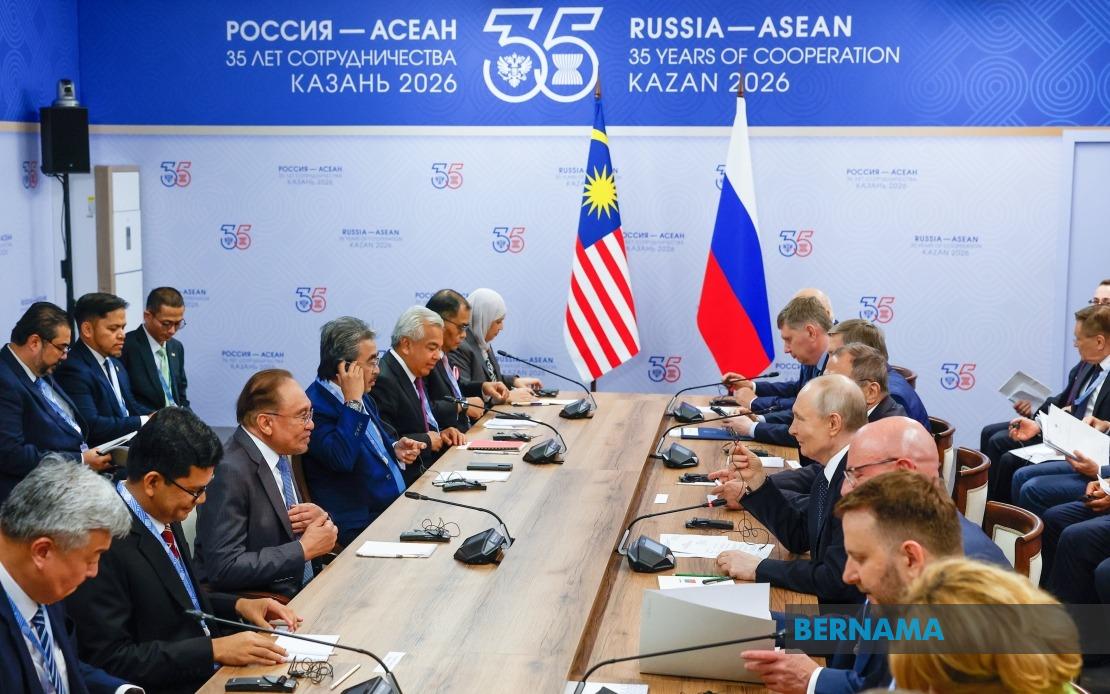
Russian President Vladimir Putin has signalled Moscow's commitment to deepening its relationship with Malaysia, describing the two countries as well-positioned to expand their strategic partnership as they approach a significant milestone. Speaking at the ASEAN-Russia Commemorative Summit in Kazan on June 18, Putin underscored the substantial foundation both nations have built for future collaboration, setting the stage for what could be an increasingly important bilateral relationship in the broader context of Russia-Southeast Asia dynamics.
The timing of Putin's remarks proved significant, as the conversation between the Russian leader and Malaysian Prime Minister Datuk Seri Anwar Ibrahim took place amid preparations for the 60th anniversary of formal diplomatic relations between Moscow and Kuala Lumpur scheduled for next year. This milestone represents not merely a historical marker but reflects decades of consistent engagement that has weathered geopolitical shifts and regional transformations. Putin emphasised that both nations approach this anniversary with what he termed "substantive positive experience," suggesting that the relationship has matured beyond ceremonial exchanges into practical cooperation across multiple sectors.
The institutional scaffolding supporting Russia-Malaysia ties extends across multiple channels, providing durability to the partnership regardless of broader political circumstances. Putin highlighted the regular engagement maintained through government ministries, specialised agencies, and parliamentary bodies, creating numerous touchpoints for dialogue and coordination. More importantly, he drew attention to an intergovernmental commission dedicated specifically to economic, scientific, technical and cultural cooperation, which serves as the principal mechanism for translating bilateral goodwill into concrete joint initiatives. This institutional infrastructure suggests that both countries have moved beyond ad-hoc collaboration toward a more structured approach to managing their relationship.
Tangible economic growth forms the backbone of Russia-Malaysia bilateral relations, with trade figures demonstrating resilience and expansion despite international sanctions and geopolitical tensions. Putin highlighted that bilateral trade increased by 12.9 per cent during 2025, characterising this growth as a positive indicator of the relationship's commercial vitality. For Malaysian businesses and policymakers, this trajectory indicates sustained opportunities within Russian markets, particularly in sectors where Malaysia possesses competitive advantages. The trade expansion occurs within a global context where many Western nations maintain restrictive measures toward Russia, making Malaysia's willingness to maintain and grow commercial ties particularly significant from Moscow's perspective.
Beyond trade statistics, Putin emphasised Russia's strong interest in collaborating with Malaysia across education, scientific research, technological development, tourism and cultural exchange. These non-commercial dimensions of bilateral engagement reflect recognition that durable partnerships require people-to-people connections and knowledge sharing alongside economic transactions. For Malaysian students, researchers and cultural professionals, expanded cooperation in these areas could unlock additional opportunities for advancement and international exposure. Russia's emphasis on these sectors also suggests that Moscow views Malaysia as a gateway to broader Southeast Asian engagement in educational and scientific domains.
Malaysia's role within ASEAN structures carries particular weight in Russian calculations, as Putin explicitly acknowledged. He welcomed Malaysia's support for strengthening the Russia-ASEAN strategic partnership, noting that Malaysia hosted the inaugural summit-level meeting between Russia and ASEAN in 2005. This historical point carries significance because it demonstrates Malaysia's long-standing willingness to serve as a bridge between Russia and the broader Southeast Asian community. Putin's appreciation for Malaysia's continued advocacy for this partnership suggests that Moscow values Malaysia not only as a bilateral partner but as an advocate within ASEAN for maintaining engagement with Russia, a role that becomes increasingly important as regional geopolitical alignments continue to evolve.
The reference to Malaysia's chairmanship of ASEAN in the previous year indicates recognition of Malaysia's elevated platform within regional affairs. Putin's comments suggest that Russia monitors Malaysia's rotating leadership roles closely and perceives them as opportunities to advance Moscow's interests within the broader Southeast Asian community. For Malaysia, this attention underscores both the opportunities and responsibilities that accompany leadership positions within ASEAN, as major powers seek to leverage such roles to advance their strategic objectives in the region.
Putin's characterisation of Malaysia as a "long-standing global partner" reflects Moscow's broader perception of the country's geopolitical significance. Rather than viewing Malaysia through a narrow transactional lens, Russian leadership appears to recognise the country's capacity to maintain pragmatic, balanced relationships with multiple major powers while advancing its own national interests. This appreciation likely stems from Malaysia's historical ability to navigate complex regional dynamics without aligning exclusively with any single power bloc, a quality increasingly valued in an era of intensifying great power competition.
The personal diplomatic gestures embedded in Putin's remarks deserve analytical attention, as they reflect the importance Russia attaches to relationship maintenance at the leadership level. His recollection of previous meetings with Anwar Ibrahim and his explicit request to convey best wishes to His Majesty Sultan Ibrahim, King of Malaysia, demonstrate attention to the ceremonial and personal dimensions of high-level diplomacy. Such gestures, while seemingly routine, serve important functions in maintaining goodwill and signalling respect for Malaysian institutions and leadership, particularly significant given the formal protocols surrounding monarchy in Malaysia.
The broader strategic context within which Russia-Malaysia relations operate cannot be overlooked. As Russia faces increasing isolation from Western nations due to its actions in Ukraine and broader geopolitical competition with NATO powers, Southeast Asian relationships assume heightened importance. Malaysia, as a significant regional economy and influential ASEAN member, becomes part of Russia's broader strategy to maintain international engagement and demonstrate that Moscow retains meaningful partnerships beyond its traditional sphere of influence. For Malaysia, maintaining productive relations with Russia while balancing relationships with Western powers and China requires sophisticated diplomatic navigation.
Looking forward, the 60th anniversary of diplomatic relations provides both nations with an opportunity to contemplate deeper integration. Putin's emphasis on "further expansion" suggests that Russia believes untapped potential exists in multiple domains, from energy cooperation to technological collaboration. For Malaysian policymakers, the challenge lies in identifying areas where deeper engagement with Russia creates genuine mutual benefit without compromising Malaysia's strategic autonomy or relationships with other important partners. The expansion of bilateral ties must be calibrated carefully to align with Malaysia's broader foreign policy objectives and regional positioning.
The substance of Putin-Anwar discussions at Kazan reflects a relationship in transition from routine diplomatic engagement toward more purposeful strategic coordination. Both nations possess complementary interests in maintaining ASEAN unity, promoting multipolarity in international affairs, and expanding economic cooperation. As regional alignments continue to shift and new technologies reshape global competition, the Russia-Malaysia partnership may offer both countries valuable opportunities for differentiation and influence within their respective spheres. The challenge ahead involves translating diplomatic goodwill into measurable outcomes that benefit ordinary citizens in both nations through job creation, technological advancement and cultural enrichment.

%22%2F%3E%3C%2Fpattern%3E%3C%2Fdefs%3E%3Crect%20width%3D%22100%25%22%20height%3D%22100%25%22%20fill%3D%22url(%23ph40buhg)%22%2F%3E%3Crect%20width%3D%22100%25%22%20height%3D%22100%25%22%20fill%3D%22url(%23ph40buhp)%22%2F%3E%3Ctext%20x%3D%2250%25%22%20y%3D%2250%25%22%20text-anchor%3D%22middle%22%20dominant-baseline%3D%22central%22%20fill%3D%22rgba(255%2C255%2C255%2C0.95)%22%20font-family%3D%22Georgia%2C%20'Times%20New%20Roman'%2C%20serif%22%20font-weight%3D%22700%22%20font-size%3D%22320%22%20letter-spacing%3D%22-0.02em%22%3EGRS%3C%2Ftext%3E%3C%2Fsvg%3E)