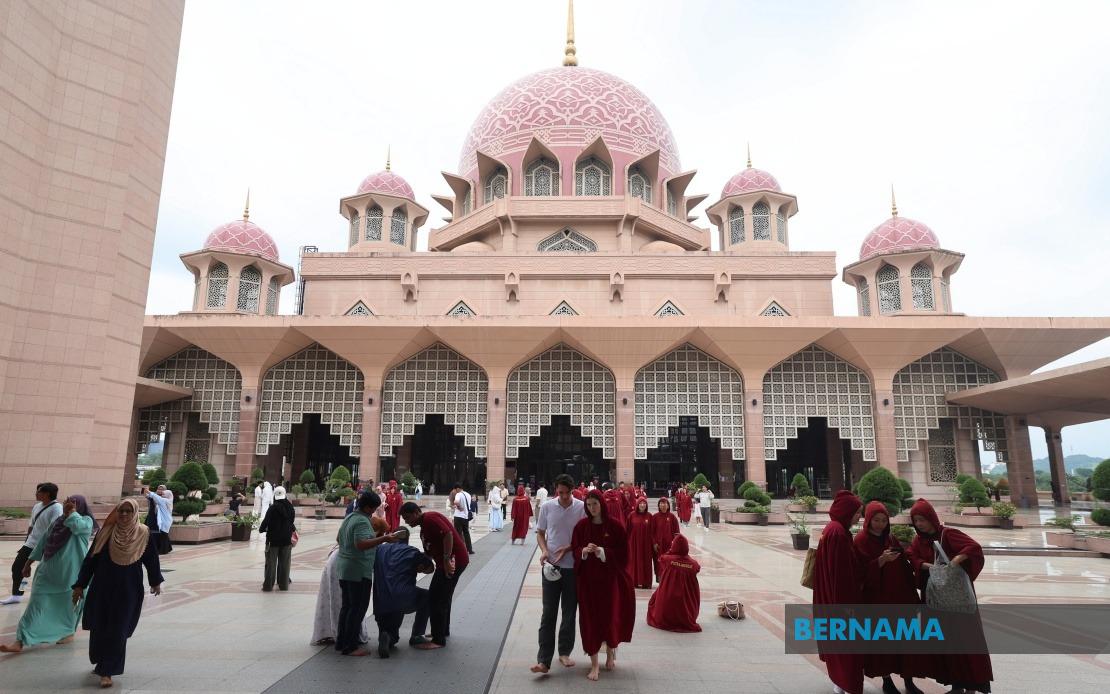
The Putra Mosque in Putrajaya is preparing to welcome approximately 5,000 attendees for the National Maal Hijrah 1448H/2026M celebration, marking a significant religious and national observance that brings together prominent figures from government, diplomacy, and Islamic leadership. The gathering represents one of Malaysia's most important Islamic occasions, drawing both domestic participants and guests from overseas to commemorate the historic migration of Prophet Muhammad SAW and its profound significance in Islamic history.
Sultan of Perak Sultan Nazrin Shah will officiate the proceedings, underscoring the event's national importance and royal patronage. His presence reflects the traditional role of Malaysia's sultans in endorsing and elevating major Islamic celebrations. The formal programme will feature his royal address, a moment anticipated by attendees as a key highlight of the day's activities. This ceremonial dimension reinforces the connection between Malaysia's Islamic institutions and the constitutional monarchy, a relationship that remains central to the nation's identity.
The guest list encompasses Malaysia's highest levels of government representation. Deputy Prime Ministers Datuk Seri Ahmad Zahid Hamidi and Datuk Seri Fadillah Yusof are confirmed attendees, alongside numerous Cabinet ministers, department heads, and senior officials. International representation through foreign dignitaries demonstrates Malaysia's commitment to fostering interfaith and cross-cultural dialogue within an Islamic context, positioning the nation as a bridge between the Muslim world and the broader international community. This diplomatic dimension has become increasingly important as Malaysia navigates its role in regional geopolitics.
A central feature of the celebration involves the presentation of the National and International Tokoh Maal Hijrah Awards, recognising exceptional individuals whose work embodies Islamic principles and contributes meaningfully to the faith's advancement. Recipients are selected based on rigorous criteria encompassing deep knowledge within their professional domains, moral excellence, and tangible efforts to strengthen Islam at both national and transnational levels. These awards serve not merely as ceremonial recognition but as a mechanism for identifying and elevating role models whose examples can inspire broader Muslim communities across Malaysia and beyond.
The Department of Islamic Development Malaysia (JAKIM) has chosen this year's theme deliberately to reconnect contemporary Muslims with the spiritual essence of Hijrah. The migration of Prophet Muhammad SAW represented far more than a physical relocation; it symbolised the establishment of the first Islamic civilisation based on divine principles and communal values. By encouraging modern Muslims to understand Hijrah as a blueprint for positive transformation, JAKIM seeks to translate a seventh-century historical event into practical guidance for addressing contemporary challenges facing Muslim societies.
Innovation in this year's programming reflects evolving approaches to religious observance in Malaysia. The Tausiyyah @ Maal Hijrah programme, held at Putra Mosque in the days preceding the main celebration, introduced structured reflection on Quranic verses through the concept of tadabbur. Participants engaged not simply in passive listening to quranic recitations by accomplished qari, but in guided contemplation aimed at extracting wisdom and practical application from sacred texts. This pedagogical shift acknowledges that contemporary audiences benefit from facilitated understanding rather than traditional lecture formats alone.
The deliberate pairing of Quranic reflection with an emphasis on viewing Hijrah as a catalyst for positive change carries particular relevance for Malaysian audiences navigating rapid social transformation. The programme encourages Muslims to interpret the Prophet's migration not as a retreat from the world but as an exemplar of purposeful action, strategic planning, and commitment to enduring principles despite external pressures. This framing proves especially significant given Malaysia's multicultural context, where Muslims must balance religious observance with civic duties and intercommunal coexistence.
Following the main celebration, the National and International Tokoh Maal Hijrah Lecture scheduled for the following day at Putrajaya Islamic Complex Auditorium extends the event's educational impact. This venue shift and timing strategy allows award recipients to deliver substantive addresses sharing their professional expertise and personal journeys, transforming the celebration into a knowledge-sharing platform. The lecture format provides international guests and domestic participants with concrete insights into how Islamic principles translate into practical achievement across diverse professional fields, from academia and business to humanitarian work and governance.
The scale and composition of this year's gathering reflect broader trends in how Malaysia approaches Islamic commemoration. Rather than confining religious observances to mosque settings or purely spiritual contexts, the government increasingly integrates state machinery, diplomatic engagement, and institutional infrastructure into Islamic events. This approach simultaneously elevates the status of religious occasions within the national calendar and ensures government coordination with spiritual leadership in framing narratives about Islam's contemporary relevance. For Malaysian Muslims and international observers, such events communicate official commitment to Islamic identity as integral to national governance rather than peripheral to it.
The emphasis on international participation carries implications extending beyond ceremonial courtesy. By hosting foreign representatives and international award recipients, Malaysia reinforces its positioning as a centre of Islamic thought and practice beyond the Middle East. This diversification of Islamic intellectual and spiritual authority holds significance in an era when Muslim-majority nations increasingly compete for influence in global Islamic discourse. Malaysia's Maal Hijrah celebration, with its carefully curated mix of national leaders, religious scholars, and international figures, exemplifies soft power strategy rooted in cultural and religious credibility rather than military or economic coercion.
For Southeast Asian context specifically, Malaysia's prominent Maal Hijrah observance offers neighbouring Muslim communities in Indonesia, Brunei, and southern Thailand a model for integrating religious commemoration with state authority and international engagement. The event demonstrates how Islamic traditions can be practised within modern institutional frameworks without compromising spiritual authenticity. This balance proves increasingly important as Muslim-majority nations across the region navigate pressures from both secular globalisation and transnational Islamic movements, seeking middle paths that preserve religious values while enabling economic development and social stability.
The cumulative effect of these various dimensions—royal patronage, government participation, international representation, institutional innovation, and educational programming—positions the National Maal Hijrah celebration as far more than a religious commemoration. It functions as a statement about Islam's centrality to Malaysian identity, Muslim scholarly excellence, interfaith engagement potential, and the nation's aspirations within regional and global hierarchies. Attendees departing Putrajaya will carry back to their respective communities and countries narratives about Islam as a dynamic, intellectually vibrant tradition capable of addressing contemporary challenges while honouring historical legacy, precisely the message Malaysia appears intent on projecting through such carefully orchestrated events.

%22%2F%3E%3C%2Fpattern%3E%3C%2Fdefs%3E%3Crect%20width%3D%22100%25%22%20height%3D%22100%25%22%20fill%3D%22url(%23ph40buhg)%22%2F%3E%3Crect%20width%3D%22100%25%22%20height%3D%22100%25%22%20fill%3D%22url(%23ph40buhp)%22%2F%3E%3Ctext%20x%3D%2250%25%22%20y%3D%2250%25%22%20text-anchor%3D%22middle%22%20dominant-baseline%3D%22central%22%20fill%3D%22rgba(255%2C255%2C255%2C0.95)%22%20font-family%3D%22Georgia%2C%20'Times%20New%20Roman'%2C%20serif%22%20font-weight%3D%22700%22%20font-size%3D%22320%22%20letter-spacing%3D%22-0.02em%22%3EGRS%3C%2Ftext%3E%3C%2Fsvg%3E)