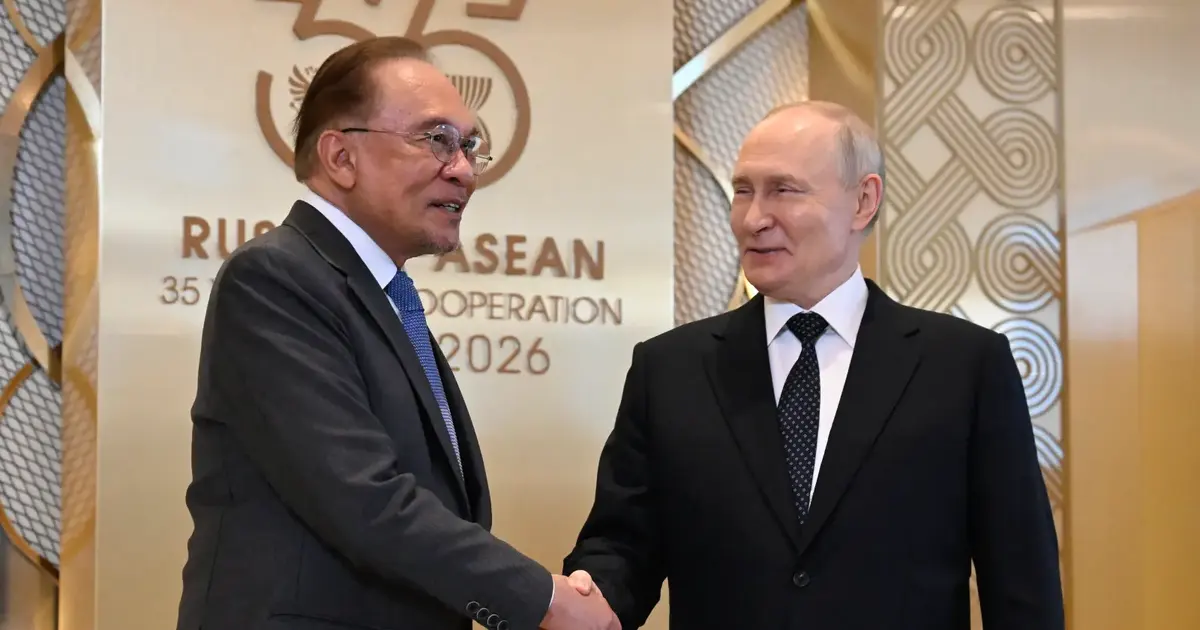
Malaysia has secured a significant energy commitment from Russia, with President Vladimir Putin guaranteeing crude oil and liquefied natural gas supplies extending over the next 20 years, according to Prime Minister Anwar Ibrahim. The assurance represents a stabilisation of bilateral energy ties at a time when Malaysia faces mounting pressure to diversify its economic relationships and secure long-term commodity access across volatile global markets.
The pledged energy corridor addresses a strategic concern for Malaysia's industrial base and power generation sector. Domestic reserves of crude oil and natural gas have been declining for several years, necessitating greater reliance on imported supplies to maintain energy security and sustain manufacturing competitiveness. A two-decade guarantee from a major energy exporter eliminates price volatility risk over that horizon and provides predictability for long-range infrastructure and industrial planning. For Malaysian refineries and petrochemical complexes, such certainty permits investment in facility upgrades and capacity expansion without the shadow of future supply disruptions.
The Russia-Malaysia energy engagement unfolds within a broader geopolitical context of shifting supply dynamics in Asia. Traditional suppliers in the Middle East remain important, yet diversification across multiple sources—including Central Asia, Southeast Asia, and Russia—reduces dependency on any single region and mitigates exposure to regional conflicts or supply shocks. Malaysia's geographic position as a major refining and trading hub for Asian energy markets amplifies the significance of stable inbound flows, as downstream customers across the region depend on Malaysian facilities and logistics infrastructure.
Prime Minister Anwar Ibrahim's simultaneous engagement with Turkmenistan signals Malaysia's intent to deepen ties across Central Asia's resource-rich economies. Turkmenistan itself is a substantial natural gas producer, particularly relevant given its proximity to Asian markets through pipeline corridors and its liquefied export capacity. The visit addresses a secondary dimension of Malaysia's energy strategy: moving beyond mere consumption to playing an active role in continental supply chains that link Central Asian reserves with Asian buyers. This positions Malaysia as a potential facilitator and intermediary in energy trade rather than a passive purchaser.
Beyond hydrocarbons, the Prime Minister's delegation is pursuing export opportunities with China, Japan, and South Korea—three cornerstone economies of regional manufacturing and consumption. Malaysia's manufacturing sector, particularly electronics, semiconductors, chemicals, and refined petroleum products, depends on market access to these countries. Expanding exports to these major economies directly correlates with domestic employment, industrial capacity utilisation, and foreign exchange earnings. Each market presents distinct demand structures: China's scale and diverse industrial base, Japan's high-value manufacturing and technology standards, and South Korea's advanced technology and petrochemical sectors all demand tailored approaches to market penetration and competitiveness.
The timing of these negotiations reflects Malaysia's economic priorities during a period of moderating global growth. Securing long-term energy supplies at favourable terms bolsters cost competitiveness for Malaysian manufacturers, particularly those competing in price-sensitive sectors. Simultaneously, enhancing export channels to major Asian markets protects against the risk of slowing demand in traditional Western markets and provides growth pathways aligned with Asia's economic trajectory. The convergence of energy security and market access within a single strategic engagement demonstrates sophisticated statecraft aimed at maximising economic returns from bilateral relationships.
Central Asia represents an underdeveloped opportunity for Malaysian businesses and investors. The region offers abundant natural resources, emerging consumer markets, and potential collaboration in processing and value-added industries. Limited Malaysian presence in Turkmenistan and other Central Asian states suggests considerable headroom for deepening economic footprint. Visits by senior Malaysian officials and energy agreements create diplomatic scaffolding upon which broader commercial relationships can develop. Trade chambers, business delegations, and joint ventures often follow government-to-government commitments, gradually building the institutional and commercial networks necessary for sustained economic engagement.
Energy costs constitute a structural determinant of Malaysia's competitiveness in labour-intensive manufacturing sectors. Countries competing for investment in electronics assembly, textiles, and chemicals production benefit from lower input costs including energy. A long-term guarantee of Russian oil and gas supplies, potentially at contractually advantageous rates, enhances Malaysia's appeal as a manufacturing destination relative to competitors in Bangladesh, Vietnam, or Indonesia. Multinational corporations evaluating factory locations factor energy price stability and supply certainty into site selection decisions. Malaysia's improved energy security profile may therefore yield tangible foreign direct investment dividends extending years into the future.
The Russia-Malaysia energy arrangement also carries subtle implications for Malaysia's balancing act between great-power relationships. As a non-aligned nation, Malaysia maintains relationships with Russia, Western powers, and China simultaneously. Energy partnerships with Russia do not necessitate political alignment but do signal economic pragmatism and commitment to diversified partnerships. For Malaysia, such engagements underscore a foreign policy philosophy rooted in economic interests rather than ideological bloc membership—an approach increasingly appealing to Southeast Asian nations seeking autonomy within an increasingly polarised geopolitical environment.
Looking forward, the substantive implementation of these agreements will determine their actual impact. Long-term energy contracts require establishing logistical networks, payment mechanisms, and regulatory frameworks. Similarly, export expansion to China, Japan, and South Korea demands competitive pricing, quality standards, and reliable supply chains. The announcements represent political commitments and strategic intention, yet the intervening months and years will reveal whether these pledges translate into sustained flows of energy and goods, or remain aspirational declarations. Monitoring contract finalisations, shipment volumes, and export growth metrics will provide Malaysian investors and policymakers with realistic assessments of the engagement's economic contribution.
%22%2F%3E%3C%2Fpattern%3E%3C%2Fdefs%3E%3Crect%20width%3D%22100%25%22%20height%3D%22100%25%22%20fill%3D%22url(%23ph2z7t1g)%22%2F%3E%3Crect%20width%3D%22100%25%22%20height%3D%22100%25%22%20fill%3D%22url(%23ph2z7t1p)%22%2F%3E%3Ctext%20x%3D%2250%25%22%20y%3D%2250%25%22%20text-anchor%3D%22middle%22%20dominant-baseline%3D%22central%22%20fill%3D%22rgba(255%2C255%2C255%2C0.95)%22%20font-family%3D%22Georgia%2C%20'Times%20New%20Roman'%2C%20serif%22%20font-weight%3D%22700%22%20font-size%3D%22272%22%20letter-spacing%3D%22-0.02em%22%3EAnwar%3C%2Ftext%3E%3C%2Fsvg%3E)