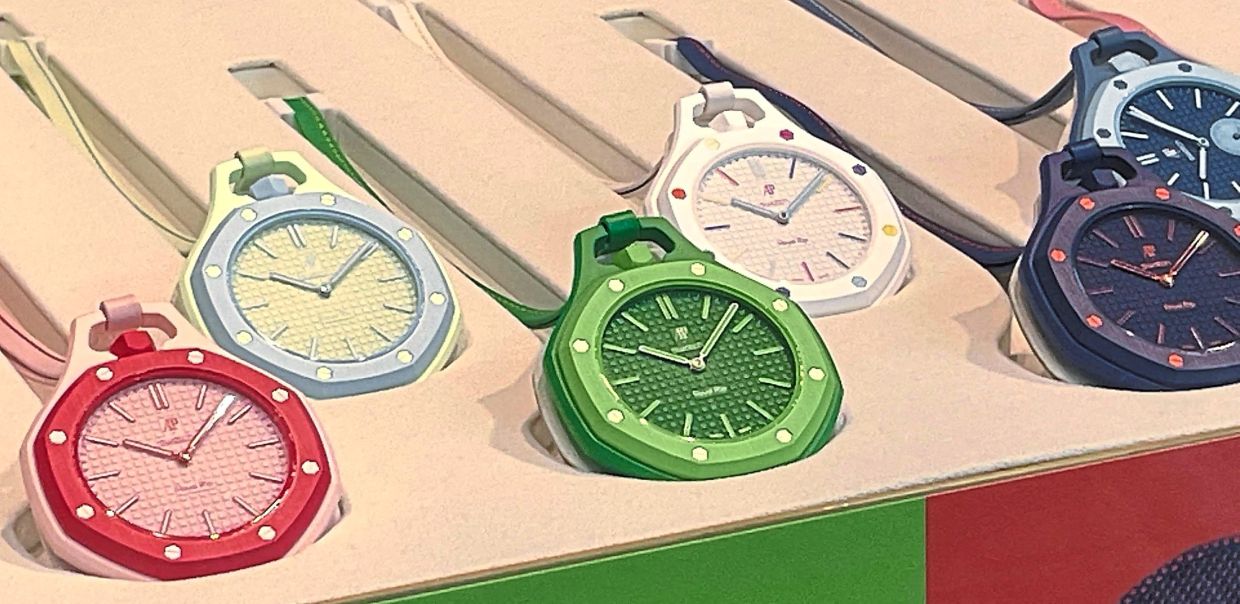
When Swatch and Audemars Piguet unveiled Royal Pop on May 16, the watch industry witnessed a carefully orchestrated collision between mass-market accessibility and haute horlogerie prestige. The collaboration introduced eight bioceramic pocket watches priced below S$600 (RM1,800)—a figure that would represent a fraction of even entry-level Royal Oak wristwatch pricing—yet sparked the kind of cultural frenzy typically reserved for limited-edition luxury releases. The launch generated substantial visibility across media channels and social platforms, yet it simultaneously exposed a fundamental shift occurring within luxury marketing: the cultivation of manufactured scarcity and consumer desire that transcends traditional notions of exclusivity.
The path to Royal Pop's announcement exemplified modern luxury theatre. Beginning weeks before the official May 12 reveal, cryptic newspaper advertisements and social media teasers hinted at something simultaneously "iconic" and "unexpected," language deliberately vague enough to stimulate speculation. Watch enthusiasts and casual observers alike filled informational voids with theories and artificial intelligence-generated renderings that circulated rapidly across Reddit, Instagram, and dedicated horological forums. Simultaneously, strict non-disclosure agreements and tightly compartmentalised teams ensured that credible details and official imagery remained embargoed, preventing leaks that might prematurely satisfy curiosity. This carefully managed secrecy functioned as a tension-building mechanism, transforming anticipation into something approaching fervent impatience.
The actual reveal subverted expectations in significant ways. Rather than producing affordable wristwatch interpretations of the Royal Oak—a design that has defined Audemars Piguet's identity since 1972—the collaboration pivoted entirely toward pocket watches. This format choice carried genuine strategic implications. The collection borrowed Gerald Genta's most recognisable Royal Oak elements: the octagonal bezel geometry, the distinctive "Petite Tapisserie" dial pattern, and eight visible hexagonal screws. Available in two configurations—Lepine models with crowns positioned at twelve o'clock and Savonnette pieces featuring three o'clock crowns with small seconds subdials—the watches employed hand-wound SISTEM51 movements, mechanically transparent designs emphasising minimalist construction rather than the traditional complexity associated with haute horlogerie.
The bioceramic material selection reinforced the collection's tonal departure from luxury solemnity. These polymer-ceramic composites, typically associated with playfulness and contemporary design rather than precious metals and traditional craftsmanship, positioned Royal Pop as a deliberate reinterpretation rather than a diluted copy. This distinction proved crucial to the brand strategy. Audemars Piguet avoided positioning Royal Pop as an "affordable Royal Oak," a framing that would have directly challenged the brand's core wristwatch ecosystem, where entry-level models command prices near S$30,000 (RM94,881). By transposing the Royal Oak's visual language into pocket watches—a nostalgic, niche category largely abandoned by modern watchmaking—Audemars Piguet maintained sufficient psychological and categorical distance from its prestigious main line, permitting creative play with heritage design codes without substantively threatening brand exclusivity.
For Swatch, Royal Pop represents a calculated escalation following the stunning success of its 2022 MoonSwatch collaboration with Omega. That partnership demonstrated the commercial power of pairing an accessible mass-market brand with established luxury credentials. Lengthy queues formed at retail locations across multiple continents; police deployed crowd-management resources in several cities; resellers quickly flipped units at substantial markups. These dynamics emerged despite prices below S$400 (RM1,265)—price points typically considered incompatible with scarcity-driven luxury marketing. The MoonSwatch revealed something profound about contemporary consumer psychology: controlled artificial scarcity, regardless of retail price, can generate disproportionate cultural buzz, media attention, and commercial momentum.
Royal Pop amplifies this playbook while introducing crucial variations. Unlike Omega, which operates within the Swatch Group's corporate structure, Audemars Piguet maintains independence, a distinction that transforms Royal Pop from another internal co-branded exercise into something more strategically ambitious. The collaboration signals Swatch's evolution from watch manufacturer into a platform through which independent luxury houses can expand audience reach without compromising their core brand positioning. This represents a genuine innovation in luxury strategy: providing established heritage brands access to younger, price-sensitive consumers through carefully quarantined side projects rather than permanent product line extensions.
Pat Law, founder of local social marketing agency Goodstuph, articulates the value exchange operating within such collaborations: "Luxury today is not just about ownership anymore. It's about proximity." For Swatch, this proximity translates directly into cultural elevation. Overnight, a playful plastic watch inherits decades of accumulated craftsmanship narratives, horological prestige, and design heritage. Swatch's brand identity simultaneously becomes intertwined with aspirational luxury codes that would require years of independent development to achieve. For Audemars Piguet, the calculus differs substantially. The brand acquires contemporary relevance at significant scale without requiring product line dilution. Most young consumers would never voluntarily enter an Audemars Piguet boutique, yet Royal Pop introduces the brand directly into their cultural consciousness, occupying mental space years before they potentially develop sufficient financial means to purchase traditional pieces.
Yet this stratagem carries genuine risks that extend beyond immediate commercial calculations. Academic research examining luxury brand democratisation suggests that while accessibility-focused collaborations generate compelling short-term sales spikes and media attention, they simultaneously introduce erosion dynamics threatening long-term brand equity. When visual identity codes become widely distributed and accessible to mass audiences, the psychological differentiation distinguishing luxury from ordinary diminishes proportionally. Consumers who encounter Royal Pop's octagonal bezels and characteristic tapisserie patterns might develop reduced desire for corresponding wristwatch versions, reasoning that design codes they already possess—even in alternative formats—no longer represent exclusive achievement. The pocket watch format provides some insulation against this dynamic, but the risk remains meaningful, particularly if Swatch subsequently launches additional Royal Oak interpretations featuring more accessible formats.
The Royal Pop phenomenon also reflects broader transformations within how contemporary consumers construct luxury meaning. Ownership remains important, yet proximity, cultural currency, and narrative participation increasingly shape aspirational brand relationships. Younger consumers demonstrate reduced attachment to permanent acquisitions and enhanced interest in experiential participation—whether queuing for limited releases, sharing social media documentation, or possessing cultural knowledge about collaboration announcements. Royal Pop capitalises on these shifting preferences by making the brand accessible through engagement and narrative rather than primarily through ownership. The pocket watches themselves, while charming and mechanically competent, function secondarily to the cultural cachet surrounding their acquisition.
For Malaysian and Southeast Asian consumers, Royal Pop carries particular resonance. The region has demonstrated exceptional enthusiasm for collaborative luxury releases, with MoonSwatch launches generating similar queuing phenomena across urban centres. The affordable luxury positioning aligns with regional purchasing preferences, where brand prestige and design heritage matter substantially yet price accessibility remains important. Audemars Piguet's historical positioning as aspirational luxury—desirable yet financially remote for most consumers—transforms through Royal Pop into something tangible and obtainable within single paycheques. This recalibration potentially reshapes regional brand perception, introducing younger consumers to Audemars Piguet's design language and horological reputation through an accessible gateway.
Moving forward, the success of Royal Pop will likely determine whether collaborative luxury becomes institutionalised strategy or remains novelty phenomenon. If watches achieve rapid sell-throughs and maintain secondary market premiums, expect additional heritage brands to approach Swatch with similar propositions. However, if saturation dilutes the cultural exclusivity these collaborations initially generate, the model may lose commercial viability. The pocket watch format provides Audemars Piguet meaningful protection against brand dilution, yet the psychological risks remain genuine. Luxury fundamentally depends upon scarcity, exclusivity, and differentiation—dynamics that direct accessibility simultaneously reinforces and undermines.


%22%2F%3E%3C%2Fpattern%3E%3C%2Fdefs%3E%3Crect%20width%3D%22100%25%22%20height%3D%22100%25%22%20fill%3D%22url(%23ph40buhg)%22%2F%3E%3Crect%20width%3D%22100%25%22%20height%3D%22100%25%22%20fill%3D%22url(%23ph40buhp)%22%2F%3E%3Ctext%20x%3D%2250%25%22%20y%3D%2250%25%22%20text-anchor%3D%22middle%22%20dominant-baseline%3D%22central%22%20fill%3D%22rgba(255%2C255%2C255%2C0.95)%22%20font-family%3D%22Georgia%2C%20'Times%20New%20Roman'%2C%20serif%22%20font-weight%3D%22700%22%20font-size%3D%22320%22%20letter-spacing%3D%22-0.02em%22%3EGRS%3C%2Ftext%3E%3C%2Fsvg%3E)