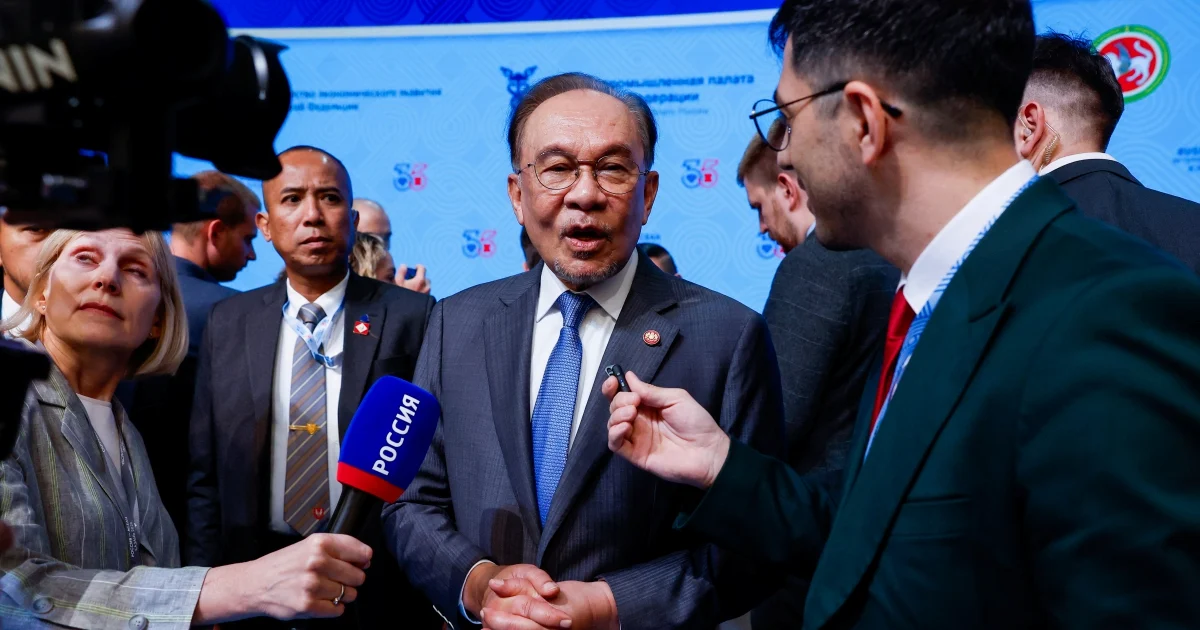
Prime Minister Datuk Seri Anwar Ibrahim has made an unexpected personal revelation about his cultural tastes, underscoring a broader diplomatic philosophy that positions arts and literature as fundamental instruments for building stronger international partnerships. Speaking during his time in Kazan, the prime minister articulated his fondness for Russian musical compositions and written works, framing these aesthetic interests within the context of how nations might deepen their bonds through avenues beyond commerce and trade.
The prime minister's acknowledgment of his appreciation for Russian cultural products reflects a deliberate diplomatic stance. By publicly endorsing Russian artistic traditions, Anwar has signalled that Malaysia views Russia not merely as an economic partner or geopolitical actor, but as a custodian of intellectual and creative heritage worthy of engagement and study. This positioning carries particular weight in the contemporary international environment, where bilateral relationships increasingly depend on multifaceted connections spanning political, economic, and cultural domains.
Anwar's remarks underscore an understanding that cultural exchanges function as a counterbalance to transactional arrangements. While trade agreements and investment protocols constitute the conventional machinery of statecraft, the prime minister argues that artistic and literary appreciation creates what might be termed soft diplomatic capital. When leaders demonstrate genuine interest in a nation's cultural output, they communicate respect for its civilisational contributions and openness to understanding its worldview through the perspectives enshrined in its art forms.
Russia possesses an extraordinarily rich musical heritage spanning centuries, from classical composers like Tchaikovsky and Shostakovich to contemporary artists. Similarly, Russian literature—encompassing towering figures such as Tolstoy, Dostoevsky, and Pushkin—has fundamentally shaped global intellectual discourse. Anwar's invocation of these traditions suggests Malaysia recognises the intellectual depth and historical significance embedded within Russian cultural production. For Malaysian audiences, this represents a reminder that exposure to different literary and musical worlds expands understanding of other societies and their values.
The mention of literary appreciation carries additional weight given Anwar's own reputation as an intellectual figure within Malaysian politics. Throughout his career, he has positioned himself as a leader engaged with ideas, philosophy, and the written word. His disclosure of fondness for Russian literature aligns with a personal brand that emphasises intellectual curiosity and cosmopolitan sensibilities. This alignment strengthens the credibility of his remarks about cultural diplomacy, as listeners perceive him as speaking from genuine conviction rather than mere rhetorical necessity.
For Malaysia-Russia relations specifically, Anwar's emphasis on cultural exchange opens potential new channels of engagement. Academic partnerships, artistic collaborations, literary translation initiatives, and musical performances could become more prominent components of bilateral relations. Universities might develop exchange programmes centring on Russian language and culture; publishing houses could invest in translating contemporary Russian authors for Southeast Asian audiences; cultural institutions could facilitate exhibitions of Russian artistic works. These initiatives, though seemingly modest compared to trade statistics, build reservoirs of mutual understanding that render diplomatic relationships more resilient.
The timing of these remarks also warrants consideration. Malaysia navigates a complex geopolitical landscape where maintaining balanced relationships across multiple poles remains a strategic imperative. By articulating appreciation for Russian cultural achievements during a visit to Kazan, Anwar demonstrates Malaysia's commitment to engagement with Russia that transcends narrow economic calculation. This approach potentially strengthens Malaysia's capacity to maintain relationships that reflect national interests without appearing to align exclusively with any particular bloc or alliance structure.
Furthermore, Anwar's framing of cultural cooperation as equivalent in importance to economic ties represents a subtle but significant reorientation of diplomatic priorities. In contemporary discussions of bilateral relations, economic metrics—foreign direct investment, trade volume, infrastructure projects—typically dominate the conversation. By insisting on the equivalence of cultural exchange, the prime minister challenges this hierarchy. He argues that a nation's soft power derives significantly from its ability to influence others through cultural attraction, not merely through economic leverage or military capability.
For Malaysian society more broadly, Anwar's remarks invite reflection on how the country engages with international cultures. Malaysia has positioned itself as a multicultural nation, yet cultural diplomacy sometimes receives proportionally less attention than infrastructure investment or trade promotion. The prime minister's public endorsement of Russian cultural appreciation might encourage greater institutional support for language learning, literary translation, and artistic exchange programmes involving not only Russia but diverse international partners.
The practical implications extend to educational policy as well. If Russian music and literature merit appreciation at the highest levels of government, educational institutions might consider expanding curricula to include exposure to these traditions. Students developing multilingual and cross-cultural competencies emerge better equipped for increasingly globalised careers and contribute to societies with greater cultural sophistication.
Anwar's comments ultimately articulate a vision of international relations where national prosperity depends on multidimensional engagement rather than transactional calculations alone. Economic partnerships require strong foundations of mutual comprehension, shared values, and genuine interest in each other's societies. Cultural exchanges, mediated through music, literature, and artistic expression, cultivate precisely these foundations. By acknowledging his personal affinity for Russian cultural products, the prime minister models the kind of intellectual openness he advocates for in bilateral relations, demonstrating that leaders themselves must embody the cross-cultural curiosity they expect from their nations.

%22%2F%3E%3C%2Fpattern%3E%3C%2Fdefs%3E%3Crect%20width%3D%22100%25%22%20height%3D%22100%25%22%20fill%3D%22url(%23ph40buhg)%22%2F%3E%3Crect%20width%3D%22100%25%22%20height%3D%22100%25%22%20fill%3D%22url(%23ph40buhp)%22%2F%3E%3Ctext%20x%3D%2250%25%22%20y%3D%2250%25%22%20text-anchor%3D%22middle%22%20dominant-baseline%3D%22central%22%20fill%3D%22rgba(255%2C255%2C255%2C0.95)%22%20font-family%3D%22Georgia%2C%20'Times%20New%20Roman'%2C%20serif%22%20font-weight%3D%22700%22%20font-size%3D%22320%22%20letter-spacing%3D%22-0.02em%22%3EGRS%3C%2Ftext%3E%3C%2Fsvg%3E)