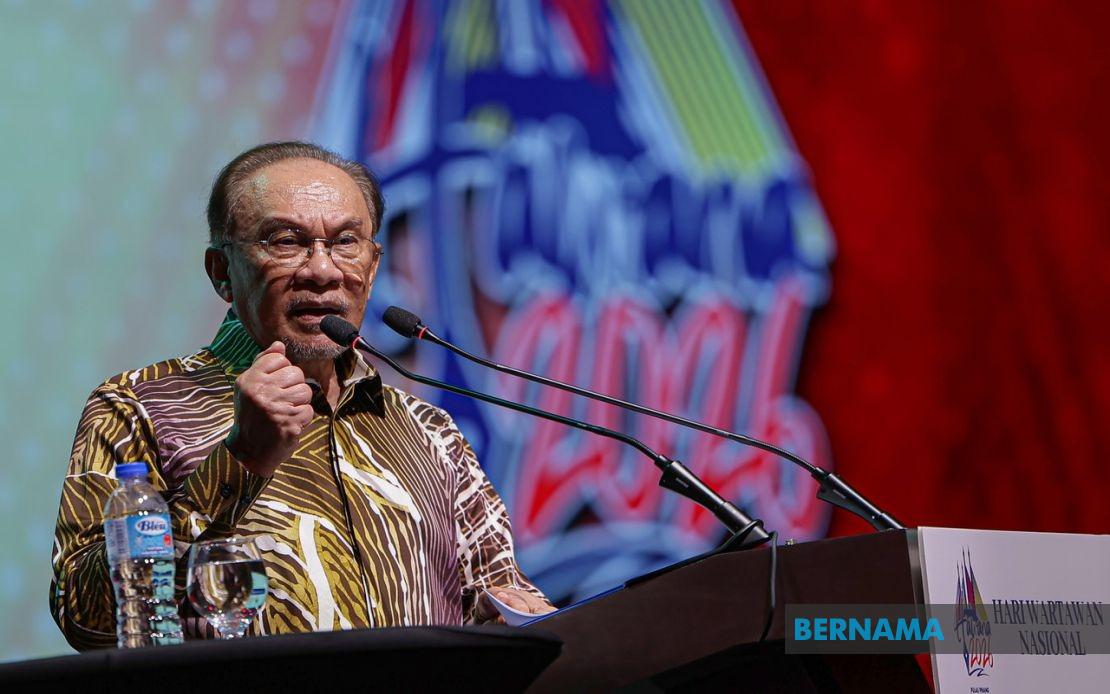
Prime Minister Datuk Seri Anwar Ibrahim has thrown his weight behind the appointment of former Federal Court judge Tan Sri Nallini Pathmanathan as the new chairman of the Malaysian Media Council, viewing the move as instrumental in restoring public confidence in the self-regulatory media body. Delivering remarks at the National Journalists' Day (HAWANA) 2026 celebration in Butterworth on June 20, Anwar emphasised that Nallini's distinguished judicial credentials and established integrity make her well-positioned to elevate the council's standing in the eyes of the public.
The Prime Minister's endorsement carries particular significance given the timing of the MMC's formal establishment under the Malaysian Media Council Act 2025, legislation that marks a watershed moment in how Malaysia's news industry regulates itself. By anchoring the council's leadership with someone of Nallini's stature, the government appears intent on signalling that the body will operate with judicial rigour and independence. Anwar was explicit in his reasoning, stating that what matters most is that Nallini brings unimpeachable credentials to the role, thereby enabling the council to project a refreshed image and inspire greater public trust in its oversight mechanisms.
Nallini's elevation to the MMC chairmanship represents a significant endorsement from Malaysia's highest political office, coming after the Malaysian Media Council board unanimously approved her appointment during a May 26 meeting. This unanimity among board members suggests broad consensus that her background as a Federal Court judge provides the necessary gravitas to lead an institution tasked with strengthening journalistic standards across the country. Her appointment reflects a deliberate strategy to insulate the new regulatory body from perceptions of political interference by placing judicial expertise at its helm.
The establishment of the MMC as a formal statutory body represents an important structural development for Malaysia's media landscape. Unlike ad hoc or purely voluntary arrangements, the council now operates within a defined legislative framework that specifies its core functions: elevating journalistic standards, processing public grievances against media outlets, advancing ethical conduct in reporting, and protecting press freedom as a foundational democratic principle. These responsibilities demand a chairperson capable of navigating complex tensions between media freedom and public accountability—precisely the skill set Nallini's judicial experience has equipped her to handle.
For Malaysian journalists and media organisations, Nallini's appointment carries both practical and symbolic implications. Practically, her judicial background suggests the council will apply consistent, principled reasoning when adjudicating disputes and complaints. Symbolically, her presence as a respected member of Malaysia's judiciary signals that media regulation need not be a political instrument but can instead function as a genuine arbiter of professional standards. This distinction matters enormously in a region where media independence remains contested and where public confidence in regulatory bodies often fluctuates based on perceived political alignment.
The event itself drew a notable gathering of government and media leadership, including Penang Chief Minister Chow Kon Yeow, Communications Minister Datuk Fahmi Fadzil, Malaysian National News Agency (Bernama) chairman Datuk Seri Wong Chun Wai, and senior Communications Ministry officials. This assembly underscored the high-level political and institutional investment in the MMC's success. The participation of both state and federal representatives reflects recognition that media regulation intersects with multiple domains of governance, from communications policy to constitutional principles around freedom of expression.
Anwar's explicit congratulations to Nallini, coupled with his statement wishing her success, amounts to presidential-level political cover for her tenure. In the context of Malaysia's governance structures, such public endorsement from the Prime Minister significantly strengthens any regulatory leader's capacity to make independent decisions without facing subsequent political pressure or challenge. By publicly backing Nallini, Anwar has essentially committed his office's prestige to supporting the council's independence, at least during his administration's tenure.
The broader context for this appointment lies in sustained global and regional scrutiny of press freedom in Southeast Asia. Malaysia's media environment, while more pluralistic than some regional peers, has historically faced questions about political influence on editorial decisions and regulatory consistency. The formalisation of the MMC and Nallini's appointment can be interpreted as an attempt to address these longstanding concerns by creating institutional mechanisms for independent oversight that transcend individual political administrations or temporary policy shifts.
For Malaysian media organisations themselves, the MMC's formal establishment presents both opportunity and constraint. While a professional self-regulatory body can theoretically protect editorial autonomy by demonstrating industry capacity for responsible self-governance, it simultaneously creates a formal grievance mechanism through which public complaints about journalistic conduct will be processed systematically. Outlets must now navigate standards codified within the MMC's procedures, though adherence to such standards might ultimately provide stronger protection against government intervention than existed previously.
Looking forward, Nallini's effectiveness as MMC chairman will likely be measured by her ability to handle high-profile complaints with fairness while maintaining the council's perceived independence from political pressure. The cases she decides and the reasoning she articulates will establish precedents that shape Malaysia's media regulatory environment for years. Her judicial experience suggests she is accustomed to explaining complex decisions in writing, a discipline that should serve her well in building public understanding of the council's determinations.
The timing of this appointment also reflects Malaysia's positioning within global conversations about artificial intelligence, disinformation, and digital-era journalism. A regulatory body led by someone with Nallini's gravitas and legal acumen will be better positioned to develop sophisticated responses to emerging challenges that traditional media regulation frameworks never contemplated. This forward-looking dimension makes her appointment particularly valuable beyond the immediate question of restoring confidence in media governance.
For stakeholders across Malaysia's political and media ecosystems, Nallini's appointment represents a calculated investment in institutionalised media regulation premised on judicial expertise rather than partisan direction. Whether this approach succeeds will depend substantially on her ability to command respect across competing media organisations and political interests while maintaining the intellectual independence that characterised her judicial career. The Prime Minister's public backing provides essential political space for such independence to flourish.
%22%2F%3E%3C%2Fpattern%3E%3C%2Fdefs%3E%3Crect%20width%3D%22100%25%22%20height%3D%22100%25%22%20fill%3D%22url(%23ph2y81qg)%22%2F%3E%3Crect%20width%3D%22100%25%22%20height%3D%22100%25%22%20fill%3D%22url(%23ph2y81qp)%22%2F%3E%3Ctext%20x%3D%2250%25%22%20y%3D%2250%25%22%20text-anchor%3D%22middle%22%20dominant-baseline%3D%22central%22%20fill%3D%22rgba(255%2C255%2C255%2C0.95)%22%20font-family%3D%22Georgia%2C%20'Times%20New%20Roman'%2C%20serif%22%20font-weight%3D%22700%22%20font-size%3D%22320%22%20letter-spacing%3D%22-0.02em%22%3ETV3%3C%2Ftext%3E%3C%2Fsvg%3E)
%22%2F%3E%3C%2Fpattern%3E%3C%2Fdefs%3E%3Crect%20width%3D%22100%25%22%20height%3D%22100%25%22%20fill%3D%22url(%23ph2pvjyg)%22%2F%3E%3Crect%20width%3D%22100%25%22%20height%3D%22100%25%22%20fill%3D%22url(%23ph2pvjyp)%22%2F%3E%3Ctext%20x%3D%2250%25%22%20y%3D%2250%25%22%20text-anchor%3D%22middle%22%20dominant-baseline%3D%22central%22%20fill%3D%22rgba(255%2C255%2C255%2C0.95)%22%20font-family%3D%22Georgia%2C%20'Times%20New%20Roman'%2C%20serif%22%20font-weight%3D%22700%22%20font-size%3D%22170%22%20letter-spacing%3D%22-0.02em%22%3EJudicial%3C%2Ftext%3E%3C%2Fsvg%3E)