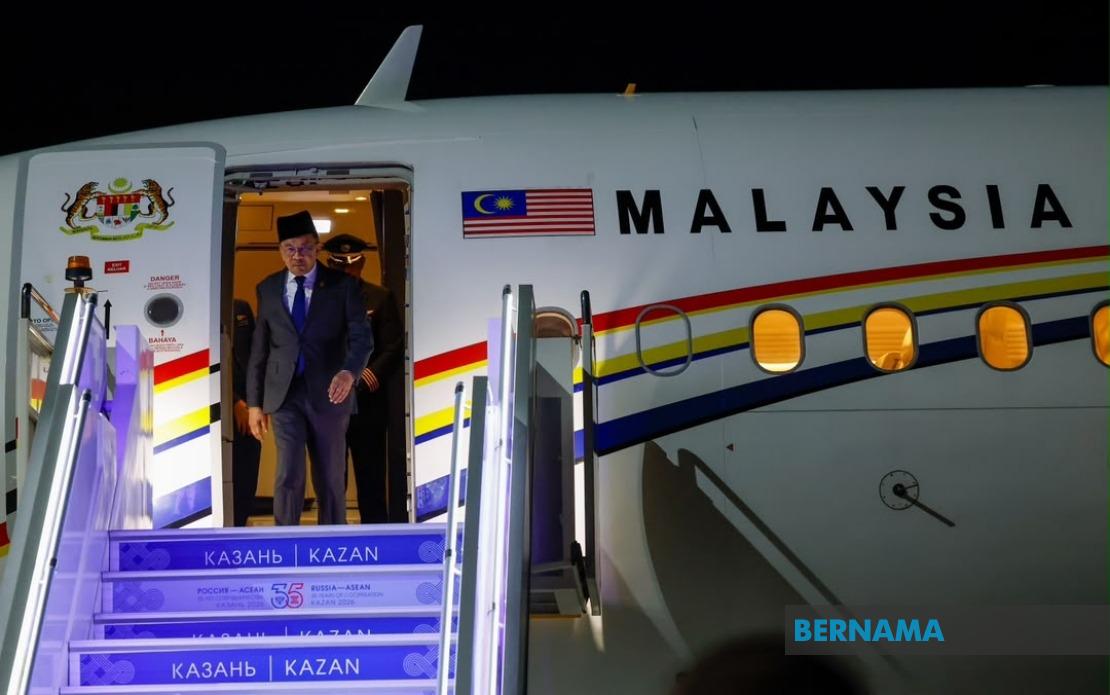
Prime Minister Datuk Seri Anwar Ibrahim touched down in Kazan on Monday evening to participate in a landmark ASEAN-Russia Commemorative Summit scheduled for June 17-18, cementing Malaysia's role in advancing dialogue between the 10-member bloc and Moscow at a critical juncture in regional geopolitics. His aircraft landed at Kazan International Airport at 10.20 pm local time, marking the start of a two-day engagement with Russian leadership and fellow ASEAN nations in the capital of Tatarstan.
The delegation travelling with Anwar reflects the economic and diplomatic weight Malaysia intends to bring to the proceedings. Minister of Investment, Trade and Industry Datuk Seri Johari Abdul Ghani, Minister of Economy Akmal Nasrullah Mohd Nasir, and senior officials from both the Prime Minister's Office and Foreign Ministry accompanied the premier, signalling that trade, investment, and strategic partnership form the core agenda. Upon arrival, Malaysia's Ambassador to Russia Datuk Cheong Loon Lai greeted the Malaysian contingent, while the Russian side fielded representatives including the Minister of Digital Development of Tatarstan Ilya Nachvin and Kazan Mayor Ilsur Metshin, along with state protocol officials.
This summit carries profound symbolic weight for the region. The gathering marks the 35th anniversary of ASEAN-Russia relations, which were formally established in Kuala Lumpur in 1991, transforming what was once a distant geopolitical relationship into a structured partnership framework. Three and a half decades of engagement have created substantial institutional linkages and practical cooperation mechanisms, yet the modern geopolitical landscape—marked by great power competition and shifting alliance patterns—demands both reflection on past achievements and strategic recalibration for the future.
The summit agenda encompasses a notably broad spectrum of cooperation areas, reflecting the multifaceted nature of contemporary regional partnerships. Discussions are slated to address trade and investment frameworks, energy security collaboration, food security cooperation, digital economy initiatives, science and technology partnerships, cultural exchanges, educational programmes, and people-to-people linkages. For Malaysia specifically, these discussions carry particular relevance given the nation's position as a leading Southeast Asian economy with deep interests in energy markets, food supply chains, and technological advancement. The breadth of the agenda suggests that ASEAN and Russia recognise their interdependencies extend well beyond traditional diplomatic channels into economic and social domains.
Four substantive outcome documents are expected to emerge from the summit, each designed to provide strategic direction for bilateral and multilateral cooperation. The Kazan Declaration commemorating the 35th anniversary will serve as the political statement of commitment, whilst the Joint Statement on Energy Cooperation addresses one of the most consequential partnership areas given Russia's position as a major energy supplier and ASEAN's growing energy demands. A corresponding Joint Statement on Cultural Cooperation acknowledges the importance of people-to-people understanding in sustaining long-term relations, whilst the Comprehensive Plan of Action to Implement the ASEAN-Russia Strategic Partnership 2026-2030 provides a five-year operational roadmap translating high-level commitments into actionable programmes.
Malaysia's emphasis on ASEAN Centrality within this engagement reflects a consistent strategic priority for the country. By hosting and championing ASEAN's collective interests in dialogue with major powers like Russia, Malaysia reinforces the regional bloc's influence in shaping the architecture of Asia-Pacific relations. This approach proves especially valuable in an increasingly multipolar world where smaller nations gain leverage through cohesive regional positioning rather than isolated bilateral negotiations. The Foreign Ministry's characterisation of the visit as reflecting Malaysia's commitment to strengthening ASEAN's external relations underscores how individual nation diplomacy serves larger bloc objectives.
Beyond the multilateral summit framework, Anwar's itinerary includes bilateral meetings with Russian President Vladimir Putin and Tatarstan's leadership, as well as separate engagements with fellow ASEAN leaders attending the summit. These bilateral conversations typically serve as vehicles for negotiating specific national interests whilst building personal relationships that facilitate future cooperation. The Malaysian prime minister is expected to emphasise Malaysia's traditional diplomatic concerns, including advocacy for dialogue and peaceful conflict resolution, support for economic resilience amid external pressures, advancement of energy and food security objectives, and deepening of people-to-people connections that generate grassroots support for government-to-government partnerships.
This Kazan visit represents Anwar's third journey to Russia since assuming office in November 2022, demonstrating consistent prioritisation of the Russian relationship despite international tensions affecting Moscow's external relations. His September 2024 attendance at the Eastern Economic Forum in Vladivostok provided exposure to Russian regional development initiatives and economic actors, whilst a May 2025 official visit to Moscow yielded substantive discussions with President Putin covering trade, investment, agriculture, education, aerospace technology, and energy cooperation. The progression of these visits suggests deepening engagement beyond ceremonial exchanges into concrete areas of mutual benefit.
The timing of this summit occurs amid a complex global environment where middle powers like Malaysia must navigate between major power interests whilst defending regional autonomy. ASEAN's ability to maintain constructive relationships with Russia whilst simultaneously engaging Western powers and China requires careful diplomatic calibration, and Malaysia frequently serves as a trusted interlocutor capable of articulating regional positions without alienating powerful partners. Anwar's participation in the ASEAN-Russia summit demonstrates Malaysia's commitment to inclusive regional architecture where diverse partnerships complement rather than conflict with one another, a principle increasingly important as geopolitical polarisation intensifies elsewhere in the world.

%22%2F%3E%3C%2Fpattern%3E%3C%2Fdefs%3E%3Crect%20width%3D%22100%25%22%20height%3D%22100%25%22%20fill%3D%22url(%23ph40buhg)%22%2F%3E%3Crect%20width%3D%22100%25%22%20height%3D%22100%25%22%20fill%3D%22url(%23ph40buhp)%22%2F%3E%3Ctext%20x%3D%2250%25%22%20y%3D%2250%25%22%20text-anchor%3D%22middle%22%20dominant-baseline%3D%22central%22%20fill%3D%22rgba(255%2C255%2C255%2C0.95)%22%20font-family%3D%22Georgia%2C%20'Times%20New%20Roman'%2C%20serif%22%20font-weight%3D%22700%22%20font-size%3D%22320%22%20letter-spacing%3D%22-0.02em%22%3EGRS%3C%2Ftext%3E%3C%2Fsvg%3E)