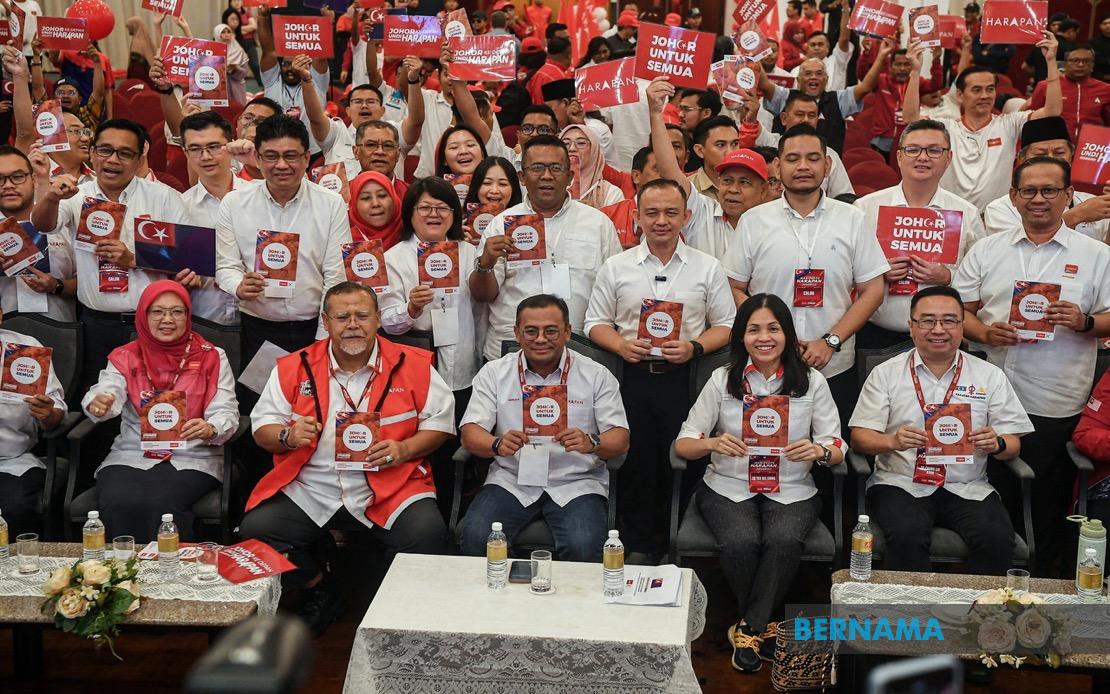
Pakatan Harapan has presented its electoral platform for the 16th Johor state election as a carefully calibrated response to tangible community demands and the state's fiscal position, rather than aspirational sloganeering that cannot be executed. Launching the 'Johor Untuk Semua' (Johor For All) manifesto in Johor Bahru on July 3, senior party figures sought to distinguish their campaign by anchoring policy commitments to demonstrated feasibility and local economic conditions.
Johor DAP chairman Teo Nie Ching, who also serves as Deputy Communications Minister at the federal level, stressed that the coalition possesses both the conviction and capacity to translate manifesto pledges into concrete governance outcomes. She framed the document not as wish-list politics but as a strategic roadmap informed by systematic consultation with constituents and appraisal of what the state economy can sustainably support. This positioning reflects broader coalition thinking that voters have grown skeptical of platforms promising unlimited benefits without fiscal grounding.
The manifesto encompasses ten substantial policy offerings, each targeting distinct demographic constituencies within Johor's electorate. A dedicated Johor Health Scheme represents perhaps the most ambitious healthcare proposal, building on models already operational elsewhere in the country. Assistance programmes for first-time property purchasers address the enduring affordability crisis affecting young adults seeking to establish independent households. An allocation of RM500 million directed toward youth empowerment initiatives responds to concerns about limited economic mobility among Johor's younger cohort, whilst educational sector investments tackle persistent quality and access disparities.
Border infrastructure emerges as another significant commitment, with Pakatan Harapan pledging to reduce waiting times at Johor-Singapore crossing points by half through coordinated effort with federal authorities. This objective carries particular resonance for thousands of cross-border workers and businesses whose daily productivity hinges on efficient transit. Teo indicated confidence that achieving this target depends fundamentally on harmonized action between state and federal Home Ministry officials, a dependency that underscores how Malaysian federalism often fragments policy implementation responsibility across multiple governance tiers.
The reference point of Selangor's established healthcare model becomes strategically important in Teo's framing of the Johor proposal's credibility. By invoking a successful precedent from another opposition-governed state, the coalition attempts to neutralize skepticism that such schemes represent untested ideology. Selangor's operational track record supplies tangible evidence that similar comprehensive health coverage can function effectively within Malaysian state administration, thereby reassuring a cautious electorate that 'Bangsa Johor' residents need not regard the health initiative as experimental or destabilizing.
The manifesto's deliberate embrace of universalist language—articulated through the 'For All' component of its title—suggests strategic calculation regarding Johor's complex social fabric. Rather than targeted assistance narrowly serving specific ethnic or class segments, Pakatan Harapan frames its programme as comprehensively inclusive, addressing education requirements for all children, health access for all residents, and property pathways for all qualified buyers. This rhetorical choice carries significance in a state where coalition performance depends on broadening support beyond traditional demographic bases.
Teo's confidence regarding manifesto delivery nonetheless carries important caveats, explicitly contingent upon receiving robust backing from the federal government and sustaining collaborative relationships across governance levels. This acknowledgment reveals a political reality that often constrains state-level ambition in Malaysia: resources, regulatory authority, and implementation capacity frequently rest with federal institutions. A Johor state government operating within a hostile or indifferent federal framework might struggle materially to deliver even narrowly-scoped commitments, let alone a ten-point platform requiring coordination with multiple federal departments.
The timing of the manifesto launch, occurring nine days before polling scheduled for July 11, compresses the window for voters to absorb and evaluate competing platforms. Early voting commencing July 7 means the critical period for persuasion proves even more compressed. Within this accelerated timeline, Pakatan Harapan's strategy emphasizes substantive detail and reference to proven models elsewhere, presumably betting that demonstrable feasibility carries greater persuasive weight than inspirational rhetoric detached from implementational reality.
For Malaysian political observers, the manifesto's emphasis on economic grounding and federal coordination points toward mature campaign politics conscious of structural constraints and fiscal limits. Rather than promising transformative ruptures, Pakatan Harapan positions itself as careful administrator capable of navigating Malaysia's complex federal architecture and the inherent friction points between state ambitions and federal prerogatives. Whether this pragmatic positioning resonates more persuasively than opposition promises of transformative change will emerge through Johor's electoral response on July 11.

