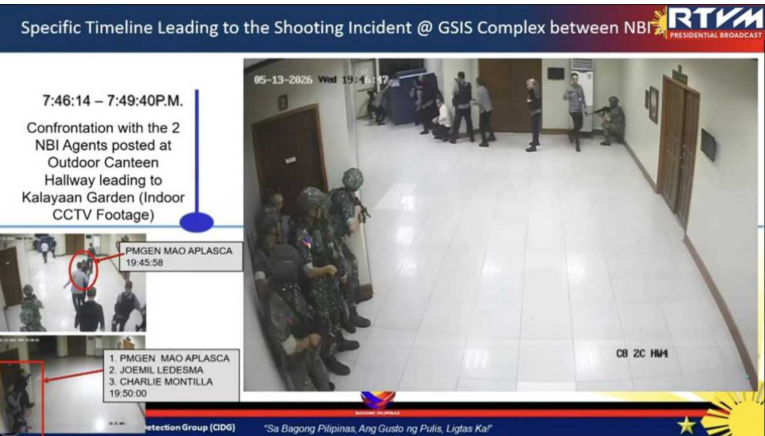
The Philippine Department of Justice has launched a focused inquiry into whether government officials should face charges stemming from a shooting incident at the Senate building on May 13 and the subsequent escape of Senator Ronald dela Rosa from protective custody early the following morning. Justice Secretary Fredderick Vida confirmed that prosecutors are actively examining the circumstances surrounding both events and exploring whether connections exist between them.
According to Vida, investigators have gathered substantial evidence in their preliminary work. Members of the National Bureau of Investigation provided testimony, journalists who were present offered accounts of events, and security camera recordings have been reviewed as part of the evidentiary foundation. The footage and statements indicate that shots were fired from the fifth floor of the Senate complex, with the apparent target being an identifiable NBI vehicle stationed at the GSIS premises. This positioning suggests a deliberate and coordinated action rather than random violence.
The dual nature of these incidents—a violent attack followed almost immediately by the departure of a prominent political figure from custody—has raised significant questions about potential coordination or systemic failure. The timing raises obvious concerns about whether these events were connected or simply coincidental occurrences during a period of apparent institutional breakdown. Vida acknowledged the gravity of these questions but cautioned against premature conclusions.
When pressed about whether specific individuals have been identified as targets of the investigation, Vida indicated that while no formal charges or accusations have been formally lodged at this stage, the evidence gathered points toward the involvement of multiple public officials. The breadth of potential suspects appears considerable, suggesting this is not a narrow inquiry focused on a single actor but rather a wider examination of administrative and security protocols that may have been compromised.
The investigation's scope extends beyond simple criminal acts to encompass potential breaches of duty, lapses in security procedures, and possibly criminal conspiracy. For officials in protective custody such as Senator dela Rosa, security arrangements typically involve multiple layers of oversight and authorization. The fact that he was able to depart raises fundamental questions about who approved his departure, what authority permitted his release, and whether proper procedures were followed.
Vida emphasized that his department's approach would prioritize professional standards and objectivity. He stated explicitly that no individual would receive preferential treatment based on position or status, articulating the principle that institutional rank does not confer exemption from legal accountability. Simultaneously, he stressed that individuals would not be presumed guilty or subjected to public condemnation before evidence had been thoroughly examined and legal procedures properly completed.
This balancing act reflects the sensitivity of investigating government officials in a country where such inquiries can become politically charged. The Philippines, like many regional democracies, has experienced instances where investigations into public officials have been weaponized for political purposes or, conversely, where genuine wrongdoing has been sheltered through institutional protection. Vida's repeated emphasis on fairness and thoroughness suggests an attempt to insulate the investigation from accusations of political motivation on either side.
The incident raises broader concerns about institutional capacity and internal security within the Philippine government. The Senate building's security infrastructure, including CCTV systems and access controls, came under scrutiny. The fact that shots could be fired from an identifiable location within the complex without immediate response indicates potential gaps in threat assessment or emergency protocols. Similarly, the ability of a senator under protective custody to depart without apparent authorization suggests either deliberate misconduct or organizational confusion about responsibility.
For regional observers, this case underscores vulnerabilities that exist across Southeast Asian governments. Security breaches involving legislative buildings and the escape of high-profile detainees reflect systemic issues that extend beyond individual negligence. Training gaps, outdated equipment, unclear chains of command, and corruption all contribute to such incidents. The Philippine investigation may yield lessons applicable to security frameworks across the region.
The investigation also carries implications for political stability and public confidence in institutions. When senators can escape protective custody and when gunfire erupts from government buildings, citizens reasonably question whether the state possesses effective control over its own infrastructure and personnel. This undermines the legitimacy of state institutions and creates openings for non-state actors to exploit instability.
Vida's department now faces the challenging task of building a prosecutable case while maintaining credibility. If the investigation proves to be thorough and leads to accountability regardless of rank, it could strengthen institutional legitimacy. Conversely, if investigations stall or appear one-sided, public cynicism would deepen. The stakes extend beyond the immediate individuals involved to encompass confidence in the entire justice system.
The investigation's progression will likely reveal much about the Philippines' institutional capacity to police itself. As Vida noted, the matter remains under active investigation with findings continuing to emerge. The outcome will depend on whether prosecutors can overcome potential institutional resistance and political pressure to follow evidence to its logical conclusions, and whether the public perceives the process as genuinely impartial.

%22%2F%3E%3C%2Fpattern%3E%3C%2Fdefs%3E%3Crect%20width%3D%22100%25%22%20height%3D%22100%25%22%20fill%3D%22url(%23ph40buhg)%22%2F%3E%3Crect%20width%3D%22100%25%22%20height%3D%22100%25%22%20fill%3D%22url(%23ph40buhp)%22%2F%3E%3Ctext%20x%3D%2250%25%22%20y%3D%2250%25%22%20text-anchor%3D%22middle%22%20dominant-baseline%3D%22central%22%20fill%3D%22rgba(255%2C255%2C255%2C0.95)%22%20font-family%3D%22Georgia%2C%20'Times%20New%20Roman'%2C%20serif%22%20font-weight%3D%22700%22%20font-size%3D%22320%22%20letter-spacing%3D%22-0.02em%22%3EGRS%3C%2Ftext%3E%3C%2Fsvg%3E)