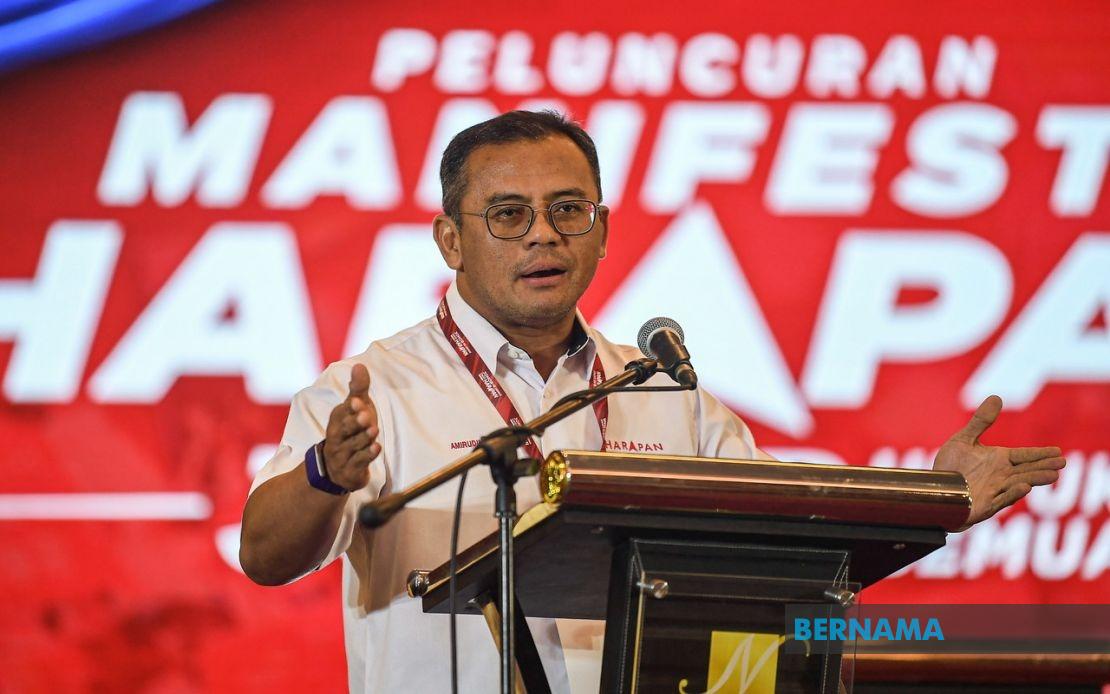
Datuk Seri Amirudin Shari, the Selangor Menteri Besar and a key figure within Pakatan Harapan's leadership structure, has positioned the coalition's governance record as a cornerstone of its political messaging heading into the 16th Johor state election. Speaking at the unveiling of PH's "Johor for All" manifesto in Johor Bahru on July 3, Amirudin argued that the bloc's stewardship at federal and state levels has produced tangible economic outcomes that warrant voter confidence.
The MADANI administration, led by Prime Minister Datuk Seri Anwar Ibrahim, has pursued an economic strategy centred on currency stabilization and foreign capital inflows. According to Amirudin's remarks, the ringgit has strengthened to its highest valuation in 16 years under the current government—a metric often used by administrations to demonstrate macro-economic competence and investor confidence. This currency performance represents a departure from earlier periods of weakness and carries symbolic weight in political narratives around fiscal management and national resilience.
Beyond currency movements, the PH-led federal government has pursued consistent GDP growth according to official figures cited during the campaign event. Investment levels have risen substantially, reflecting both domestic capital deployment and foreign direct investment, which Amirudin characterized as evidence of international confidence in Malaysia's economic direction. The narrative serves to counter opposition claims about economic mismanagement and positions PH as the steward of stability in an uncertain global environment.
At the subnational level, Selangor and Penang emerge as principal economic engines within PH-governed territories. Amirudin emphasized that these two states collectively account for nearly 40 percent of Malaysia's national economic output—a concentration of productive capacity that underscores the political significance of governing these regions. Selangor alone contributes disproportionately to this figure, a reality that shapes both federal revenue flows and the state's political leverage within coalition dynamics.
Selangor's economic trajectory illustrates the growth narrative PH wishes to project. The state's gross domestic product reached RM432 billion in the Department of Statistics Malaysia's 2023 assessment, and has since expanded by RM28 billion to reach RM460 billion according to data released within two days of Amirudin's address. This expansion signals ongoing economic dynamism within Malaysia's most industrialized and populous state, with implications for employment generation, tax revenue, and consumer spending patterns across the broader economy.
The comparative scale of Selangor's economy relative to Johor—where voters are preparing to cast ballots—carries particular rhetorical weight. Amirudin's claim that Selangor's economic output is now twice that of Johor invites voters to consider which coalition of political actors has demonstrated superior capacity for wealth generation and state development. This framing implicitly argues that PH's governance model has delivered superior outcomes compared to alternative political arrangements, though Johor has been governed by opposition coalitions during key periods of comparison.
The manifesto launch represents a calculated political positioning ahead of crucial electoral competition. By emphasizing macro-economic indicators and state-level growth statistics, PH seeks to redirect voter attention toward aggregate economic performance rather than micro-level grievances or other electoral considerations. The strategy assumes that voters weigh collective economic advancement alongside other concerns, and that credit for growth accrues to the incumbent coalition.
However, translating state-level economic expansion into electoral support requires voters to perceive personal benefit from aggregate growth. Rising GDP and currency strength may generate satisfaction among business communities and foreign investors, but may resonate differently with workers concerned about wage growth, affordability pressures, or employment stability. The disconnect between macro-economic metrics and household-level economic experiences represents a persistent challenge for incumbent parties claiming credit for growth.
For Southeast Asian observers, Malaysia's political economy reflects broader patterns visible across the region. Coalition politics, state-level economic disparities, and the use of growth statistics to legitimize political authority recur throughout the region's democracies. Selangor's dominant economic contribution mirrors the role of Bangkok in Thailand or Metro Manila in the Philippines, concentrating both wealth and political leverage within specific jurisdictions. Understanding Johor voters' receptiveness to PH's economic messaging may offer insights into how other Southeast Asian electorates evaluate coalition governance and growth claims.
The salience of PH's economic narrative will ultimately depend upon election day dynamics, voter prioritization of policy domains, and the effectiveness of opposition counter-messaging. Alternative coalitions may argue that growth benefits have been unevenly distributed or that specific populations have been excluded from prosperity gains. Johor's electoral choice will reflect not merely assessment of aggregate economic performance but also regional political traditions, communal considerations, and local governance track records.

