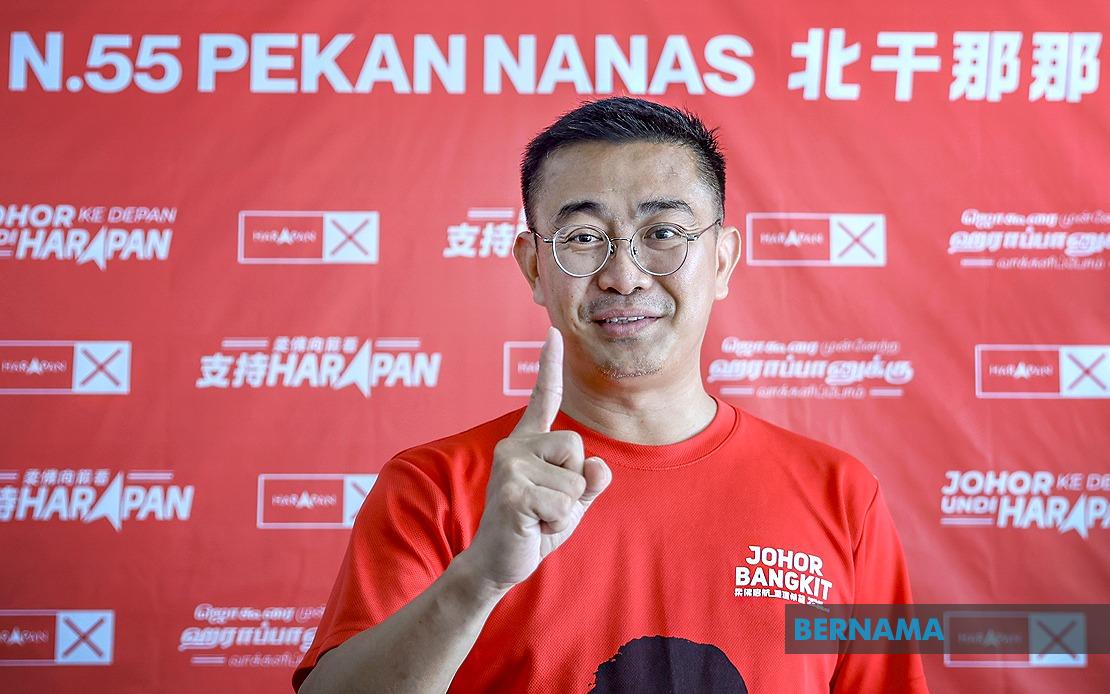
Yeo Tung Siong, Pakatan Harapan's candidate for the Pekan Nanas state constituency in Johor, is banking heavily on his decade-long tenure as the district's representative to reclaim a seat he held for two consecutive terms between 2013 and 2022. In campaigning across the district, the former vice-principal and discipline teacher believes his hands-on approach to constituent service sets him apart from competitors and gives him a credible foundation upon which voters can evaluate his suitability for another mandate.
During his roadshow across Pekan Nanas and its surrounding neighbourhoods, Yeo reports having engaged approximately 60 percent of the electorate through a combination of walkabouts, community talks, organised group meetings, door-to-door visits, and appearances at public markets and informal dining venues. The reception from voters has been encouraging, he told reporters in Pontian, suggesting that his visibility and accessibility throughout the campaign period have resonated positively with residents grappling with local challenges. Such engagement metrics, whilst difficult to independently verify, reflect a strategy centred on personal connection rather than large-scale political rallies—an approach that appeals to voters seeking representatives who are reachable and responsive to grassroots concerns.
His previous service record showcases concrete infrastructure achievements, though scaled modestly. Yeo secured a RM500,000 allocation to straighten the Pulai River's flow, addressing flooding issues that have long plagued the constituency. Working alongside private sector partners, he also facilitated the construction of drainage channels bordering Kampung Melayu Raya, demonstrating capacity to coordinate multi-stakeholder projects aimed at environmental and public health outcomes. These initiatives, whilst not transformative at a state or federal level, represent the bread-and-butter development work that district assemblymembers typically champion to demonstrate their effectiveness and legitimacy to constituents.
The two primary concerns raised repeatedly by voters throughout Yeo's campaign rounds point to persistent infrastructure and economic gaps in the Pekan Nanas area. Traffic congestion between Pontian and Johor Bahru reflects poor road connectivity, whilst limited job opportunities signal economic underdevelopment relative to the state capital. These grievances are not unique to Pekan Nanas; they echo across similar suburban constituencies across Johor where rapid urbanisation has outpaced infrastructure planning and where employment options remain concentrated in larger urban centres.
To address transportation bottlenecks, Yeo has prioritised two proposed shortcut routes that would link Ulu Pulai to Pekan Nanas and connect Pulai to Sri Bunian junction. If implemented, these corridors would materially reduce travel times between the constituency and Johor Bahru, potentially unlocking economic activity by facilitating commuter flows and improving accessibility for businesses. However, the feasibility and timeline for such projects depend on state-level funding allocation and coordination with federal authorities—realities that constrain the autonomy of district representatives, a reality often overlooked by voters evaluating campaign promises.
On employment generation, Yeo proposes reviving a career carnival initiative that he previously organised in collaboration with major corporations operating near Pekan Nanas. Such events serve primarily as networking platforms connecting job seekers with employers rather than creating permanent employment; their effectiveness depends on sustained private sector participation and labour market conditions largely beyond the control of a state assemblymember. Nonetheless, they represent a pragmatic, low-cost approach to improving labour market information and reducing friction in job-matching processes—particularly valuable in constituencies where unemployment stems partly from information asymmetries rather than absolute job scarcity.
Social welfare assistance constitutes another pillar of Yeo's platform. He commits to facilitating access to government support mechanisms administered by the Social Welfare Department (JKM), the Social Security Organisation (SOCSO), and allied institutions. This pledge essentially amounts to promise of efficient constituency case-work—ensuring that eligible residents navigate bureaucratic processes to access entitlements they are already entitled to receive. Whilst unglamorous, such facilitation can materially improve the lives of vulnerable populations and represents concrete value that representatives can deliver within existing institutional frameworks.
Yeo's candidacy reflects a recurring pattern in Malaysian electoral politics where incumbents or former officeholders leverage developmental achievements and service records to secure re-election. His emphasis on accessibility and personal engagement contrasts with more protocol-conscious politicians, a positioning that appeals to voter preferences for approachable representatives even when substantive policy differences between candidates prove limited. The appeal of such accessibility should not be underestimated; constituent service—resolving potholes, cutting through bureaucratic red tape, securing small allocations—forms the foundation of local electoral politics across the country.
The contest for Pekan Nanas features a direct two-way competition between Yeo and the incumbent Tan Eng Meng representing Barisan Nasional, simplifying voter choice in a district where neither major coalition faces serious challenge from independent candidates or third-party contenders. This binary framework means that swing voters' decisions will likely hinge on comparative assessments of each candidate's local credibility, development record, and perceived responsiveness rather than broader ideological or party-level considerations.
For Pakatan Harapan statewide, recapturing Pekan Nanas would constitute a modest symbolic victory—reclaiming a seat previously held—but carries limited bearing on the overall state election outcome unless the contest proves extraordinarily tight across constituencies. Nevertheless, Yeo's campaign exemplifies the ground-level dynamics shaping Johor politics, where local development delivery, personal reputation, and constituent accessibility remain paramount to electoral fortunes despite the veneer of larger national political movements.

