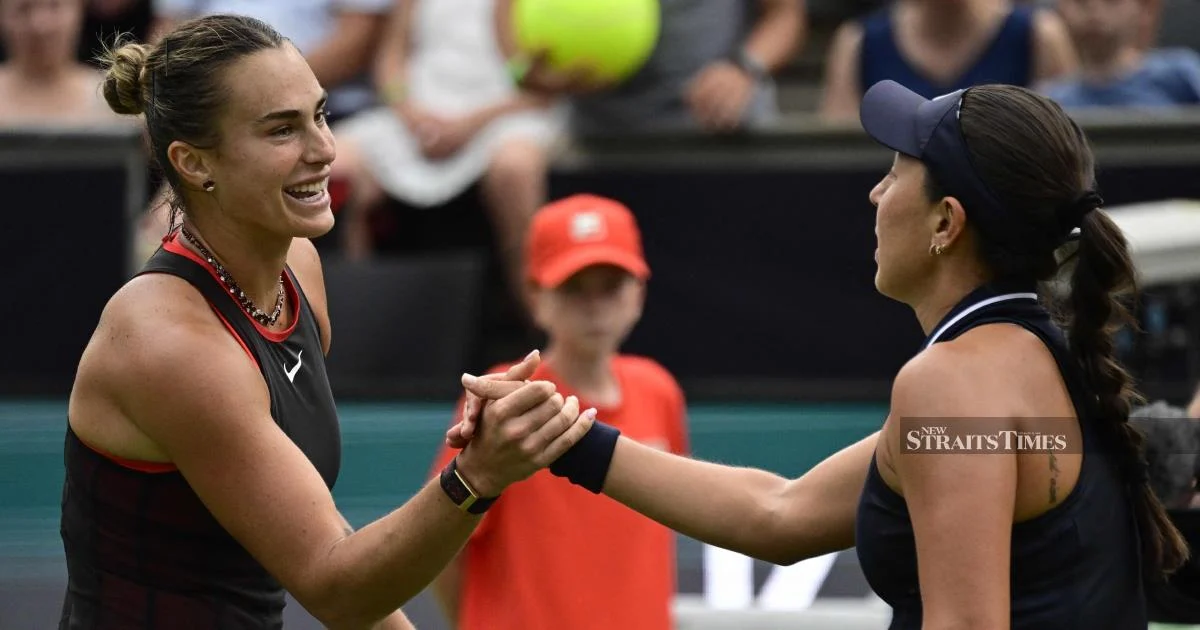
Jessica Pegula claimed a significant upset at the Berlin WTA grass-court championships, dismantling world number one Aryna Sabalenka across three sets to book her place in the final. The American's 6-2, 6-7 (4-7), 6-0 triumph represents a major scalp on the professional tennis circuit, where Sabalenka's dominant ranking has made her one of the sport's most formidable competitors.
Pegula's victory carries particular weight given Sabalenka's status as the overwhelming favourite heading into the tournament. The Belarusian has established herself as a force on all court surfaces in recent seasons, combining raw power with improving tactical flexibility. Yet on Berlin's grass courts, the surface proved to favour Pegula's style of play, particularly her ability to construct points with precision and capitalise on shorter rallies that neutralise the heavy-hitting approach favoured by higher-ranked opponents.
The match unfolded in starkly contrasting phases. Pegula dominated the opening set with clinical precision, breaking Sabalenka's service early and never relinquishing her advantage to win 6-2. This commanding start suggested a potential rout, but Sabalenka, known for her mental resilience, regrouped in the second set. The subsequent tiebreak proved tighter, though ultimately Pegula prevailed 7-4 in the breaker following crucial pressure applied at key moments when Sabalenka faced break opportunities.
The final set represented complete capitulation from the world number one. Pegula continued her aggressive serving and court coverage, building on the momentum accumulated through the opening two sets. Sabalenka appeared to lose focus and rhythm as Pegula's confidence visibly increased, resulting in a decisive 6-0 whitewashing that underscored the American's dominance on the day. The sequence of results illustrated how thoroughly Pegula had seized control of the contest.
For Pegula, this represents a return to the Berlin final stage. The American has previously contested the championship match at this venue, demonstrating her capacity to perform at the highest levels of WTA competition. Grass-court tennis remains a specialised domain where surface-specific skills prove decisive, and Pegula's baseline control and net game have consistently yielded positive results on this particular surface where big servers and aggressive hitters must maintain precision over raw power.
The implications for Southeast Asian tennis enthusiasts centre on how grass-court tournaments continue to produce unpredictable outcomes despite seeding hierarchies. While Sabalenka's ranking reflects her consistency across seasons, individual tournaments—particularly on specialised surfaces—reward players who possess technical versatility and mental fortitude. Pegula's victory demonstrates that rankings, while significant, do not predetermine specific match outcomes, especially when lower-seeded competitors execute their game plans with discipline.
Sabalenka's defeat raises questions about the sustainability of her dominance when facing accomplished opponents who specifically tailor their strategies to exploit surface conditions and playing style. The world number one's power-driven game, while highly effective on hard courts where she has won multiple Grand Slam titles, encounters resistance on grass where reduced bounce and faster court conditions reward accuracy and defensive acuity. This loss may prompt refinement of her approach heading into major grass-court competitions.
Pegula's trajectory through this tournament also reflects broader trends in women's professional tennis, where depth of talent has increased substantially. Players ranked outside the top five now regularly defeat top-ranked competitors, particularly when matches occur on surfaces that do not inherently favour the higher-ranked player's natural strengths. This competitive unpredictability enhances the sport's entertainment value while challenging traditional seeding assumptions.
The American will now prepare for her second Berlin final appearance with considerable momentum. Having dismantled the world's top-ranked player, Pegula enters the championship match as a competitor fully justified in harbouring legitimate championship ambitions. Her serve-and-volley capabilities combined with consistent ground-stroke execution should position her favourably regardless of opponent, though the identity of her final adversary will influence tactical preparation in the coming days.
Grass-court season remains pivotal for establishing credentials heading toward the year's most prestigious tournaments. Victories of this magnitude—particularly when they involve defeating the world number one—accumulate ranking points, enhance confidence, and provide genuine evidence of capability when circumstances align favourably. For Pegula, this Berlin breakthrough represents both an individual achievement and validation of her technical approach to professional tennis competition at the highest echelon.