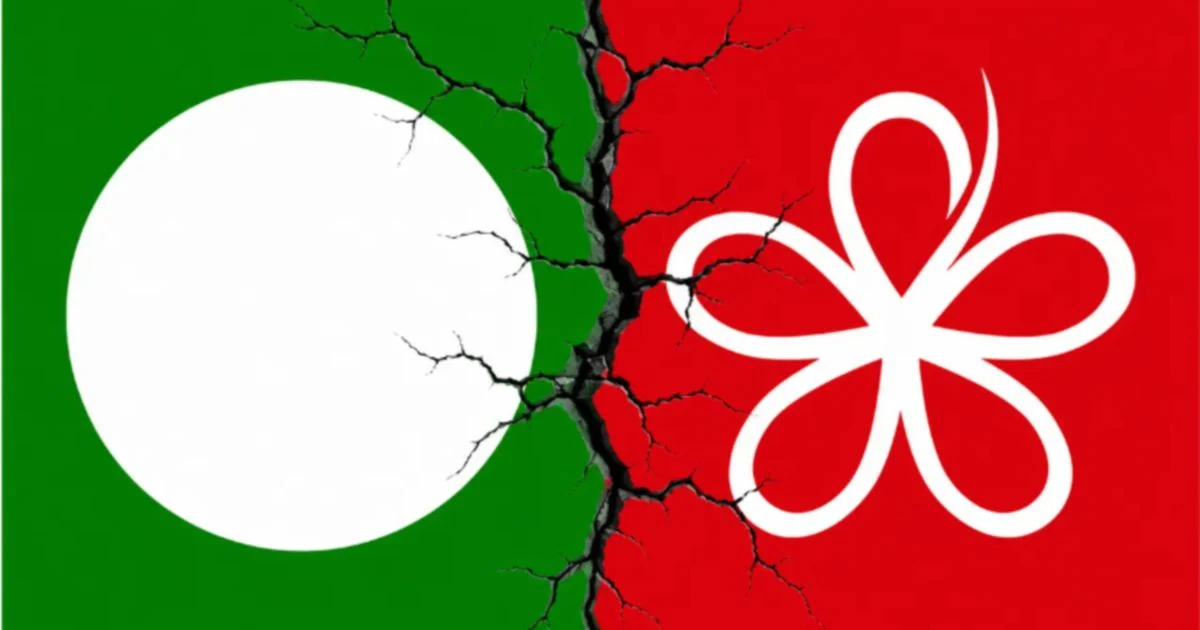
Deteriorating relations between PAS and Bersatu are increasingly casting a shadow over Perikatan Nasional's viability as a unified electoral force, with analysts warning that unresolved internal conflicts could severely hamper the coalition's performance when voters go to the polls for the 16th General Election. The two parties, which form the ideological and organizational backbone of PN, have found themselves at loggerheads over multiple policy and strategic issues, creating operational friction that extends beyond mere political posturing into matters affecting ordinary party members and grassroots supporters.
The friction between the Islamist PAS and the Malay-nationalist Bersatu has roots extending back to their divergent political philosophies and competing ambitions within the coalition hierarchy. Where PAS has traditionally emphasised its Islamic credentials and resistance to secular governance models, Bersatu has sought to position itself as a broader-based Malay political movement capable of attracting a wider demographic beyond PAS's conservative base. This fundamental philosophical tension, previously manageable during the early phases of PN's formation, has become increasingly difficult to contain as both parties jockey for influence and resources ahead of what promises to be a highly competitive general election.
Electoral mathematics compound the political tension. Perikatan Nasional currently operates with a fragile parliamentary position, and any significant loss of voter confidence could prove catastrophic. Malaysian voters, particularly those in key swing constituencies and among the crucial middle-class urban and suburban demographics, have shown increasing wariness of coalitions that project internal disunity. The 15th General Election demonstrated voters' appetite for change and willingness to punish coalitions perceived as unstable or riven by factional disputes. A similar electoral punishment awaits PN if internal divisions are perceived as unresolved or irreconcilable.
The PAS-Bersatu rift carries particular significance because both parties depend on overlapping voter bases, particularly in rural and semi-urban Malay-Muslim communities. Where these constituencies overlap geographically, competition between the two parties for nomination tickets and campaign resources creates winners and losers within the coalition itself. Members and supporters of whichever party fails to secure nominations may feel aggrieved, potentially leading to reduced campaign enthusiasm or, in worst-case scenarios, tactical voting against the coalition's official candidates. This internal fracturing of electoral machinery precisely when coordination is most critical could easily translate into aggregate vote losses across multiple constituencies.
Beyond the mechanics of electoral competition, the broader narrative of PN disunity risks undermining the coalition's core message to voters. Political coalitions succeed by convincing electors that their combined strength offers superior governance to available alternatives. When coalition partners appear unable to resolve their own internal disputes, voters naturally question whether such partners can effectively govern in the national interest. The Barisan Nasional previously benefited from a perception of hierarchical stability; Pakatan Harapan and Pakatan Rakyat had narrative coherence around reform and progressive governance. Perikatan Nasional, by contrast, has struggled to develop a compelling unified message, and the PAS-Bersatu tensions only deepen that vulnerability.
The Southeast Asian context adds urgency to these dynamics. Malaysia's regional standing and economic stability depend partly on investor confidence and government effectiveness. Coalitions projecting internal dysfunction undermine these factors. Thailand's repeated coalition collapses offer a cautionary tale about how internal strains can paralyse governance and create investor uncertainty. While Malaysia's institutions remain significantly stronger, the principle holds: visible coalition tensions damage investor confidence and public morale. For a coalition seeking electoral renewal, such dynamics are particularly damaging because they suggest governance problems before power is even secured.
State-level politics potentially exacerbate these tensions. Perikatan Nasional governs several states where PAS and Bersatu hold significant positions. Where state governments are governed by PN, disagreements between the two parties over resource allocation, development priorities, and administrative appointments can spill into public view, creating the impression of chaos rather than strategic disagreement. Perak, Terengganu, and Kedah have experienced PAS-Bersatu tensions that occasionally manifest in disputes over state contracts, licensing decisions, and bureaucratic appointments. These localised conflicts, when publicised, reinforce voter perceptions of coalition instability.
Young voters and urban constituencies appear particularly sensitive to coalition disunity. These demographic groups, increasingly consequential in Malaysian elections as voter turnout patterns evolve, tend to punish coalitions perceived as faction-ridden or led by politicians engaged in petty disputes rather than substantive policy debates. The social media environment amplifies every hint of tension, with partisan accounts from both PAS and Bersatu supporters creating echo chambers that frame disagreements in maximally dramatic terms. This digital amplification means that even minor coordination failures become inflated into narratives of fundamental coalition breakdown.
Resolution of the PAS-Bersatu tensions will require more than cosmetic unity displays or carefully choreographed joint appearances. Genuine reconciliation demands both parties accept constraints on their individual ambitions for the greater coalition good, secure agreements on seat allocation and campaign resource distribution, and develop coherent shared messaging on key policy areas where their positions diverge. Such compromises are politically costly for both sides, as they require each party to explain to its most committed supporters why coalition discipline necessitates accepting outcomes that violate their preferred positions.
The timing of these tensions, emerging several years before GE16 rather than in the immediate pre-election period, theoretically provides opportunity for resolution. Parties have time to rebuild institutional trust, establish working mechanisms for dispute resolution, and demonstrate coordinated governance capacity through their state administrations. However, that window will not remain open indefinitely. Without visible progress toward reconciliation, the rift risks becoming permanently embedded in voter consciousness, cementing perceptions of PN as internally fractured and unreliable.
For Malaysian voters, the PAS-Bersatu tensions ultimately raise fundamental questions about whether Perikatan Nasional represents a durable political force or merely a temporary coalition of convenience united primarily by opposition to Pakatan Harapan. The answer will substantially influence electoral calculations across multiple demographic and geographic segments of the electorate. A coalition that cannot manage its internal tensions convincingly risks returning to opposition after GE16, regardless of the national political environment.

%22%2F%3E%3C%2Fpattern%3E%3C%2Fdefs%3E%3Crect%20width%3D%22100%25%22%20height%3D%22100%25%22%20fill%3D%22url(%23ph40buhg)%22%2F%3E%3Crect%20width%3D%22100%25%22%20height%3D%22100%25%22%20fill%3D%22url(%23ph40buhp)%22%2F%3E%3Ctext%20x%3D%2250%25%22%20y%3D%2250%25%22%20text-anchor%3D%22middle%22%20dominant-baseline%3D%22central%22%20fill%3D%22rgba(255%2C255%2C255%2C0.95)%22%20font-family%3D%22Georgia%2C%20'Times%20New%20Roman'%2C%20serif%22%20font-weight%3D%22700%22%20font-size%3D%22320%22%20letter-spacing%3D%22-0.02em%22%3EGRS%3C%2Ftext%3E%3C%2Fsvg%3E)