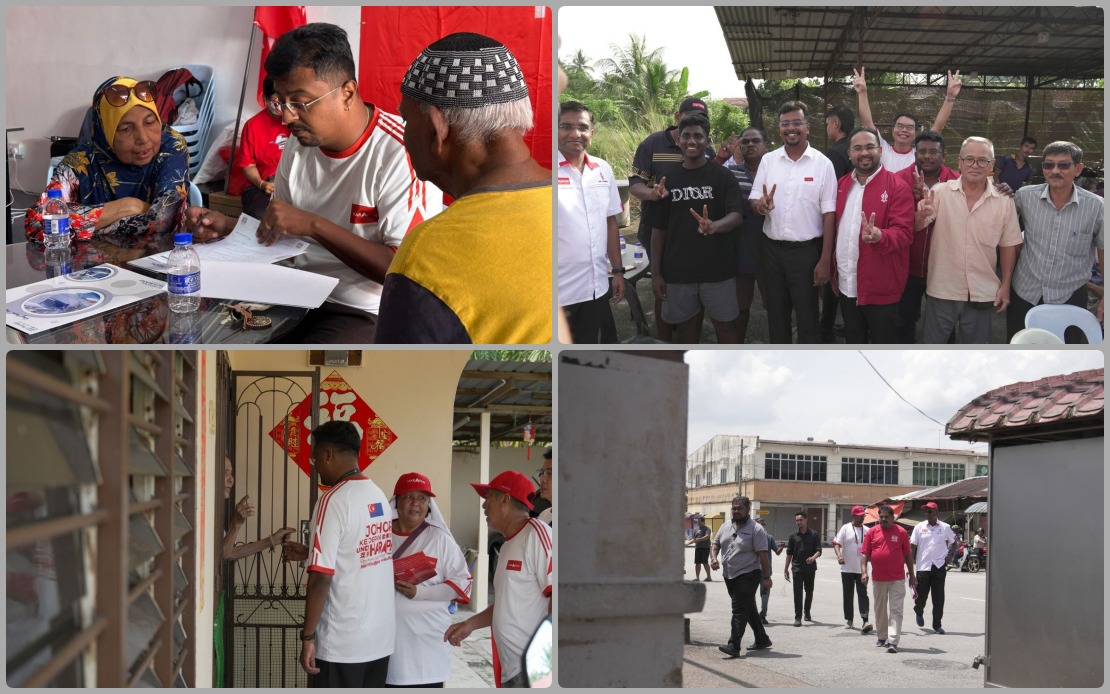
Dr. A. Ruban, the Pakatan Harapan (PH) candidate vying for the Paloh state assembly seat, was hospitalised in Batu Pahat on July 7 to undergo medical treatment for complications related to a chronic spinal condition. The admission followed acute pain that severely restricted his mobility, forcing him to withdraw from active campaigning as the Johor state election enters its final stretch.
According to Abdul Majid Abd Aziz, Dr. Ruban's campaign manager, the candidate's health deteriorated over the course of the morning, ultimately necessitating hospital admission at noon. Abdul Majid attributed the relapse to the rigorous demands of state-level electioneering, which has required Dr. Ruban to undertake extensive ground-level engagement with voters across the constituency.
Dr. Ruban's spinal troubles are not new. He carries a pre-existing history of vertebral complications and has previously undergone surgical intervention for similar issues. However, the recurring pain emerged as a direct consequence of his demanding field schedule, with extensive walkabouts and community interactions apparently triggering the flare-up. Campaign fatigue combined with an unforgiving timetable has exacerbated what was already a vulnerable area of his health.
Yet the situation remains manageable from a medical standpoint. Hospital officials reported that Dr. Ruban's condition is not critical, and barring unforeseen complications, he may be discharged within one to two days. This prognosis suggests that his enforced absence from the campaign trail may prove temporary, potentially allowing him to resume limited activities in the final days before polling day on July 11.
The timing of this health setback is awkward for the PH machinery in Paloh, arriving less than a week before voters cast their ballots. Abdul Majid moved quickly to reassure supporters and the public that the campaign would proceed uninterrupted, with party workers intensifying ground engagement to compensate for their candidate's temporary unavailability. The camp's commitment to circulating Dr. Ruban's policy platform underscores the centrality of his candidacy to PH's broader strategy in Johor.
The Paloh contest has shaped up as a four-way battle of considerable interest. Beyond Dr. Ruban and his PH backing, the seat features D. Jeevakumar representing Perikatan Nasional (PN), independent contender G. Kamaleswaren standing alone, and incumbent Lee Ting Han flying the Barisan Nasional (BN) standard. The multifaceted nature of this contest means that voter fragmentation may play a decisive role in determining the final outcome.
Johor's 16th state election represents a significant political test for all three major coalitions. The peninsula's second-most populous state has historically served as a reliable BN stronghold, yet the 2022 federal election demonstrated the capacity of opposition parties to make inroads in constituencies long considered secure. PH's performance in Paloh and beyond will offer critical indicators of whether the party can consolidate support in traditionally Malay-majority rural seats, or whether demographic and ideological shifts are insufficient to overcome entrenched advantages.
The confluence of Dr. Ruban's health crisis and the imminent election reflects the physical and mental toll that electoral campaigns exact on candidates, particularly in Malaysia's intense, extended political environment. State-level elections typically compress activity into shorter timeframes while maintaining high-contact intensity, compelling candidates to maintain punishing schedules that leave little room for recovery or medical attention.
For PH operatives, the challenge lies in maintaining momentum without their candidate's direct participation during these crucial final days. Voter fatigue and attention decay are real phenomena in electoral contests, and candidate visibility traditionally commands disproportionate influence in shaping final voting decisions. The party must therefore calibrate its strategy to ensure that Dr. Ruban's absence does not translate into lost ground at the ballot box.
The broader implications extend beyond Paloh. If Dr. Ruban recovers sufficiently to resume campaigning, even in limited capacity, it may reinforce perceptions of his commitment and resilience. Conversely, any prolonged health complications could inadvertently raise questions about his fitness to serve in elected office, a narrative that opposition camps might seek to exploit. Malaysian voters frequently weigh character and personal qualities alongside policy platforms, making candidate optics unusually consequential.
The medical setback also illuminates the understaffed and infrastructure-challenged nature of opposition politics in Malaysia. Established parties like BN possess institutional machinery and resource reserves that allow for contingency planning when candidates face incapacity. Younger coalitions like PH must therefore rely on rapid mobilisation and volunteer commitment to overcome such obstacles.
With early voting having taken place on July 7 and election day scheduled for July 11, the window for campaign recovery remains narrow. Dr. Ruban's return to the field, should it materialise, will carry symbolic weight beyond his mere presence, signalling resilience and continuity to an electorate that prizes steadfastness in its representatives.

