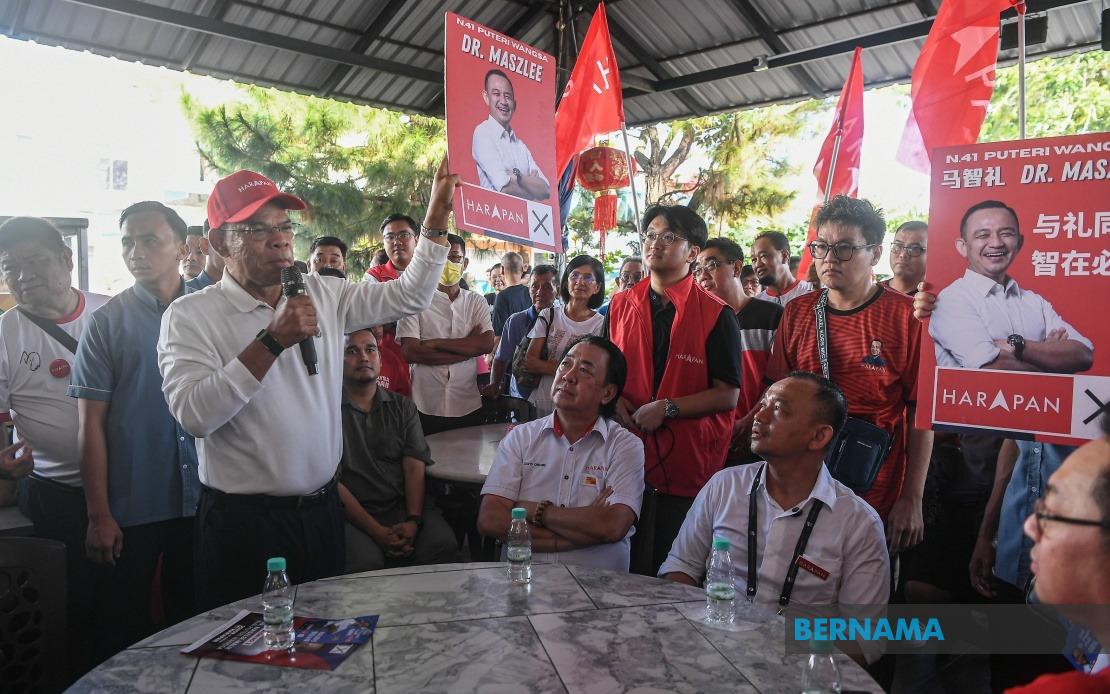
Pakatan Harapan is capitalising on what its leadership describes as accelerating momentum in the Johor state election campaign, with the coalition's secretary-general attributing the surge to a carefully calibrated geographical strategy that treats each of the 56 contested seats as distinct political terrain. Datuk Seri Saifuddin Nasution Ismail, who doubles as PKR's joint election director, explained that the coalition has internally classified constituencies into priority tiers based on on-ground support data, allowing campaign resources to concentrate where they are most effective. This approach reflects a more granular understanding of electoral dynamics than the traditional blanket campaign, acknowledging that voter concerns in urban areas like Puteri Wangsa differ fundamentally from those in rural seats such as Endau or Johor Lama.
The strategic differentiation between constituencies represents a departure from conventional broad-brush electioneering in Malaysian politics. By explicitly recognising that each seat presents unique demographic, economic, and social profiles, Pakatan Harapan signals confidence in its data analytics capability and local party structures. The classification system allows candidates and campaigners to tailor messaging rather than deploy generic talking points, potentially resonating more effectively with diverse voter bases. For Johor voters, this methodology suggests a coalition that has invested in understanding regional variations—a detail that carries weight in a state where economic dependence on palm oil, port commerce, and manufacturing coexists with agricultural constituencies and urban centres competing for development attention.
Saifuddin Nasution credited opposition missteps with inadvertently boosting Pakatan Harapan's position. He highlighted PAS's decision to contest only 11 of the 56 seats whilst encouraging supporters to back Barisan Nasional in the remaining 45 constituencies, framing this as a strategic calculation that benefits the coalition. The implicit message is that PAS's choice to effectively cede substantial ground while maintaining the fiction of contesting creates confusion about the Islamist party's true electoral role, potentially driving fence-sitters toward Pakatan Harapan as a more coherent alternative. This observation carries significance for understanding the complex three-way competition defining Malaysian state politics, where coalition arithmetic and seat allocation often determine voter behaviour more directly than ideology alone.
By contrast, the Pakatan Harapan secretary-general emphasised his coalition's transparency in seat distribution and manifesto construction. The coalition has allocated seats clearly among its three component parties—PKR contesting 20 seats, Amanah 19, and DAP 17—across all 56 constituencies. This comprehensive coverage, while mathematically straightforward, serves a political purpose: it signals that Pakatan Harapan is presenting a complete alternative government ready to govern the entire state rather than a niche opposition. The transparency claim also positions the coalition as favouring clarity over strategic ambiguity, a rhetorical advantage in a political environment where voter trust remains fragile after years of coalition flux and broken promises from both government and opposition formations.
The role of prominent defectors in strengthening Pakatan Harapan's narrative should not be underestimated. Datuk Dr Mohd Puad Zarkashi, a former UMNO Supreme Council member, appeared at a series of talks with Prime Minister Datuk Seri Anwar Ibrahim at Felda Ulu Tiram, generating headlines that underscore fractures within the traditional Malay-Muslim political establishment. For Johor voters, particularly those in Felda settlements where UMNO has historically maintained deep organisational roots, the sight of former party elites endorsing Anwar Ibrahim and Pakatan Harapan carries psychological weight. Such defections signal that the once-monolithic Malay political bloc is fragmenting, creating space for voters to reconsider traditional allegiances without feeling they are abandoning communal identity.
The appointment of Dr Maszlee Malik as the Puteri Wangsa candidate illustrates Pakatan Harapan's effort to field candidates with professional credentials and bureaucratic experience. Saifuddin Nasution's characterisation of Maszlee as a qualified candidate and essential asset to a Pakatan Harapan state government reflects the coalition's strategy of emphasising competence and governance capability. For urban and semi-urban Johor voters concerned about administrative effectiveness, such candidacies provide reassurance that the coalition is not merely an oppositional force but a viable governing team capable of delivering public services and implementing policy programmes.
The election itself presents a significant test of Pakatan Harapan's ability to translate campaign momentum into actual electoral gains. With 172 candidates across all parties contesting and voting scheduled for July 11, the race remains fluid. Early voting on July 7 may provide preliminary signals about turnout patterns and voter enthusiasm, factors that often prove decisive in Malaysian state elections where margins can be thin. The polling day result will reveal whether the coalition's seat-specific strategy and the appeal of candidates like Maszlee and endorsers like Mohd Puad Zarkashi have genuinely moved the needle in Pakatan Harapan's favour or whether Johor's traditional political leanings remain resilient.
For the wider Malaysian political landscape, a strong Pakatan Harapan performance in Johor would reinforce the coalition's claim to be a durable national alternative to Barisan Nasional. Johor has long been considered a Barisan stronghold, making any substantial gains there symbolically significant. Conversely, if Barisan Nasional retains comfortable control, it would suggest that the prime ministerial coalition has limits beyond the federal level and that state politics remains driven by different dynamics than national contests. The Johor election thus functions as a barometer of broader political realignment in Malaysia, with implications extending well beyond the state itself.
Saifuddin Nasution's confidence in Pakatan Harapan's upward trajectory should be contextualised within the coalition's recent federal performance. Since coming to power in 2022, the government has navigated economic pressures, inflation, and internal party tensions. A successful Johor campaign would provide political capital for sustaining coalition cohesion and reinvigorating grassroots activism, whilst a disappointing result could accelerate defections or embolden internal dissidents questioning the coalition's electoral viability. The stakes extend beyond seats and into the future structural stability of Malaysian governance, making July 11 a date of consequence for political observers across the region.

