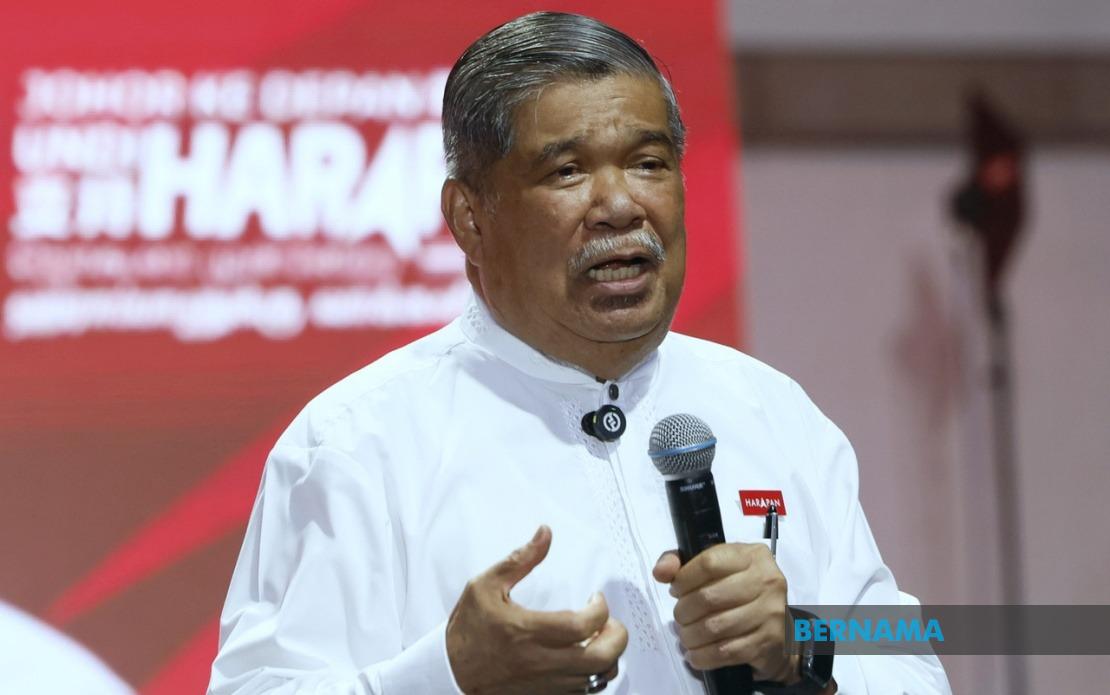
The Pakatan Harapan coalition has dismissed concerns over a recent PAS directive urging its supporters to vote for Barisan Nasional candidates in seats the Islamic party is not competing for in the Johor state election. Speaking after a campaign event in Permas Jaya on July 1, Amanah president Datuk Seri Mohamad Sabu characterized the move as yet another tactical manoeuvre that would not derail the coalition's momentum as polling day approaches on July 11.
Mohamad, who holds the portfolio of Minister of Agriculture and Food Security, projected confidence that PH's ground organization would press ahead with its scheduled campaign activities unaffected by the opposition strategy. His remarks underscored a deliberate attempt by the coalition to project unity and steadiness in the face of what it perceives as coordinated political maneuvering designed to fragment the anti-BN vote. The minister's dismissal of the directive as inconsequential signaled that PH leadership believes its message resonates strongly enough with voters that last-minute tactical shifts by rivals would prove ineffective.
At the heart of PH's counter-argument lies an appeal to voter rationality grounded in principles rather than identity politics. Mohamad emphasized that the coalition's competitive advantage stems from its demonstrated ability to forge cooperation across Malaysia's diverse racial and religious communities—a model he framed as fundamental to both political stability and sustained economic growth. He explicitly cautioned Johor residents against allowing themselves to be swayed by appeals to ethnic or religious sentiment, instead urging them to evaluate candidates on the basis of competence, service delivery record, and commitment to equitable governance.
The timing of these statements reflects broader strategic messaging from the coalition as it enters the final phase of campaigning. By elevating the discussion beyond tactical maneuvers to foundational questions about how Malaysia should be governed, PH seeks to reframe the election not as a personality-driven contest but as a referendum on competing visions of statecraft. This positioning appeals particularly to urban, educated voters and younger demographics who have shown receptiveness to issue-based politics rather than communal mobilization.
Alignment between state and federal governments has emerged as a central pillar of PH's pitch to Johor voters. Mohamad argued that administrative coordination between Kuala Lumpur and Johor Bahru would unlock significant benefits, specifically citing the modernization of public transportation networks, upgrades to border facilities that serve as key entry points for international commerce, and efforts to attract fresh capital investment into the state. These arguments resonate with practical concerns affecting daily life for ordinary Johoreans while also signaling that the coalition views the state contest as integral to implementing its broader national development agenda.
DAP strategic director Liew Chin Tong, who simultaneously serves as Deputy Finance Minister, pivoted the discussion toward generational dynamics and voter participation patterns. His analysis of the 2022 Johor election results highlighted how subdued turnout, particularly among younger voters, had disproportionately benefited BN's position. Liew attributed this partly to external factors—specifically the inability of many Johor residents employed across the border in Singapore to return home and cast ballots during the previous election due to COVID-19 travel restrictions. This observation underscores how geographic proximity to Singapore shapes Johor's electoral politics in ways that campaigns must account for.
Liew's emphasis on youth participation carries particular significance for PH's electoral prospects. The coalition has invested substantially in mobilizing younger voters, viewing them as more amenable to cross-communal appeals and less bound by traditional patronage networks. By framing the second phase of campaigning around substantive policy proposals rather than political rivalry, Liew signaled that DAP and its coalition partners intend to compete on the terrain of governance capacity and problem-solving rather than on ground typically favoring the ruling establishment.
The specific policy priorities Liew articulated reflect concerns that resonate across Southeast Asian urban regions facing similar structural challenges. Employment quality and wage competitiveness stood foremost in his list, reflecting the reality that many Johor residents migrate to Singapore in search of better-paying opportunities. Framed differently, this reveals a talent drain that undermines the state's own economic development—a challenge that quality job creation within Johor could help address. Public infrastructure, particularly transportation networks and management of flood-prone areas, figured prominently in his catalogue of governance priorities, as these directly impact livability and business environment considerations.
The broader context of Johor's election extends beyond immediate state-level concerns. As the second-most populous state and a crucial economic hub straddling the Peninsula's southern tier, Johor functions as a bellwether for national political trends. Its proximity to Singapore further complicates campaign dynamics, as many voters have comparative reference points for governance quality and service standards. Additionally, the ambitious Johor-Singapore Special Economic Zone (JS-SEZ) project represents a flagship initiative requiring coordinated effort between state and federal authorities—precisely the kind of administrative alignment that PH has made central to its pitch.
The framing of close federal-state cooperation as essential for accelerating development projects represents implicit criticism of governance dynamics under BN administrations. Liew's emphasis on this point suggests that PH intends to argue that continuation of the ruling coalition's grip on Johor would mean perpetuation of the present political stalemate, with administrative friction between Putrajaya and Johor Bahru undermining resource allocation and project implementation. By contrast, PH's presence in both spheres would supposedly streamline decision-making and execution.
Voter participation patterns will prove decisive as the election approaches its final weeks. Both coalitions understand that this is not merely a contest of policy arguments but fundamentally a test of which side can mobilize its base more effectively. PH's confidence that PAS's directive will not materially affect outcomes may rest partly on confidence in its own organizational capacity among its core constituencies, but also potentially on calculations about how many PAS supporters might resist party directives perceived as inconsistent with PH's broader message.
The 16th Johor state election, with all 56 seats contested by PH and BN and polling scheduled for July 11, arrives at a moment when Malaysia's political landscape remains unsettled following the 2022 federal election and the subsequent realignment of ruling coalitions. A PH victory in Johor would represent a significant demonstration of the coalition's ability to compete effectively even in the southern heartland traditionally associated with UMNO strength, while a BN hold would suggest continued capacity to maintain power bases despite national political volatility. For voters themselves, the choice presents competing visions of how the state should be administered and what priorities should shape its future.

